
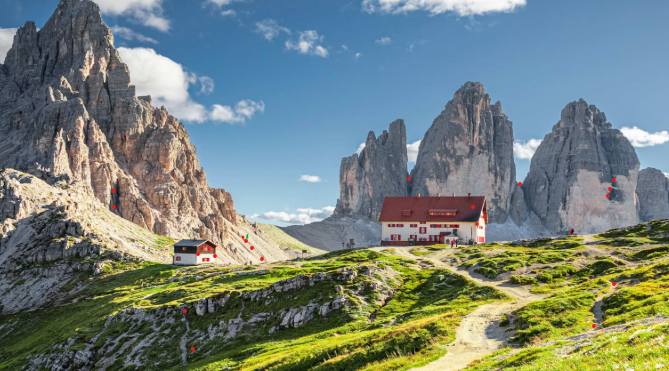
Dolomites hut to hut hiking is a multi-day alpine adventure across northern Italy where hikers move between mountain huts, follow high-altitude trails, and experience limestone peaks, valleys, local cuisine, and mountain scenery without carrying full camping equipment.
- What Is Dolomites Hut-to-Hut Hiking
- Why Hike Hut-to-Hut in the Dolomites?
- What Mountain Huts Like?
- How Difficult Is Dolomites Hut-to-Hut Hiking?
- Best Time for Dolomites Hut-to-Hut Hiking
- Alta Via Routes in the Dolomites
- Other Multi-Day Hut-to-Hut Routes
- Alta Badia High Route
- Dolomiti Paloronda Ferrata
- Dolorama Trail
- Tre Cime di Lavaredo Trek
- Catinaccio–Rosengarten Traverse
- Hut Reservations
- Booking Through a Self-Guided Hiking Company
- Hut Price
- Rifugio Etiquette
- Permits, Water, Dogs and Trail Navigation
- Alpine Pasture Huts vs. Rifugi
- Wildlife
- Packing List
- How Long Do Dolomites Hut-to-Hut Hikes Take?
- Carrying Your Gear
- 3-Day Tre Cime di Lavaredo
What Is Dolomites Hut-to-Hut Hiking
Dolomites hut-to-hut hiking means walking a planned multi-day route between staffed mountain refuges rather than returning to the same hotel each evening. The system combines hiking, overnight accommodation, alpine scenery, food, and access to some of the most dramatic parts of the Italian Alps.
The mountain huts, commonly called Rifugio, are positioned along hiking routes and are often accessible only on foot. Depending on the location, a hut may provide dormitory rooms, private rooms, warm food, beverages, showers, communal bathrooms, and other basic amenities.
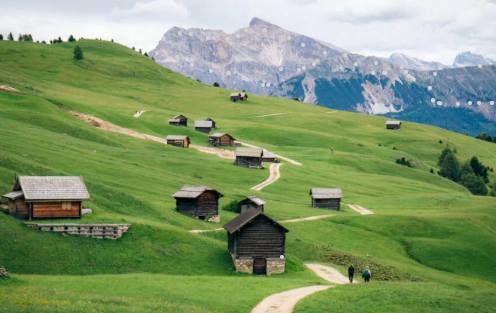
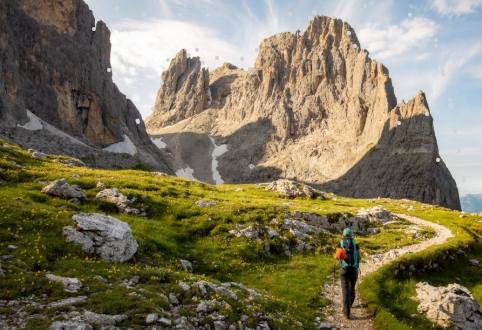
The experience is deliberately simple. A hiker leaves one mountain refuge in the morning, follows a trail toward the next point, and arrives at another hut for the night. That rhythm makes it possible to spend several days immersed in the alpine environment rather than treating the mountains as a series of short day trips.
Rifugi can vary considerably. Some are basic stone-and-wood mountain lodges with shared bunkhouses, while others offer surprisingly comfortable facilities, extensive meals, beverages, espresso, or even wellness amenities. Most importantly, they provide strategic overnight accommodation that turns long-distance hiking into a manageable sequence of daily stages.
The Dolomites also have a distinctive cultural character because Italian, German, and Ladin influences meet across the mountain region. Local cuisine and traditional mountain hospitality therefore become part of the hiking experience rather than an afterthought.
Why Hike Hut-to-Hut in the Dolomites?
The strongest reason to choose hut-to-hut hiking is that it allows travelers to experience the Dolomites continuously, moving through alpine landscapes instead of repeatedly returning to a base town.
The scenery changes dramatically from one stage to another. A single itinerary can pass through lush meadows, narrow valleys, towering limestone peaks, sheer cliffs, and high-altitude terrain. Early starts can also put hikers on the trail before the busiest hours, while an overnight stay at elevation creates opportunities for quieter sunset and sunrise views.
There is also a practical advantage: hikers do not need to carry camping equipment for most established hut-to-hut routes. A lighter pack can make steep ascents and rocky terrain considerably more manageable.
Food adds another dimension. Mountain huts serve hearty meals and beverages, giving hikers a chance to experience regional cooking after several hours on the trail. The shared setting also creates natural opportunities to meet other hikers following the same route.
For travelers considering hut-to-hut hiking Europe more broadly, the Dolomites stand out because the network of mountain huts is unusually integrated with established hiking routes.
What Mountain Huts Like?
Rifugios are staffed mountain accommodations designed primarily for hikers and climbers, ranging from basic bunkhouse-style shelters to comfortable mountain lodges with surprisingly extensive facilities.
The word Rifugio is Italian, while Hütte is used in German-speaking areas and Ütia da munt reflects the Ladin language. These names can appear on maps and signs, so recognizing them helps travelers understand that they refer to mountain accommodation rather than an ordinary hotel.
Facilities differ from hut to hut. Some provide private rooms, while others rely mainly on dormitory rooms and shared bunkhouses. Bathrooms may include flush toilets and showers, although communal facilities are common.
The setting is often the main luxury. A mountain lodge positioned beneath limestone walls or beside an alpine valley can offer an experience that a conventional hotel cannot easily reproduce.
Travelers should also expect limitations. Wi-Fi may be unavailable, mobile reception can vary, and sleeping areas are shared in many huts. That is part of the attraction for hikers who want to unplug and spend several days focused on the trail.
For those specifically researching Luxury hut to hut hiking Dolomites, the term “luxury” should be interpreted carefully. Luxury may mean a private room, better dining, a scenic location, improved facilities, or a more comfortable itinerary rather than a five-star hotel experience.
How Difficult Is Dolomites Hut-to-Hut Hiking?
Dolomites hut-to-hut hiking ranges from moderate to challenging, with difficulty determined by elevation gain, trail surface, daily distance, weather, and whether a route includes exposed or secured sections.
A trail can be clearly marked and still be physically demanding. Steep ascents, rocky terrain, long descents, and elevations reaching roughly 4,000 to 8,000 feet require reasonable fitness and preparation.
The major Alta Via routes also differ substantially. Alta Via 1 is generally regarded as one of the more approachable long-distance options, whereas Alta Via 2 introduces more demanding terrain and sections involving via ferrata, exposure, and secured passages.
A useful planning mistake to avoid is judging difficulty only by kilometers. Two stages with the same distance can feel completely different if one contains substantially more elevation gain or technical terrain.
Hikers should therefore evaluate the complete stage: distance, ascent, descent, altitude, trail surface, exposure, and expected weather.
Best Time for Dolomites Hut-to-Hut Hiking
The main Dolomites hut-to-hut hiking season generally runs from late June or early July through September, when most high trails are more accessible and mountain huts operate for the summer.
Mid-July, August, and early September are popular because conditions are generally favorable, but popularity also means greater demand for accommodation. Early and late-season hiking can be quieter, but lingering snow or changing weather can complicate high-altitude routes.
October requires particular caution because many mountain huts have already closed and conditions can become less predictable.
| Period | Main consideration |
| Late June | Possible lingering snow |
| Early July | Season beginning; conditions vary |
| Mid-July | Established hiking season |
| August | Peak summer demand |
| Early September | Good balance of season and conditions |
| Mid/Late September | Increasing closures and weather changes |
| October | Many huts closed |
Checking individual hut opening dates is more useful than relying on a generic “summer season” label because opening and closing schedules can differ.
Alta Via Routes in the Dolomites
The Alta Vie are long-distance hiking routes crossing different mountain groups in the Dolomites. They are among the clearest choices for travelers looking for a structured Dolomites hut-to-hut hiking itinerary.
| Route | Approx. Distance | Typical Stages |
| Alta Via 1 | 120 km | 8–10 |
| Alta Via 2 | 180 km | 13 |
| Alta Via 3 | 100 km | 8 |
| Alta Via 4 | 85 km | 5–7 |
| Alta Via 5 | 90 km | 7 |
| Alta Via 6 | 180 km | 11 |
| Alta Via 7 | 36 km | 5 |
| Alta Via 8 | 63 km | 4 |
| Alta Via 9 | 180 km | 12–14 |
| Alta Via 10 | 200 km | 18 days |
The routes are not interchangeable simply because they share the Alta Via name. Their length, terrain, hut availability, technical difficulty, and overall character differ considerably.
Alta Via 1
Alta Via 1 covers about 120 km between Lago di Braies and the Belluno area, usually divided into 8–10 stages.
It is one of the most popular choices for first-time long-distance hikers in the Dolomites because the route is well established and frequently traveled. Its popularity can also make hut reservations more competitive during peak season.
For hikers prioritizing a recognizable route, social atmosphere, and a manageable multi-day structure, Alta Via 1 is often the natural starting point.
Alta Via 2
Alta Via 2 is considerably more demanding, covering about 180 km in roughly 13 stages.
The route crosses major mountain groups including Puez-Odle, Sella, Marmolada, Pale di San Martino, and the Feltrine mountains. Certain sections involve via ferrata, exposure, and secured passages.
That combination makes technical preparation more important than simply increasing walking fitness. Travelers should assess the exact route conditions and their experience before choosing it.
Other Multi-Day Hut-to-Hut Routes
The Dolomites offer many options beyond the famous Alta Vie. Shorter routes can be more suitable for travelers who have only a few days or want to concentrate on one mountain group.
Alta Badia High Route
The Alta Badia High Route is a roughly 76-km circular hut-to-hut trail around the mountains of Val Badia in South Tyrol. The route begins and ends in Corvara and can be completed in approximately seven days.
Its circular format is useful for travelers who prefer returning to the same general area rather than completing a point-to-point crossing.
Dolomiti Paloronda Ferrata
Dolomiti Paloronda Ferrata combines hut-to-hut hiking with a series of via ferrata sections in the Pale di San Martino.
It is better suited to hikers who specifically want secured mountain routes rather than a conventional walking-only itinerary.
Dolorama Trail
The 61-km Dolorama Trail crosses the Lüsner Alm mountain pastures and continues toward Sass de Putia, Passo delle Erbe, Schlüterhütte/Rifugio Genova, the Adolf Munkel Trail, and the Resciesa plateau.
Its combination of open alpine terrain and mountain-hut stages creates a different experience from the longer Alta Via crossings.
Tre Cime di Lavaredo Trek
The Tre Cime di Lavaredo Trek is a compact 3-day hut-to-hut route around one of the Dolomites’ best-known mountain groups.
The itinerary combines Val Fiscalina, the Tre Cime area, mountain huts, and clearly marked trails. It can be an attractive introduction for travelers who want the hut experience without committing to a week-long crossing.
Catinaccio–Rosengarten Traverse
This approximately 3-day trek crosses the Rosengarten mountains and can include the Santner Via Ferrata, Vajolet Towers, and Rifugio Alpe di Tires.
Its technical elements mean that route selection should be based on hiking experience rather than scenery alone.
Hut Reservations
Mountain-hut reservations should be treated as an essential part of planning, particularly for popular routes during peak season.
For busy periods, booking 6 to 12 months ahead can be sensible when dates are fixed or a particular hut is essential to the itinerary. Reservations are especially important for larger groups or travelers seeking private rooms.
Unlike a conventional hotel network, there is not necessarily one reservation system covering every Rifugio. Individual huts may use online booking, email, telephone reservations, or deposits.
A useful strategy is to build the hiking itinerary around confirmed hut availability rather than selecting a route first and assuming every overnight stop will be available.
Booking Through a Self-Guided Hiking Company
A self-guided hiking company can simplify hut-to-hut planning by arranging reservations and providing route information while allowing travelers to hike independently.
This approach sits between a fully independent trip and a guided tour. The traveler still walks without a guide but may receive a structured itinerary, accommodation arrangements, maps, and planning support.
Guided trips can be preferable when a route contains technical terrain or when travelers want someone else to manage navigation and logistics. Self-guided trips generally provide more independence.
Travelers considering Luxury hut to hut hiking Dolomites may also find specialized itineraries that emphasize more comfortable accommodation, private rooms, luggage support, or upgraded dining where available.
Hut Price
The typical hut-to-hut hiking cost can vary significantly, but a practical planning range from the supplied data is approximately €80–€100 per person per day for accommodation and meals, depending on the hut and package.
| Cost factor | What changes the price |
| Accommodation | Dormitory vs. private room |
| Meals | Breakfast, dinner, or half-board |
| Drinks | Beverages and additional purchases |
| Showers | Some facilities may involve an extra charge |
| Payment | Some huts accept cards; others may require cash |
| Route | Popular locations can have higher prices |
Examples from the supplied data include approximately €55 at one hut, €85 at another, and €100 at another. These figures should be treated as planning examples rather than fixed current prices.
The real budget should therefore include food, drinks, possible showers, transport to trailheads, and any equipment or luggage-transfer costs.
Rifugio Etiquette
Rifugio etiquette is straightforward: hikers should respect shared spaces, follow hut rules, and minimize disruption to other guests.
Boots are commonly removed before entering sleeping areas and placed in designated shoe cubbies or drying rooms. Wet clothing should be dried only where the hut permits it.
Dinner can operate on an assigned schedule, and shared tables are normal. Quiet hours may begin around 10 PM, making late-night conversations inappropriate in communal sleeping areas.
A sleeping-bag liner is also useful because shared accommodation has different bedding arrangements from a conventional hotel.
Permits, Water, Dogs and Trail Navigation
Most standard hiking in the Dolomites does not require a general hiking permit, but travelers still need to understand individual trail, hut, transport, and protected-area rules.
Water availability varies between mountain huts, so hikers should carry reusable water bottles and confirm whether a particular source is potable.
Navigation is another area where preparation matters. Well-marked trails reduce the risk of getting lost, but weather can change visibility quickly. A detailed trail map, including Tabacco maps commonly used for the region, provides a useful backup when visibility deteriorates.
Dogs require separate consideration because individual Rifugios can have different policies. Advance notice may be necessary, and an additional fee can apply.
Wild camping should not be treated as the default alternative to hut accommodation. Restrictions apply, and designated camping areas should be used where permitted.
Alpine Pasture Huts vs. Rifugi
Not every mountain hut encountered on a Dolomites trail provides overnight accommodation.
Alm, Baita, and Malga can refer to alpine pasture establishments where hikers may stop for food and drinks during the day. A Rifugio, by contrast, is specifically associated with mountain refuge accommodation.
Understanding this distinction prevents a common planning error: assuming that every building marked as a hut can be used as an overnight stop.
Wildlife
Hiking trails can cross alpine pastures where cattle are grazing, so hikers should maintain a safe distance and avoid disturbing animals.
Cattle may appear calm but can react unpredictably when hikers approach calves or move too close. Staying on the trail, keeping dogs controlled where permitted, and giving animals space are simple precautions.
Packing List
A good hut-to-hut packing list prioritizes mobility rather than carrying everything needed for traditional camping.
Hiking Gear
The essential hiking gear includes a suitable backpack, high-cut hiking boots, and hiking poles. The goal is a stable, comfortable setup capable of handling steep ascents and rocky terrain without unnecessary weight.
Mountain Trekking Essentials
Mountain trekking essentials include sunglasses, climbing gloves where technical terrain requires them, two 1-liter water bottles, a beanie, a sun hat, and gloves.
Weather in the mountains can change faster than conditions in nearby valleys, so lightweight protection is more valuable than packing for a single expected temperature.
Overnight Rifugio Essentials
Overnight Rifugio essentials include a sleeping-bag liner, waterproof slippers, headlamp, ear plugs, e-reader, and microfiber towel.
These small items become particularly useful in shared accommodation, where hikers may arrive at different times and sleeping arrangements can be communal.
How Long Do Dolomites Hut-to-Hut Hikes Take?
Dolomites hut-to-hut hikes can range from roughly 3 to 10 days, depending on the route, number of stages, and desired pace.
A shorter itinerary can focus on Tre Cime di Lavaredo or another compact mountain group, while longer Alta Via routes require more continuous days on the trail.
Daily hiking may take around 4 to 8 hours, but that figure should never be treated as a fixed timetable. Elevation gain, terrain, weather, breaks, photography, and route-finding can all change the actual time.
For planning purposes, the Dolomites hut to hut hiking distance should therefore be evaluated alongside elevation and technical difficulty rather than used alone.
Carrying Your Gear
Travelers can either carry their own hiking packs or arrange luggage transfer where the route and service allow it.
A luggage-transfer option can leave the hiker carrying only a smaller day bag, reducing the physical burden during steep sections. However, luggage services are route-dependent and should be confirmed before building the itinerary around them.
Independent hikers without transfers should keep the pack focused on genuine trail and overnight necessities rather than treating the mountain hut like a hotel with unrestricted luggage capacity.
3-Day Tre Cime di Lavaredo
A three-day Tre Cime itinerary provides a useful model for understanding how a shorter Dolomites hut-to-hut hiking itinerary works.
The route connects the Val Fiscalina, Tre Cime area, and several mountain huts. The supplied includes clearly signed trails and does not depend on technical via ferrata equipment.
The important point is that even a three-day route can contain substantial walking. A stage of 16.6 km and around 7 hours is a serious hiking day, while another stage of 11.1 km and around 4 hours is considerably shorter.
Day 1
The first stage starts around the Rifugio Piano Fiscalina/Fischleinbodenhütte Parking Lot and passes through Rifugio A. Locatelli, Rifugio Lavaredo, Rifugio Auronzo, and Langalm before returning toward the Rifugio A. Locatelli area.
The supplied itinerary covers approximately 16.6 km and around 7 hours of hiking.
Day 2
The second stage links Rifugio A. Locatelli with Rifugio Pian di Cengia, Rifugio Zsigmondy Comici, and the Rifugio Piano Fiscalina Parking Lot.
This section covers approximately 11.1 km and around 4 hours, making it shorter than the first stage.
Day 3
The third day completes the Tre Cime hut-to-hut itinerary by returning from the mountain huts toward Val Fiscalina. From the remaining section of the route, hikers continue through alpine terrain, passing dramatic limestone peaks and high-mountain scenery before descending toward the valley. The final stage is shorter than some full-day mountain sections, making it a practical finish to the three-day route.
The route combines marked hiking trails, mountain scenery, and sections of exposed terrain. Hikers should still allow enough time for changing weather and trail conditions, particularly when walking at higher elevations. Once the descent reaches Val Fiscalina, the three-day Dolomites hut-to-hut hiking route is complete.
Other Post
Our Guide To Places To Visit In Rhode Island: From Newport To Block Island
The Great Pyramid Of Cholula Explained: History, Builders, Secrets, And Surprising Facts
How I Travel to Epic Adventures Beyond the Ordinary: My Guide
Bozeman to Glacier National Park: The Ultimate Road Trip Itinerary