
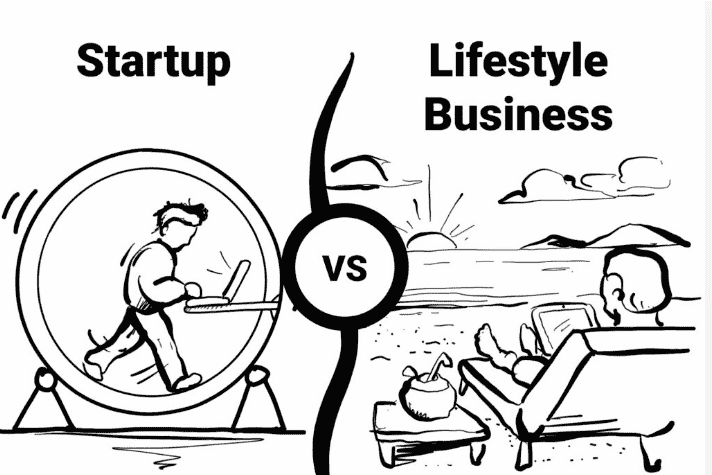
A bootstrapped startup vs lifestyle business comparison becomes clearer when the founder looks beyond funding and asks what the company is supposed to achieve. A bootstrapped startup can pursue significant growth using revenue and founder resources, while a lifestyle business is usually designed around sustainable income, ownership, flexibility, and a preferred way of life.
- Lifestyle Business Vs. Bootstrapped Startup
- Lifestyle Business Definition
- Startup Definition
- Lifestyle Business Vs Startup: Growth And Profit
- Flexibility And Freedom
- Financial Risk And Stress
- Funding And Ownership
- Time Commitment And Workload
- Startup Vs. Lifestyle Business: Who You Answer To
- The Startup Clock Vs Lifestyle Business Timeline
- The False Binary: Businesses Can Exist Between The Two
- How To Decide Between A Bootstrapped Startup And Lifestyle Business
- The Honest Reality Of The Bootstrapped Path
- Common Reasons To Build A Lifestyle Business
- Common Reasons To Build A Startup
- Can A Lifestyle Business Become A Startup Later?
- How Much Money Can A Lifestyle Business Make?
- Is SaaS A Lifestyle Business Or A Startup?
- Biggest Risk Of A Lifestyle Business
- Are All Startups Or Lifestyle Businesses The Same?
- Frequently Asked Questions
The distinction is easy to blur because bootstrapping describes how a company is financed, whereas a lifestyle business describes what the owner wants the business to provide. A company can therefore be both bootstrapped and growth-oriented, or bootstrapped and intentionally small.
Lifestyle Business Vs. Bootstrapped Startup
The central question is not simply whether a founder raises money. It is whether the company is being built primarily for scalable growth or for sustainable income and personal freedom.
A founder with strong entrepreneurial aspirations may have several possible paths. The same business idea could become a lifestyle business, a bootstrapped startup, or eventually a venture-backed company depending on its market, customers, capital requirements, and long-term goals.

That applies across industries. Pet services, food, restaurants, software, IT, auto repair, education, real estate, and SaaS can all be operated under different ownership and growth strategies.
Business structure is another separate issue. A corporation, LLC, sole proprietorship, or non-profit organization does not automatically determine whether a company is a startup or lifestyle business.
| Factor | Lifestyle Business | Bootstrapped Startup |
| Main objective | Sustainable income and desired lifestyle | Scalable company growth |
| Funding | Owner resources and business revenue | Owner resources and reinvested revenue |
| Outside capital | Usually unnecessary | Optional |
| Ownership | Often concentrated with founder | Usually founder-controlled initially |
| Growth pace | Deliberate | Potentially aggressive |
| Profit | Often prioritized early | May be reinvested for growth |
| Exit | Optional | Possible but not essential |
| Flexibility | Often a major objective | Can decrease as the company expands |
Bootstrapping should not be confused with keeping a company permanently small. A founder can reinvest revenue into employees, marketing, technology, and product development while maintaining ownership.
Lifestyle Business Definition
A lifestyle business exists primarily to provide its owner with sustainable income and a desired way of life.
The initial goal may be surprisingly modest: create a profitable company that reliably supports personal requirements without demanding continuous expansion.
A local law firm, auto shop, tutoring service, consultancy, or small SaaS company can fit this model. Industry alone does not define it.
Consider a SaaS founder who reaches $50K MRR, or $600K in annualized revenue. If that income comfortably supports the owner’s financial goals, there may be little practical reason to pursue venture capital.
The owner might prefer 100% ownership, predictable profits, and enough free time for family, travel, or other interests.
That does not mean the business requires little effort. Marketing, accounting, sales, customer support, product development, and operational responsibilities can still consume substantial time.
The difference is what happens after the business becomes successful. A lifestyle founder may deliberately stop pushing for maximum growth once the company produces the desired financial and personal outcome.
Startup Definition
A startup is generally created around an opportunity where significant growth could create a much larger company and financial outcome.
The founder may accept long hours, personal sacrifices, and limited personal time during the early years because resources are being directed toward product development, market expansion, hiring, and customer acquisition.
Software companies, mobile applications, gaming companies, websites, social networks, electronic products, and online marketing services can all become startups when their models support substantial scale.
Outside capital can accelerate that process. Venture funding may provide money for hiring, product development, marketing, and expansion before customer revenue can support those activities.
The trade-off is that investors typically receive equity or other financial rights. Venture capital therefore changes both the company’s financial resources and its ownership structure.
A startup may eventually pursue an acquisition, sale, public offering, or another liquidity event. None of those outcomes is guaranteed, but they can form part of the company’s long-term strategy.
Lifestyle Business Vs Startup: Growth And Profit
Growth and profit can point in different directions during the early years of a company. A lifestyle business often emphasizes sustainable profit sooner, whereas a startup may reinvest available resources to capture a larger market before maximizing profits.
For Lifestyle Business
For many lifestyle businesses, revenue becomes useful only when it translates into owner income, financial stability, and sustainable operations.
A bootstrapped SaaS company producing $50K MRR has $600K in annualized revenue. If the business maintains 70% or 80% gross margins, a substantial portion of that revenue can potentially support operating costs and profit.
The founder may choose to reinvest some of the money into hiring, marketing, or product development while keeping the organization deliberately small.
Suppose a profitable SaaS business eventually produces $1.5M or $2.5M in annual profit. A hypothetical 3x or 6x multiple could create a significant asset value, but the founder does not necessarily need to sell.
That is an important distinction. An owner can build a valuable company without treating an exit as the ultimate objective.
For Startup
A startup can deliberately postpone maximum profitability if additional spending creates faster growth.
Instead of treating every dollar of revenue as income, the company may deploy capital into sales teams, product development, marketing, hiring, and international expansion.
The founder may therefore accept lower short-term profit in exchange for a larger customer base and stronger market position.
This approach becomes particularly relevant when competitors are moving quickly. A company that grows too cautiously can lose distribution advantages even when its underlying product is profitable.
The resulting financial return depends on several variables: growth, ownership, market size, capital efficiency, and eventual liquidity.
Flexibility And Freedom
Flexibility comes from the way a business is designed, not merely from whether it is small or online.
For Lifestyle Business
A lifestyle entrepreneur can intentionally build around a preferred schedule, location, and workload.
That may include:
- Time off
- Family commitments
- Travel
- Location freedom
- Stable income
- Flexible working hours
- Personal goals
An internet-based business can offer considerable location flexibility because much of the work can be handled through an Internet connection.
Still, flexibility has limits. A founder who personally handles every customer, sale, technical problem, and operational task may own a lifestyle business without actually enjoying much freedom.
The real objective is therefore owner independence, not simply working from a laptop.
For Startup
Startup entrepreneurship creates a different relationship with time.
A founder may initially control the schedule, but investor expectations, employees, growth targets, customer demands, product launches, and organizational responsibilities can gradually reduce that freedom.
A board meeting can matter as much as a customer meeting. Hiring decisions can become more important than individual tasks. Fundraising can temporarily dominate the founder’s calendar.
The larger the organization becomes, the more the founder’s role shifts from doing the work to coordinating people, capital, and strategy.
Financial Risk And Stress
Financial risk does not disappear under either model; it simply moves through different channels.
For Lifestyle Business
The owner usually retains greater control over financial decisions but also carries much of the direct risk.
If revenue falls, the owner may need to reduce expenses, improve sales, adjust pricing, or use personal savings.
A reliable income stream can improve financial stability, but predictable revenue is never guaranteed. Customer concentration, market changes, rising costs, and business failure can still create stress.
The advantage is that the owner can usually respond without waiting for investors or a board.
For Startup
Startup funding introduces another layer of financial responsibility.
Payroll, revenue projections, investor expectations, fundraising targets, equity agreements, and partner disagreements can all influence decision-making.
Outside capital may reduce the founder’s immediate need to finance every expense personally, but it creates expectations around growth and returns.
Venture capital commonly involves an ownership stake and may involve investor participation in company governance.
A traditional small-business loan creates a different type of obligation because borrowed money must generally be repaid.
The founder therefore needs to distinguish between financial risk, ownership risk, and operational risk rather than treating them as one category.
Funding And Ownership
Funding determines how quickly a company can deploy resources, but it can also determine who participates in important decisions.
Lifestyle Business / Bootstrapping
Bootstrapping uses founder resources and business revenue instead of depending on external investors.
That approach can preserve ownership and control while encouraging the company to grow according to its actual cash flow.
If the business generates $20K, the founder cannot sustainably spend $100K every month without another funding source. This limitation can encourage disciplined hiring, careful marketing, and attention to profitable customers.
The trade-off is speed. A founder may need to wait for revenue before making investments that a funded competitor can make immediately.
Startup / Venture Funding
Venture funding gives a startup access to capital before its own revenue can fully support expansion.
That money can finance:
- Hiring
- Product development
- Marketing
- Sales
- Infrastructure
- Market expansion
Equity financing, however, means founders generally exchange part of their ownership for capital.
Dilution becomes increasingly important as additional funding rounds occur. A founder may own a smaller percentage of a much larger company, which can still produce a different financial outcome from retaining 100% of a smaller company.
The decision therefore involves more than asking, “How much money can be raised?”
The better questions include:
- How much capital is actually required?
- What percentage of ownership is being exchanged?
- What growth does the funding need to produce?
- Who receives decision-making rights?
- What happens if the next funding round does not occur?
Time Commitment And Workload
Workload depends heavily on the operating model and the stage of the company.
For Lifestyle Business
A lifestyle business can demand substantial effort during its early period.
A solopreneur may simultaneously manage marketing, accounting, sales, customer support, operations, and product development.
The goal is often to turn that initial workload into a sustainable system.
Once revenue becomes reliable, the owner can decide whether additional employees or automation are worth the cost.
This creates a different form of ambition: the founder may optimize the company for less dependence on the founder, rather than for maximum revenue.
For Startup
Startups tend to create workload around growth.
The founder may need to build a marketable product, meet advisors, communicate with investors, recruit employees, monitor competitors, raise funding, and develop distribution.
A limited budget can make the early period particularly demanding. Once funding arrives, the workload often shifts rather than disappears.
Instead of personally completing every task, the founder becomes responsible for hiring the people who can complete them.
Startup Vs. Lifestyle Business: Who You Answer To
The founder’s accountability changes as the ownership structure changes.
In a lifestyle business, customers and the owner’s personal financial goals are usually the strongest external considerations.
A funded startup adds another layer: investors, shareholders, board members, employees, and formal governance.
This does not automatically remove founder control. A founder can retain substantial ownership and influence.
However, investor expectations can affect business decisions, particularly around growth, spending, hiring, fundraising, and potential exits.
The practical distinction is between being accountable to the market and being accountable to both the market and capital providers.
The Startup Clock Vs Lifestyle Business Timeline
A funded startup often has a financial runway that creates urgency around growth.
Investors expect capital to support measurable progress, and the company may need another funding round before its existing cash is exhausted.
That creates a clock.
A bootstrapped company has a different timeline. Revenue can finance operations continuously, allowing the founder to spend several years developing the product, refining distribution, and expanding gradually.
The absence of investor funding does not eliminate deadlines. Cash flow, competitors, technology changes, customer churn, and founder capacity still matter.
The difference is that the founder generally has more authority over the pace.
The False Binary: Businesses Can Exist Between The Two
Real companies do not always fit neatly into “startup” or “lifestyle business.”
A founder might bootstrap a company until it becomes profitable, raise a smaller funding round later, and then accelerate growth.
Another business might accept outside capital but maintain strict spending discipline and remain focused on profitability.
A company can also generate enough revenue for the founder to pursue serial small exits rather than build one enormous organization.
The gray area matters because business models evolve.
A founder may begin with a lifestyle objective, discover a much larger market, and change direction.
Conversely, a startup founder may decide that continuous fundraising no longer fits the company’s economics and move toward profitability.
How To Decide Between A Bootstrapped Startup And Lifestyle Business
The decision becomes easier when the founder starts with the desired outcome instead of choosing a label first.
Several factors deserve attention:
| Question | What It Reveals |
| What income is actually required? | Lifestyle requirements |
| How large is the market? | Growth potential |
| Does the product need major upfront capital? | Funding requirements |
| How quickly must the company grow? | Capital needs |
| How important is 100% ownership? | Funding tolerance |
| Can customers fund expansion? | Bootstrapping potential |
| How much financial runway exists? | Risk capacity |
| Is an exit required? | Long-term objective |
The founder should also consider distribution. A product with excellent technology but expensive customer acquisition may require more capital than expected.
Likewise, a simple product with strong organic demand may be easier to bootstrap.
What Number Changes Your Life?
The most useful number is the amount of income required to meet the founder’s actual financial goals.
For one person, $20K per month may dramatically change the household’s financial position. Another founder may be targeting $50K per month or $1M per year.
The headline figure should not be confused with revenue. A $5M business with high expenses may generate less owner income than a $1M business with strong margins.
That distinction can change the entire lifestyle path.
A founder who needs $20K monthly to achieve the desired lifestyle may not need a company capable of producing $100M.
The Honest Reality Of The Bootstrapped Path
Bootstrapping can look simple from the outside but often involves months of uncertainty before the business becomes predictable.
During months 1 to 6, the founder may still be searching for customers, refining the product, and testing pricing.
Between months 6 and 18, different problems can emerge: customer churn, a growth plateau, limited cash flow, or difficulty hiring.
A company might reach $3K MRR and then remain there for months before finding a path toward $10K MRR.
There is no investor forcing the company to grow, but that freedom also means the founder has to recognize problems independently.
The upside appears when revenue starts compounding.
Each additional customer can finance future development, allowing the founder to build without repeatedly surrendering ownership.
This is one reason bootstrapping can create a powerful financial position even when growth initially appears slow.
Common Reasons To Build A Lifestyle Business
Lifestyle businesses often appeal to founders who value flexibility, ownership, stability, family time, travel, and control over business decisions.
Some owners simply do not want a mandatory exit.
They may prefer to operate a profitable company for decades, take consistent income, and retain control over how the business evolves.
For these founders, additional growth only makes sense when it improves the overall quality of the business or life.
Common Reasons To Build A Startup
Startups attract founders who see an opportunity where speed and scale could materially change the outcome.
Outside capital can support hiring, product development, distribution, and market expansion before organic revenue is sufficient.
The attraction may also come from the size of the market. If a product could serve millions of customers, remaining intentionally small may leave a substantial opportunity unexplored.
Acquisition, an IPO, and significant financial returns can also be part of the intended outcome.
Can A Lifestyle Business Become A Startup Later?
A lifestyle business can transition into a startup when its market opportunity becomes large enough to justify faster expansion and external capital.
The process might begin with a profitable business that has already validated its product and customers.
The founder can then create a pitch deck, approach investors, raise startup funding, and use the new capital for hiring, product development, marketing, and distribution.
That transition changes more than the bank balance.
The company may also introduce new shareholders, investor expectations, governance requirements, larger teams, and more aggressive growth targets.
Mailchimp is frequently cited as an example of a company that grew without traditional venture funding before its acquisition by Intuit. Zapier also became a notable example of a large technology company that developed through a predominantly bootstrapped path.
These examples show that bootstrapping and scale are not mutually exclusive.
How Much Money Can A Lifestyle Business Make?
There is no universal income ceiling for a lifestyle business because earning potential depends on the business model, pricing, margins, customer base, automation, and team size.
A solo business might generate hundreds of thousands of dollars annually.
A tiny-team SaaS company could potentially reach $1M or $5M in annual revenue with only a handful of people if the product has strong margins and efficient distribution.
At higher levels, however, organizational complexity tends to increase.
A business approaching $10M in revenue may need additional sales, support, management, compliance, or infrastructure.
The founder therefore has two ceilings to consider:
- Economic ceiling: how much the market can support.
- Lifestyle ceiling: how much complexity the founder is willing to accept.
The second ceiling is often the more important one for a lifestyle business.
Is SaaS A Lifestyle Business Or A Startup?
SaaS can support either model because SaaS describes how software is delivered and monetized rather than how aggressively the company must grow.
A founder can bootstrap a niche SaaS product, focus on profitability, and retain most or all ownership.
Another founder can use venture capital to build a large sales organization, expand internationally, and pursue the biggest possible market opportunity.
The same SaaS technology can therefore produce completely different businesses.
A specialized product serving a narrow group of customers may work well as a lifestyle company.
A platform targeting millions of users may require substantial capital for infrastructure, product development, marketing, and distribution.
The business model alone does not determine the strategy.
Biggest Risk Of A Lifestyle Business
Stagnation is one of the most overlooked risks.
A company can reach a comfortable revenue level and remain there for years while competitors improve their products, increase marketing expenditure, or capture distribution channels.
A heavily funded competitor may be able to spend faster than a bootstrapped company can generate cash.
That does not mean a lifestyle business must respond by chasing unlimited growth.
Instead, the owner needs to monitor customer retention, pricing, market changes, competitors, product relevance, and operating margins.
The danger is not simply slow growth. It is assuming that today’s comfortable position will automatically remain secure tomorrow.
Are All Startups Or Lifestyle Businesses The Same?
No single template describes every startup or lifestyle business.The useful variables are growth, profit, funding, ownership, control, market opportunity, business model, and founder objectives.
A small technology company is not automatically a lifestyle business, just as a funded company is not automatically a high-growth startup.The labels become useful only when they describe the company’s actual strategy.
Frequently Asked Questions
Is a lifestyle business always bootstrapped?
No, a lifestyle business is not always strictly bootstrapped. Funding can come from personal savings, early revenues, or external financing. Bootstrapping remains a common path because self-funded growth can preserve founder ownership, control, financial independence, and flexibility while maintaining low overhead.
Which is more profitable: a lifestyle business or a bootstrapped startup?
A lifestyle business can provide more predictable income and cumulative cash-flow for a founder, while a bootstrapped startup targets higher enterprise scale. Profitability depends on the business model, growth strategy, reinvestment needs, and the level of financial returns and risk the founder accepts.
What Are The Biggest Challenges Of Running A Bootstrapped Startup?
A bootstrapped startup often faces severe cash flow constraints, slower growth trajectories, and financial pressure because funding comes from the business itself. Limited capital can make competition with venture-backed competitors harder, while scalability demands may increase the risk of founder burnout over time.
Which Business Model Is Better For Entrepreneurs: Lifestyle Business Or Bootstrapped Startup?
Neither business model is universally better for entrepreneurs. A lifestyle business emphasizes autonomy, balance, and independence, while a bootstrapped startup focuses on scalable growth through self-funding. The appropriate structure depends on ownership preferences, financial control, flexibility, and the founder’s growth strategy.
Other Post
What is a Liability Adequacy Test? 8 Powerful Insights Explained
Startup Booted Fundraising Strategy: Ultimate Founders Guide