
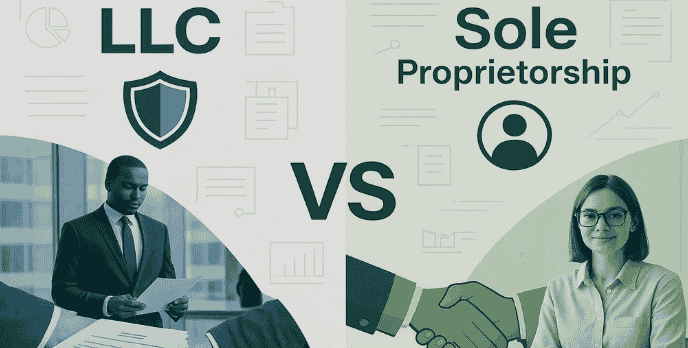
For LLC vs sole proprietorship, the key difference is legal separation: an LLC generally provides limited liability protection, while a sole proprietorship leaves the owner personally responsible for business debts and obligations. The choice also affects taxes, costs, compliance, control, and future growth.
- LLC vs. Sole Proprietorship
- What Is a Single-Member LLC?
- What Is a Sole Proprietorship?
- Advantages of a Single-Member LLC
- Disadvantages of a Single-Member LLC
- Advantages of a Sole Proprietorship
- Disadvantages of a Sole Proprietorship
- How to Set Up a Sole Proprietorship
- How to Set Up an LLC
- How Taxes Work for an LLC vs. Sole Proprietorship
- Comparing LLC and Sole Proprietorship: Similarities
- Differences Between LLC and Sole Proprietorship
- LLC vs. Sole Proprietorship: Personal Asset Protection
- LLC vs. Sole Proprietorship: Cost and Maintenance
- When Does a Sole Proprietorship Make Sense?
- Choosing the Right Structure for Your Business
- Can You Start as a Sole Proprietor and Switch to an LLC Later?
- DBA vs. Sole Proprietorship
- FAQs: LLC vs. Sole Proprietorship
- What Is The Main Difference Between An LLC And A Sole Proprietorship?
- Does An LLC Protect Your Personal Assets?
- Are LLCs And Sole Proprietorships Taxed Differently?
- Is A Sole Proprietorship Easier To Start Than An LLC?
- Does An LLC Cost More To Maintain?
- Can You Start As A Sole Proprietor And Switch To An LLC Later?
- Can An LLC Be A Sole Proprietorship?
- What Happens To A Sole Proprietorship When The Owner Dies?
- What Happens To A Single-Member LLC When The Owner Dies?
LLC vs. Sole Proprietorship
An LLC and a sole proprietorship can both work for a one-owner business, but they create very different legal relationships between the owner and the business. A sole proprietor operates without a separate legal entity, whereas an LLC creates a business entity that generally separates business liabilities from personal assets.

That distinction matters most when a business takes on contracts, employees, debt, customers, or operational risk. An owner also needs to consider formation, registration, state requirements, tax treatment, maintenance costs, and how easily the business can change as it grows.
| Factor | Sole Proprietorship | LLC |
| Legal entity | No separate entity | Separate legal entity |
| Ownership | One owner | One or multiple members |
| Personal liability | Generally unlimited | Generally limited, subject to exceptions |
| Formation | Usually simpler | Requires state formation |
| Ongoing compliance | Generally lighter | State filings and fees may apply |
| Default federal tax treatment for one owner | Reported by owner | Generally pass-through/disregarded entity |
| Tax election flexibility | Limited | May have additional tax-election options |
| Control | Owner retains control | Member generally controls a single-member LLC |
| Business continuity | Closely tied to owner | May continue according to state law and governing documents |
The practical question is therefore not simply which structure is cheaper. It is whether the business needs the legal separation and additional administrative responsibilities associated with an LLC.
What Is a Single-Member LLC?
A single-member LLC, or SMLLC, is an LLC with one owner, called a member. It creates a separate business entity and generally provides limited liability protection between business obligations and the owner’s personal assets.
For federal income tax purposes, a single-member LLC is generally treated as a disregarded entity by default. Its business income and expenses are typically reported through the owner’s personal tax return rather than through a separate federal income tax return for the LLC itself.
That tax treatment does not eliminate the LLC’s separate legal status. This distinction is important: tax classification and legal structure are not the same thing.
A single-member LLC can also have different federal tax treatment in appropriate circumstances, including an election to be taxed as a C corporation or S corporation if the applicable requirements are met.
What Is a Sole Proprietorship?
A sole proprietorship is a business owned and operated by one person without creating a separate legal entity. The owner and business are therefore not legally separated in the same way as an LLC.
This structure is common for freelancers, consultants, independent operators, and people testing a small business idea. It can be straightforward to launch, although local licenses, permits, registration requirements, or a DBA may still apply.
The simplicity comes with a major trade-off: business debts and obligations can generally reach the owner’s personal assets because the sole proprietorship does not create the same liability barrier as an LLC.
Advantages of a Single-Member LLC
The central advantage of a single-member LLC is personal asset protection. Because the LLC is a separate legal entity, business creditors generally look to the LLC for payment rather than directly to the owner’s personal assets, subject to applicable law and circumstances.
An LLC can also provide tax flexibility. A single-member LLC normally receives pass-through tax treatment by default, but qualifying businesses can potentially elect different federal tax classifications.
Other practical advantages can include:
- A separate legal entity for business operations
- Limited liability protection
- Pass-through taxation
- Greater flexibility in tax treatment
- A structure that can accommodate future growth
- Potentially greater credibility with customers, vendors, or financial institutions
The protection is not absolute. Personal guarantees, wrongful conduct, failure to maintain the entity properly, and other circumstances can create personal exposure.
Disadvantages of a Single-Member LLC
The principal disadvantage is additional compliance. Unlike an informal sole proprietorship, an LLC is formed under a state LLC statute and must satisfy the applicable formation and maintenance requirements.
Depending on the state, an owner may encounter:
- Formation fees
- Annual or biennial reports
- Franchise taxes
- Registered-agent requirements
- Periodic filings
- Naming restrictions
- Publication requirements
- Ongoing state fees
Failure to handle required filings or taxes can create compliance problems and, in some circumstances, administrative dissolution.
The owner therefore exchanges some simplicity for a formal legal structure and liability protection.
Advantages of a Sole Proprietorship
A sole proprietorship can be attractive when speed, simplicity, and low startup cost matter more than formal liability protection.
There is generally no separate entity formation process comparable to creating an LLC. A person may begin operating a business as a sole proprietor without filing LLC formation documents, although licenses, permits, DBA registration, or other legal obligations may still apply.
The structure also gives the owner 100% control over business decisions. There are no other members whose approval is normally required, and closing the business can generally be simpler than dissolving an LLC.
For federal income tax purposes, business income and expenses are generally reported on the owner’s personal return, commonly using Schedule C.
Disadvantages of a Sole Proprietorship
The most important drawback is unlimited personal liability. Since there is no separate legal entity between the owner and business, the owner can generally remain personally responsible for business debts and obligations.
A sole proprietor may also face practical limitations when raising money. Unlike a corporation, the business cannot issue stock, and financing may depend heavily on the owner’s personal finances and creditworthiness.
Other considerations include:
- Business decisions rest entirely with the owner
- Business responsibilities are concentrated in one person
- Adding another owner changes the business structure
- Business continuity can be closely tied to the owner’s life and circumstances
- Personal assets can be exposed to business liabilities
This can be manageable for a low-risk operation but becomes more significant as contractual, financial, or operational risk increases.
How to Set Up a Sole Proprietorship
A sole proprietorship is generally established simply by conducting business as an individual without forming another business entity. There is no LLC-style articles of organization filing.
However, the owner may still need a business license, local permit, DBA registration, EIN, or other taxpayer identification depending on the business and location.
The important distinction is that easy formation does not mean zero legal obligations. Licensing, taxation, employment, and industry-specific requirements can still apply.
How to Set Up an LLC
An LLC generally requires formal state registration. The owner typically selects an appropriate formation state and business name, appoints a registered agent, and files formation documents such as Articles of Organization.
After formation, the LLC may have continuing requirements such as annual reports, state fees, franchise taxes, and other compliance obligations.
If the business operates in another state in a way that triggers registration requirements, it may also need to complete a foreign qualification.
How Taxes Work for an LLC vs. Sole Proprietorship
For a single-member LLC, the default federal tax treatment is generally similar to that of a sole proprietorship: the LLC is treated as a disregarded entity for federal income tax purposes, with business income and expenses generally flowing to the owner’s tax return.
This is one reason the LLC vs sole proprietorship tax benefits question can be misleading. Forming an LLC does not automatically create a different federal income-tax bill.
The potential difference comes from the LLC’s additional tax-election flexibility. Depending on the circumstances and eligibility requirements, an LLC may elect corporate tax treatment, including S corporation or C corporation treatment.
| Tax Consideration | Sole Proprietorship | Single-Member LLC |
| Default federal income-tax treatment | Owner reports business activity | Generally disregarded entity |
| Pass-through treatment | Yes | Generally yes by default |
| Personal tax return | Generally used | Generally used by default |
| Alternative tax election | Limited | Potentially available |
| State taxes | Depends on jurisdiction | Depends on jurisdiction |
| Tax benefit from formation alone | Not automatic | Not automatic |
Tax outcomes can depend on business income, deductions, state law, employment taxes, tax elections, and other circumstances, so the legal structure should not be selected solely on the assumption that an LLC automatically reduces taxes.
Comparing LLC and Sole Proprietorship: Similarities
Both structures can support a one-owner business and allow the owner to control day-to-day and long-term business decisions.
They also share several operational requirements. Depending on the business, both may need licenses, permits, a DBA, employee-related tax compliance, and appropriate recordkeeping.
Both can also involve:
- Business income
- Business expenses
- Financial records
- Employees
- Payroll-tax requirements
- Federal, state, or local obligations
- Business names or assumed business names
The major difference is therefore not whether the owner has business responsibilities. It is how the law separates those responsibilities from the owner’s personal affairs.
Differences Between LLC and Sole Proprietorship
The defining difference is legal separation. A sole proprietorship does not create a separate business entity, while an LLC does.
That difference affects liability, formation, compliance, ownership structure, and dissolution.
An LLC can have one or multiple members, while a sole proprietorship has one owner. A sole proprietorship is generally easier to establish, but an LLC requires formal state formation and continuing compliance.
The two structures also differ when the business eventually changes. Adding another owner to a sole proprietorship generally requires moving into another business structure, whereas an LLC can already accommodate multiple members.
LLC vs. Sole Proprietorship: Personal Asset Protection
An LLC generally provides a legal separation that can protect an owner’s personal assets from many business debts and claims. A sole proprietorship generally does not provide that separation.
For example, if a business owes money to a creditor, an LLC’s separate legal existence generally means the creditor seeks payment from the LLC. A sole proprietor does not have the same entity-level barrier.
However, limited liability is not unlimited immunity. Personal guarantees, wrongful conduct, certain statutory obligations, and other circumstances can create personal liability even when a business operates through an LLC.
LLC vs. Sole Proprietorship: Cost and Maintenance
A sole proprietorship is generally cheaper and simpler to establish because there is no separate LLC formation process.
An LLC can involve formation fees, registered-agent costs, annual reports, renewal fees, franchise taxes, and other state-specific expenses. These costs vary considerably by jurisdiction.
The relevant comparison is therefore more than the initial filing fee. An owner should consider the total maintenance burden over the expected life of the business, including recurring state obligations and administrative work.
Comparison Table
| Feature | Sole Proprietorship | LLC |
| Liability Protection | None (personal assets at risk) | Yes (shields personal assets) |
| Startup State Fee | $0 | $50 – $500 |
| Annual State Fee | $0 | $25 – $300+ |
| Tax Filing | Schedule C on personal return | Pass-through or S-Corp election |
| Administrative Work | Minimal | Moderate (separate bank accounts, reports) |
When Does a Sole Proprietorship Make Sense?
A sole proprietorship can make sense when one person is testing an idea, freelancing, or operating a relatively low-risk business and wants minimal administrative complexity.
For example, a consultant who is validating demand before investing heavily in a business may value the ability to start quickly and keep maintenance simple.
However, low cost should not be confused with low risk. The owner should consider potential contractual liabilities, customer claims, debt, employees, physical operations, and the value of personal assets before choosing the structure.
Choosing the Right Structure for Your Business
The appropriate structure depends on the business’s risk profile, expected growth, administrative tolerance, ownership plans, and tax circumstances.
A sole proprietorship emphasizes simplicity and direct control. An LLC adds a formal legal structure and generally provides limited liability protection while creating additional compliance responsibilities.
A useful decision framework is:
| Consideration | Question To Ask |
| Risk | Could normal business operations create significant liability? |
| Personal assets | Would personal asset protection matter if the business faced a claim? |
| Cost | Can the owner accommodate formation and recurring state fees? |
| Growth | Could employees, partners, or outside financing become important? |
| Taxes | Does the business need tax-election flexibility? |
| Administration | Is the owner prepared to maintain an LLC properly? |
| Ownership | Will the business remain with one owner? |
This approach focuses on the actual operating circumstances rather than assuming that one structure is universally appropriate.
Can You Start as a Sole Proprietor and Switch to an LLC Later?
Yes. A business can begin as a sole proprietorship and later form an LLC when its risk, growth, ownership, or liability-protection needs change.
The transition requires more than simply changing the business name. The owner may need to establish the LLC, update contracts and accounts, obtain appropriate tax identification, move business assets where appropriate, and update licenses or registrations.
The exact process depends on the state and the nature of the business.
DBA vs. Sole Proprietorship
A DBA, or “doing business as,” is a business name registration rather than a separate business structure.
A sole proprietor can use a DBA to operate under a name other than the owner’s legal name when permitted by the applicable jurisdiction. An LLC can also use an assumed business name or DBA.
A DBA therefore does not provide the liability protection of an LLC. It changes the name under which a business operates, not the underlying legal relationship between the owner and business.
FAQs: LLC vs. Sole Proprietorship
What Is The Main Difference Between An LLC And A Sole Proprietorship?
The main difference is legal separation. An LLC creates a separate legal entity that generally provides limited liability protection, while a sole proprietorship does not separate the business from its owner.
Does An LLC Protect Your Personal Assets?
An LLC generally protects personal assets from many business debts and legal claims, but the protection has limits. Personal guarantees, wrongful conduct, and other circumstances can result in personal liability.
Are LLCs And Sole Proprietorships Taxed Differently?
Not necessarily. A single-member LLC is generally treated as a disregarded entity for federal income-tax purposes by default, meaning its business activity is generally reported through the owner’s personal tax return. An LLC can potentially make additional tax elections when eligible.
Is A Sole Proprietorship Easier To Start Than An LLC?
Yes. A sole proprietorship generally has fewer entity-formation requirements, while an LLC requires state registration, formation documents, and applicable filing fees.
Does An LLC Cost More To Maintain?
It can. An LLC may have formation fees, annual reports, registered-agent costs, franchise taxes, and other recurring state requirements that a sole proprietorship may not have.
Can You Start As A Sole Proprietor And Switch To An LLC Later?
Yes. A business owner can begin as a sole proprietor and later establish an LLC as business growth, liability concerns, ownership plans, or operational requirements change.
Can An LLC Be A Sole Proprietorship?
No. They are different legal structures. A single-member LLC can generally be taxed like a sole proprietorship by default, but it remains an LLC as a legal entity.
What Happens To A Sole Proprietorship When The Owner Dies?
A sole proprietorship is closely tied to its owner and generally does not continue as the same business entity after the owner’s death. Business assets, debts, and succession issues must be handled according to applicable law and estate arrangements.
What Happens To A Single-Member LLC When The Owner Dies?
The outcome depends on state law, the LLC’s operating agreement, ownership arrangements, and succession planning. An LLC may be able to continue under a successor rather than automatically ending, depending on the applicable rules.
Other Post
Bootstrapped Startup Funding Alternatives: What Founders Can Use
bootstrapped startup vs lifestyle business: Comparison 2026
Startup Booted Fundraising Strategy: Ultimate Founders Guide
What is a Liability Adequacy Test? 8 Powerful Insights Explained