
For years, “segmentation” meant sorting your list by job title, industry, or company size and calling it personalization. It’s a reasonable starting point, but subscribers have gotten a lot better at spotting the difference between an email that was sent to them and one that was actually built around them.
- Why Demographic Segments Run Out of Runway
- Four Signals Worth Segmenting on Instead
- A Simple Scoring Framework You Can Build This Week
- A Worked Example: Catching Re-Engagement Before a Subscriber Goes Cold
- Common Pitfalls When Building Behavioral Segments
- Why This Is Accelerating, Not Slowing Down
- Getting Started: A Checklist
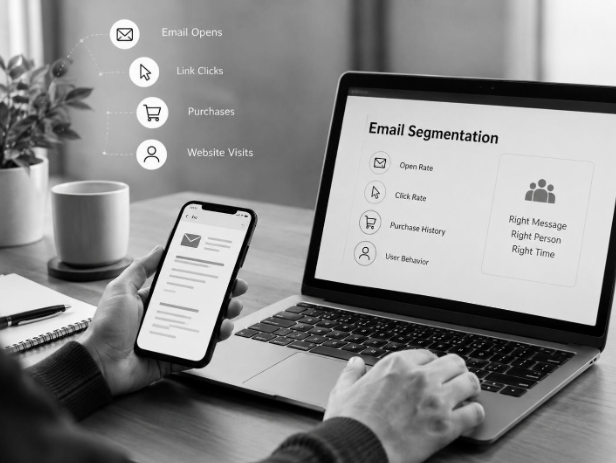
Marketing consultant Neil Patel has pointed out that a “Hi, [First Name]” token, once a small personalization win, barely registers anymore. Subscribers have seen it so many times that it reads as the absence of real personalization rather than the presence of it. What people respond to now is content and timing shaped by what they’ve actually done: what they clicked, what they bought, when they’re active, and what they’ve ignored.
That shift from who someone is to what they do is the difference between demographic segmentation and behavioral segmentation. Below is a practical framework for making that shift without needing a data science team, a full platform migration, or months of setup.
Why Demographic Segments Run Out of Runway
Demographic data answers “who is this person.” It doesn’t answer “what does this person actually want right now.” Two subscribers with the same job title and company size can have completely different relationships with your brand — one opens every email and clicks through to your blog, the other hasn’t opened anything in four months. A segment built only on job title treats them identically, and treating them identically usually means treating at least one of them wrong.
McKinsey’s research on personalized marketing makes a related point: brands that rely mainly on static profile data tend to hit a ceiling fairly quickly, while the ones that keep expanding what they actually know about customer behavior keep finding new ways to make offers and content more relevant over time. Behavioral data — what someone does inside your emails, your site, and your product — captures intent in a way a job title field never will.
Data availability is a real obstacle here, not a minor one. In one industry survey by email testing and analytics platform Litmus, roughly a quarter of marketers cited insufficient data as the main thing standing between them and better personalization. So before getting into the framework itself, it’s worth being upfront about this: the biggest bottleneck usually isn’t a smarter model. It’s that most teams aren’t capturing the signals in the first place.
Four Signals Worth Segmenting on Instead
1. Content engagement
What someone opens, clicks, and reads tells you more about their current interests than almost anything sitting in a CRM field. Duolingo’s reminder emails are a widely cited example of this in practice — the streak-based nudges are triggered by actual usage behavior, or the lack of it, rather than by a static profile attribute. The message changes based on what the person did, not who they are.
2. Lifecycle timing
A brand-new subscriber and a three-year customer shouldn’t get the same cadence or the same content, even if they share every demographic field you track. Airbnb is a commonly referenced example of timing-based personalization: a search on the site often triggers a timed follow-up email referencing that specific destination, sent close enough to the original search to still feel relevant instead of like an afterthought.
3. Conversion intent
Cart abandonment is the most familiar version of this signal, but intent usually shows up earlier than checkout. Repeated visits to a pricing page, a demo request that stalled partway through, or a download that never converted into a trial signup are all stronger predictors of buying readiness than anything on a static profile.
4. Channel and format preference
Some subscribers only ever engage with short, plain-text updates. Others click through long-form content every time. Preference centers — the kind that let a subscriber choose topics or frequency directly, an approach outlets like The New York Times use for their newsletter lineup — turn this into a segmentable data point instead of a guess buried in aggregate open-rate averages.
A Simple Scoring Framework You Can Build This Week
You don’t need machine learning to act on behavioral signals. You need a consistent way to turn raw activity into a score, and a process for updating that score over time.
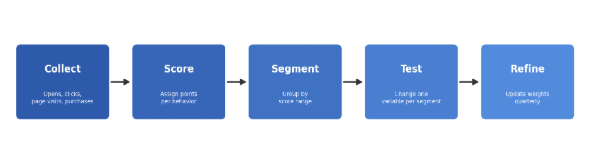
The behavioral segmentation loop: five steps, repeated quarterly.
- Collect the four signals above wherever your platform already tracks them: opens, clicks, page visits, purchase or demo activity, and any preference-center data you’ve gathered.
- Score each subscriber on a simple point scale. For example: +2 for a click in the last 14 days, +3 for a pricing-page visit, −2 for no opens in 60 days. The exact weights matter far less than having any consistent logic at all applied the same way across your list.
- Segment based on score ranges rather than static attributes: “high engagement, high intent,” “engaged but no recent purchase signal,” and “going cold” is a reasonable starting set for most lists.
- Test one specific change per segment — a different send time, a shorter subject line, a different offer — rather than overhauling the whole campaign at once. Isolating variables is the only way to know which change actually moved the number.
- Refine the scoring weights every quarter based on what actually correlated with opens, clicks, and conversions, not on assumptions made back when you first built the model. Behavior patterns drift, and a scoring model that isn’t revisited slowly becomes just as static as the demographic fields it replaced.
A Worked Example: Catching Re-Engagement Before a Subscriber Goes Cold
Say a subscriber opened every email for three months, then stopped opening anything for five weeks. Under most list structures, that person still sits in the same segment as your most active subscribers — same content, same frequency — right up until they unsubscribe or go permanently inactive, at which point it’s too late to do anything about it.
Under a behavioral score, that five-week open decay would move the subscriber into a re-engagement segment automatically. The next email they receive wouldn’t be the standard newsletter; it would be shorter and more direct, often built around a single clear ask, like confirming they still want to hear from you, or resurfacing the one piece of content they engaged with most before they went quiet. That single change — catching the drop-off early instead of waiting for a full unsubscribe — is usually where behavioral segmentation pays for itself fastest, because it is consistently cheaper to keep an existing subscriber engaged than to replace one who leaves.
Common Pitfalls When Building Behavioral Segments
Building the scoring model is the easy part. A few mistakes show up often enough to be worth flagging in advance:
Over-segmenting too early. Five or six behavioral segments is plenty to start. Splitting a list into twenty micro-segments before you have a working process for testing and refining even a handful of them just adds overhead without adding insight.
Treating one signal as the whole picture. A single pricing-page visit doesn’t mean someone is ready to buy, any more than a single missed open means someone has lost interest. Signals are most useful combined, not read in isolation.
Never revisiting the weights. A scoring model set once and left alone drifts out of date the same way a static demographic segment does. What counted as “high engagement” a year ago may not match current send frequency or content mix.
Ignoring unsubscribes and complaints as data. A spike in unsubscribes from a specific segment is itself a behavioral signal, and one of the more informative ones — it tells you directly that the segment logic, the content, or the cadence needs adjusting.
Why This Is Accelerating, Not Slowing Down
None of this is a passing trend. Investment in AI-driven personalization infrastructure is growing quickly enough that market researchers now track it as its own distinct category. Next Move Strategy Consulting’s AI Agents Market report specifically identifies personalization engines as one of the fastest-growing functional segments within customer-experience-focused AI agents, and projects the broader AI agents market to grow from USD 18.63 billion in 2026 to USD 387.90 billion by 2035. Whatever platform a team uses to send email, the direction of travel is the same: static, one-size-fits-all sends are going to keep losing ground to lists segmented on what people actually do.
Getting Started: A Checklist
Audit what behavioral data your platform already captures before building anything new. Most teams have more usable signal sitting in their existing data than they realize.
Pick one signal to start with. Content engagement is usually the easiest, since opens and clicks are already tracked by default in most email platforms.
Set a concrete re-engagement threshold, such as a specific number of days without an open or click, and build one email for that segment before doing anything more elaborate.
Test one variable at a time per segment so it’s actually possible to tell what worked and what didn’t.
Revisit scoring weights on a quarterly cadence instead of setting them once and forgetting about them.
Demographic fields will always have a place. They’re easy to collect and genuinely useful for basic list hygiene and compliance. But the emails that actually get opened, clicked, and acted on are consistently the ones built around what a subscriber has done, not just who they are on paper. Start with one signal, build the simplest possible scoring rule around it, and let the results decide what gets built next.
Author:

Sanyukta Deb is the Digital Marketing Team Lead at Next Move Strategy Consulting, where she leads content strategy and technical SEO for the firm’s B2B market research publications. She has 5 years of experience turning market data into commercial narratives for marketing and sales audiences.