

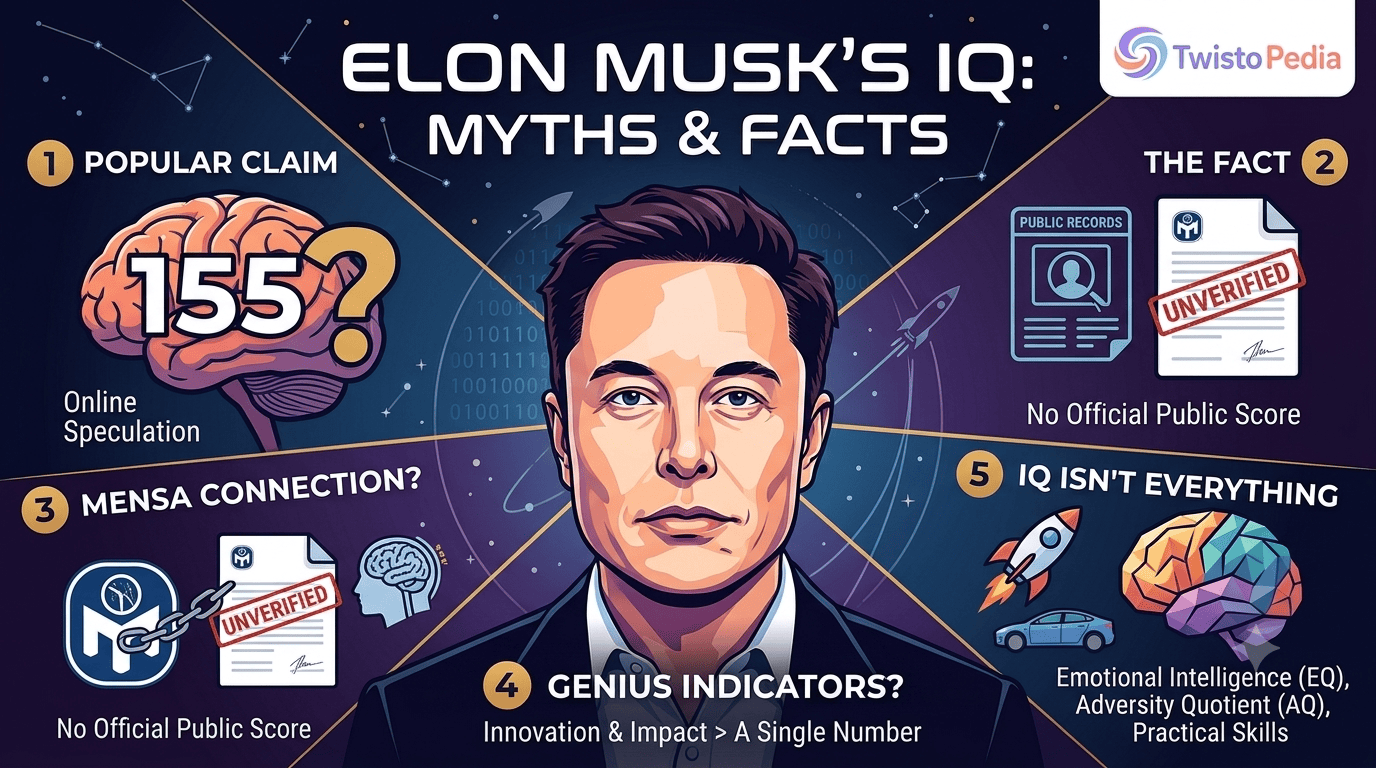
When asking what is Elon Musk’s IQ, I start with the public record, not folklore. No professionally administered IQ test is publicly disclosed, so any exact IQ score remains uncertain despite his remarkable accomplishments carefully and objectively.
- Estimating Elon Musk’s IQ
- Does A High IQ Guarantee Success?
- Specific Cognitive Abilities
- Interests And Life Goals
- The Problems With Celebrity IQ Claims
- What We Do Know About Intelligence And Achievement
- Elon Musk’s IQ: 122, 124, 155, Or Unknown?
- Is Elon Musk Actually A Genius?
- Should You Take An Online IQ Test To Compare Yourself To Elon Musk?
Estimating Elon Musk’s IQ
His Tesla, SpaceX, Neuralink, and X ventures show an entrepreneur and innovator pursuing ambitious projects through unconventional thinking. Achievement, however, cannot independently establish intelligence or a precise estimated IQ from achievement alone in practice.
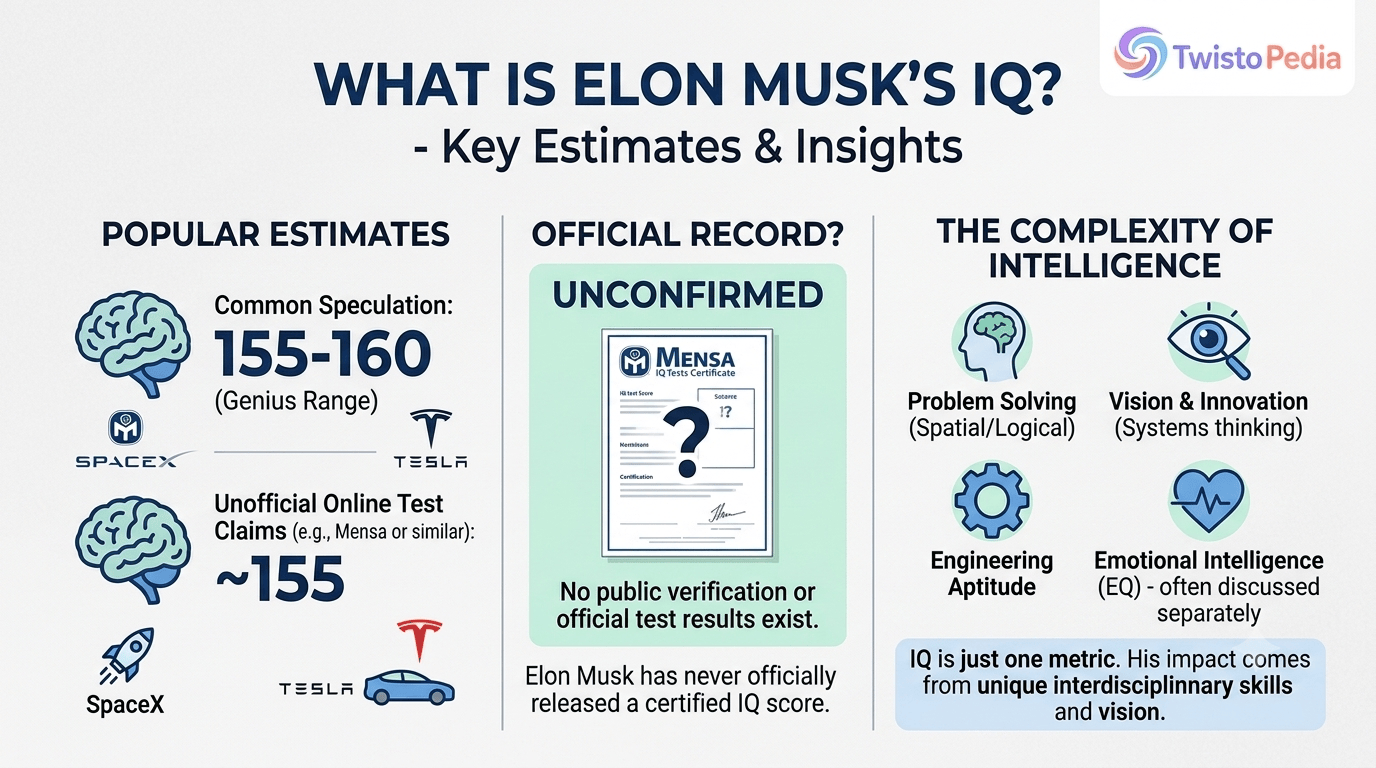
Popular internet claims suggest 150, 155, or 160, sometimes higher. I would treat those figures cautiously because reliable data matters more than repetition, especially when documented evidence is limited across online discussions from anonymous websites.
Walter Isaacson reported SAT results of 670 verbal and 730 math, producing a 1400 total score. His biography provides useful context, although historical results require careful comparison with today’s SAT scale responsibly.
Researchers can use equations to convert SAT scores into IQ estimates around 124 or 122. This offers measurable context for cognitive ability, above average performance, and responsible intelligence measurement about his score.
Does A High IQ Guarantee Success?
A high IQ can support success, but it cannot guarantee success. Above-average intelligence may improve reasoning, yet positive life outcomes also depend upon personality, opportunity, persistence, environment, and practical judgment when evaluating human performance carefully.
Studies associate intelligence with higher income and prestigious careers, especially in cognitively demanding fields. Still, I view IQ as a potential tailwind, not a complete explanation for workplace success or achievement across careers and professional environments.
Conscientiousness, emotional regulation, and interpersonal skills can influence results. In entrepreneurship, risk tolerance, resilience, and the ability to inspire others may matter alongside raw cognitive ability during difficult decisions when decisions involve people and uncertainty.
Musk’s business goals, technical interests, determination, and creativity suggest a wider profile. Social skills, opportunity, ambition, and resources can interact with intelligence while pursuing billion-dollar companies and demanding ventures while building complex ventures over time.
A willingness to take enormous risks can expose both cognitive strengths and cognitive weaknesses. Talented people, programming aptitude, spatial ability, and professional accomplishments can matter as much as generalized intelligence in technical and entrepreneurial contexts.
Specific Cognitive Abilities
Specific cognitive abilities can explain performance that a broad intelligence scores may overlook. Programming aptitude, computer programming, and technical ability may reveal specialized strengths relevant to Musk’s work beyond conventional intelligence testing carefully.
At age 17, programming-related aptitude reportedly offered a clue about technical strengths. That evidence does not prove genius, but it helps distinguish capability from assumptions based solely upon an IQ number without establishing intelligence profile.
Spatial ability matters when engineers work with rocketry, car engines, and three-dimensional space. Understanding how objects relate physically can support technical reasoning, even when standardized tests provide limited spatial measurement during engineering tasks.
The SAT does not capture every dimension of cognitive skills. Problem-solving and learning speed can emerge through practical work, where unfamiliar systems require rapid adaptation, testing, revision, and disciplined technical judgment under real conditions.
For professional performance, I would examine task-specific strengths rather than relying on one label. Professional accomplishments, strengths, weaknesses, and measurable abilities together provide a more useful picture of intelligence in action when evaluating intelligence through practical performance.
Interests And Life Goals
Musk’s interests and life goals help explain why measured intelligence alone feels incomplete. His business goals connect with technical interests, while sustained focus can turn intellectual capacity into long-term projects when judging achievement over time.
Ambition, motivation, and determination are difficult to capture through IQ testing. They influence whether an ability becomes visible, particularly when entrepreneurship demands repeated decisions under uncertainty and sustained pressure across projects requiring consistent long-term effort.
Risk tolerance, resilience,** and responses to failure can shape entrepreneurial outcomes. A person may possess strong reasoning but achieve little without motivation, persistence, or willingness to continue after setbacks rather than treating failure as evidence.
Creativity, social skills, and opportunity can change how intelligence becomes useful. Access to resources and talented people may help transform technical insight into innovation, coordination, and business success within technical and commercial environments consistently.
From an analytical perspective, professional accomplishments reflect interacting factors rather than one score. Interests, motivation, networks, technical focus, and persistence can determine whether intelligence becomes sustained performance across ambitious projects when assessing why ability becomes visible.
The Problems With Celebrity IQ Claims
Celebrity IQ stories often begin with impressive numbers. IQ claims about famous people can spread widely without original IQ scores, documented test results, or a verifiable IQ test, making certainty difficult when readers encounter repeated assertions.
A credible assessment should be publicly available, properly administered, and interpreted carefully. With historical figures such as Einstein, retroactive estimates usually involve speculation rather than measurement or historical data before accepting them as established results.
The appeal of genius-level intelligence can distort how readers understand extraordinary achievement. Above-average intelligence may be enough for ambitious goals, while human potential also depends upon creativity, learning, and circumstances without requiring exceptional genius-level test results.
Reducing ability to a single number can undervalue cognitive abilities, leadership, innovation, and practical ability. Emotional intelligence and problem-solving may contribute substantially to real-world achievement without appearing in one score that standardized assessments may not fully capture.
There is also a cultural link between wealth, influence, authority, and perceived intelligence. Social power can amplify intellectual superiority narratives, turning a score into cultural shorthand for success and status when celebrity narratives become shortcuts for explanation responsibly.
What We Do Know About Intelligence And Achievement
Intelligence remains useful when measured carefully, and IQ tests can assess important aspects of cognitive ability. Their predictive value is strongest in some cognitively demanding fields, not every life situation when interpreting scores within contexts.
Academic performance and school outcomes can reflect intelligence, preparation, environment, and opportunity. Learning skills and complex problem-solving also influence demanding jobs, where judgment involves more than a standardized score where multiple influences shape measurable performance carefully.
A higher IQ can support learning and reasoning, but the workplace adds other variables. Conscientiousness, emotional regulation, and interpersonal skills influence whether ability becomes dependable professional behavior over time consistently.
Entrepreneurship introduces risk tolerance, resilience, and failure. The ability to inspire others can turn raw cognitive ability into coordinated action, while leadership and innovation shape outcomes beyond test performance through decisions involving uncertainty and people.
The wider picture includes practical problem-solving, emotional intelligence, creativity, achievement, and professional success. Human capability contains specific abilities, cognitive strengths, and cognitive skills that no single score completely represents across environments and demanding responsibilities.
Elon Musk’s IQ: 122, 124, 155, Or Unknown?
The figures 122, 124, 155, and 160 circulate widely, but unknown remains the safest description. There is no verified IQ score from a professional IQ test publicly establishing Musk’s measured intelligence based on evidence today.
The reported SAT score of 670 verbal, 730 math, and 1400 total SAT score supplies information. SAT predictors can support an IQ estimate, but they cannot establish an actual IQ directly rather than intelligence testing.
Because the population comparison and 92.5% or 94.6% figures depend upon conversion methods, they should be treated cautiously. An evidence-based estimate differs from a confirmed cognitive assessment rather than treating estimates as facts.
Higher internet claims create conflicting estimates, especially when popular claims circulate without documentation. I would separate those claims from professional assessment, which requires direct testing and transparent scoring procedures before accepting them as established results.
The distinction between estimated score and measured result matters. Available public record evidence supports discussion of an estimate, but not certainty about Musk’s precise ranking or overall intelligence measurement with certainty from available evidence alone.
Is Elon Musk Actually A Genius?
Calling Musk a genius describes perception more readily than measurement. His strong abilities in technology, entrepreneurship, and engineering are observable, while a precise IQ remains unavailable from reliable public testing from the evidence available publicly.
His record in problem-solving and strategic thinking suggests unusual capability. Accomplishments across complex ventures demonstrate persistence and judgment, but they cannot independently establish a standardized IQ score for any individual about his cognitive profile alone.
A broader view considers general intelligence, above-average intelligence, specific abilities, and professional success together. Cultural shorthand can connect wealth and influence with genius, although perceived intelligence is not measured cognition without direct evidence of genius-level cognition.
I would separate creativity, leadership, innovation, and practical ability from any claimed number. These qualities can support business success while cognitive abilities, ambition, and risk-taking operate simultaneously across demanding entrepreneurial and technical environments over time.
Musk’s technical interests may contribute to extraordinary achievement, but that does not prove exceptional general intelligence. Business success can emerge from combinations of strategy, opportunity, persistence, technical skill, and decision-making without a verified IQ measurement.
Should You Take An Online IQ Test To Compare Yourself To Elon Musk?
An online IQ test can be entertaining, but I would not use it to compare yourself with Elon Musk. Many online tests come from amateurs or anonymous individuals, making their scores difficult to interpret without validation.
Serious psychometrics requires disciplined psychological testing, valid scoring, representative norms, and transparent procedures. Inaccurate scores become more likely when assessments lack qualified professionals or ignore established standards for testing for responsible intelligence measurement purposes consistently.
For a serious purpose, choose qualified professionals and recognized psychological tests supported by established standards. Review the documentation and development process before trusting a test promising unusually precise intelligence results before making serious decisions about results.
Some tests may use inflated scores to encourage purchases or collect money from test-takers. A credible cognitive assessment should emphasize reliable measurement, professional testing, validity, and accuracy instead rather than reliable psychological measurement too.
If your goal is genuine self-understanding, compare your performance across validated measures rather than chasing Musk’s number. Intelligence, IQ, and cognitive performance deserve careful interpretation rather than sensational online rankings across multiple validated cognitive domains.