
The great pyramid of cholula is a remarkable archaeological site in Mexico that represents one of the largest human-made structures ever created. Known as Tlachihualtepetl, this largest pyramid by volume stands in Cholula, Puebla, and reveals thousands of years of ancient civilization, religious traditions, and architectural development.
- The Great Pyramid of Cholula
- The Great Pyramid Of Cholula History
- Who Built The Great Pyramid Of Cholula
- Great Pyramid Of Cholula Vs Giza
- Key Facts About The Great Pyramid Of Cholula
- What Was The Great Pyramid Of Cholula Used For
- When Was The Great Pyramid Of Cholula Discovered
- History And Construction
- The World’s Largest Pyramid By Volume
- Unique Design And Architecture
- Why The Design Is Different From Other Pyramids
- Church Built On Top Of The Pyramid
- Hidden Pyramid And Archaeological Discoveries
- Religious And Cultural Importance
- Spanish Conquest And Transformation
- Tourism And Visitor Experience
- Cultural Events And Nearby Attractions
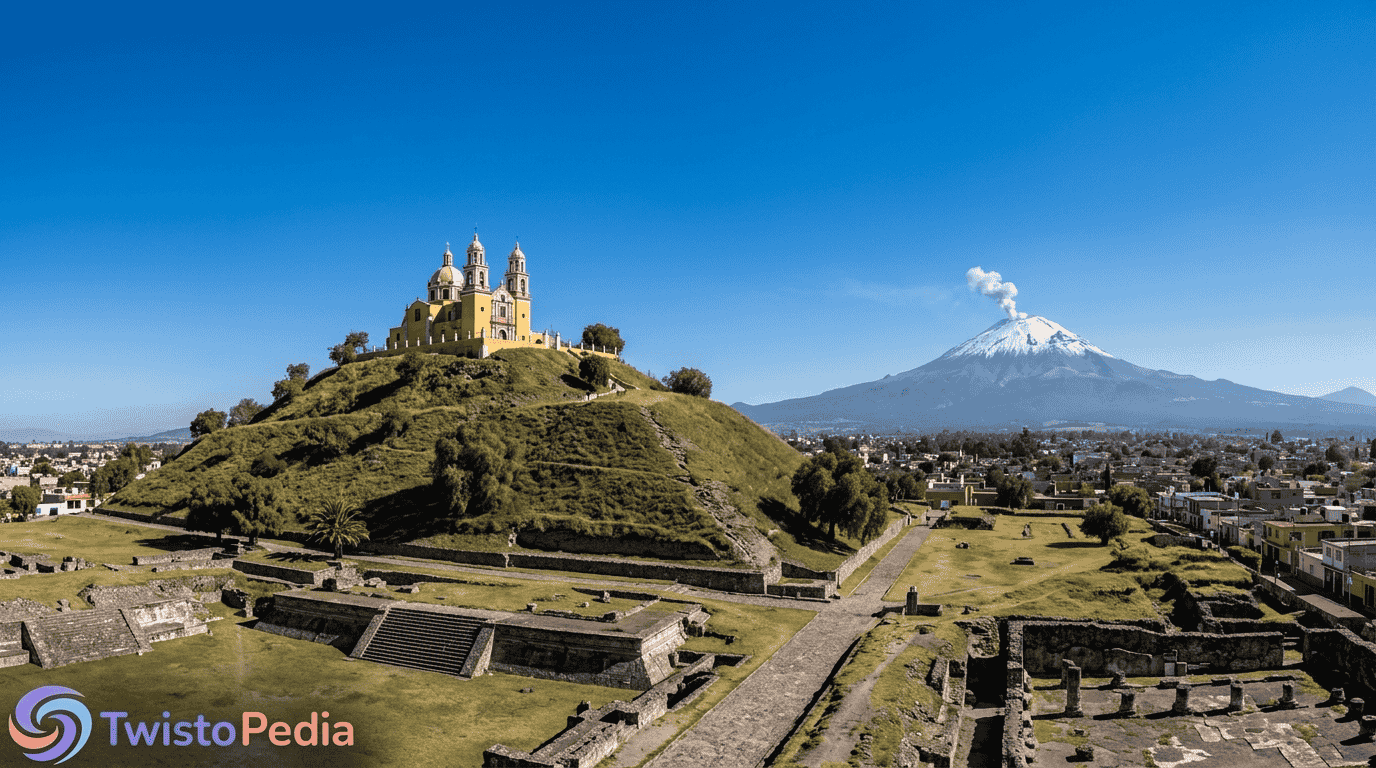
Unlike the famous stone pyramids of Egypt, the Great Pyramid of Cholula developed as a layered Mesoamerican structure built through repeated expansions. Today, much of the monument appears as a natural hill, but beneath its soil and vegetation lies a massive construction created by generations of Indigenous communities.
The monument’s importance comes not only from its size but also from its role as a sacred and cultural landmark. Its history connects pre-Hispanic heritage, religious practices, political changes, and archaeological discoveries that continue to shape understanding of ancient Mexico.
The Great Pyramid of Cholula
The Great Pyramid of Cholula is the world’s largest pyramid by total volume, measuring approximately 4.45 million cubic meters and reaching about 66 meters in height. It is located in San Andrés Cholula, within the modern state of Puebla, Mexico.
The structure is also called Tlachihualtepetl, a Nahuatl name commonly translated as “constructed mountain” or “handmade mountain.” The name reflects the way the monument blends architecture and landscape because centuries of construction created a massive mound-like appearance.
Unlike a single-phase building project, Cholula’s pyramid represents thousands of years of human effort. Ancient builders created new temples and platforms over earlier structures, producing multiple construction layers that preserve different periods of Mesoamerican cultures.
The monument contains evidence of:
- Religious center activities connected with sacred ceremonies
- Ancient temples and platforms
- Archaeological tunnels revealing earlier construction phases
- Artistic and architectural influences from different civilizations
The Great Pyramid of Cholula demonstrates that ancient engineering was not only about height. Its builders focused on creating a powerful ceremonial landscape that represented social identity, religious beliefs, and cultural continuity.
The Great Pyramid Of Cholula History
The the great pyramid of cholula history began around 300 BCE, with construction continuing through multiple centuries as different civilizations influenced the region. The monument developed during the Pre-Columbian period and remained an important part of the cultural landscape of central Mexico.
The pyramid was not created in one stage. Instead, it grew through several expansion phases, where new rulers and communities added larger platforms and temples over existing structures. This approach transformed the original monument into an enormous architectural complex.
Historical Timeline
| Period | Development |
| Around 300 BCE | Early construction of the pyramid began |
| Pre-Columbian era | Multiple civilizations expanded the structure |
| Classic period | Additional architectural changes influenced the monument |
| 1519 | Spanish forces arrived in Cholula |
| 20th century | Archaeological excavation revealed internal structures |
The pyramid became closely associated with religious traditions and the worship of Quetzalcoatl, the feathered serpent deity important across many Mesoamerican societies. Its role changed over time, but it remained connected with ceremonial activities and spiritual practices.
One of the most interesting aspects of Cholula’s history is that the monument was never truly forgotten. When Spanish explorers arrived, the pyramid was covered with vegetation and appeared like a natural landscape feature. However, the city of Cholula remained an active and significant settlement.
Who Built The Great Pyramid Of Cholula
The Great Pyramid of Cholula was built by several Mesoamerican civilizations rather than a single group. Different communities contributed to its expansion, including the Olmeca-Xicalanca, Toltec, and other Indigenous societies that occupied the Puebla Valley.
The question of who built the Great Pyramid of Cholula is complex because the monument represents centuries of cultural change. Archaeologists identify different construction styles and phases that reflect changing political and religious influences.
Major Groups Connected With Construction
| Civilization | Contribution |
| Olmeca-Xicalanca | Early development and expansion phases |
| Toltec groups | Later cultural influences and architectural changes |
| Other Mesoamerican communities | Continued maintenance and ceremonial use |
The builders primarily used materials such as adobe and earth, creating a massive structure through careful layering rather than using large stone blocks. This construction method explains why the pyramid developed a broad base and mountain-like shape.
The achievement was not simply architectural. Building such a large sacred monument required organized communities, engineering knowledge, religious motivation, and long-term cooperation across generations.
Great Pyramid Of Cholula Vs Giza
The comparison between the Great Pyramid of Cholula vs Giza shows that “largest pyramid” depends on the measurement used. The Great Pyramid of Cholula is larger by volume, while the Great Pyramid of Giza is taller and more vertically impressive.
| Feature | Great Pyramid of Cholula | Great Pyramid of Giza |
| Location | Puebla, Mexico | Egypt |
| Main measurement advantage | Largest by volume | Tallest pyramid |
| Approximate volume | 4.45 million cubic meters | Around 2.4 million cubic meters |
| Height | About 66 meters | About 146 meters originally |
| Construction style | Layered adobe-based construction | Stone construction |
The difference between these monuments highlights two different approaches to ancient engineering. Giza focused on height, precision, and monumental stone architecture. Cholula focused on enormous mass, ceremonial space, and continuous expansion over generations.
The Great Pyramid of Cholula’s base area allowed it to become one of the largest architectural achievements in human history. Its estimated volume exceeds that of Giza, proving that size cannot always be measured by height alone.
Key Facts About The Great Pyramid Of Cholula
| Fact | Details |
| Location | Cholula, Puebla, Mexico |
| Ancient name | Tlachihualtepetl |
| Meaning | Constructed mountain or handmade mountain |
| Height | Approximately 66 meters (217 feet) |
| Base size | Around 450 × 450 meters |
| Volume | Approximately 4.45 million cubic meters |
| Construction period | Began around 300 BCE |
| Cultural region | Mesoamerican civilization |
| Main material | Adobe, earth, and layered construction materials |
The pyramid is different from many famous pyramids because it was not designed as a single structure. Instead, it represents centuries of rebuilding, where communities created new temples and platforms over previous versions.
Important facts about the monument include:
- It contains a network of archaeological tunnels that allowed researchers to study earlier construction stages.
- More than five miles of tunnels have been excavated inside the pyramid.
- The summit contains the Church of Our Lady of Remedies, creating a unique connection between Indigenous history and colonial architecture.
- The monument was connected with religious center activities and ceremonial traditions.
- Its construction reflects the engineering abilities of ancient societies without modern technology.
The Great Pyramid of Cholula is also important because it challenges a common assumption that Egyptian pyramids are automatically the largest pyramids in existence. When measured by total volume, Cholula represents a greater mass of construction.
What Was The Great Pyramid Of Cholula Used For
The Great Pyramid of Cholula was primarily used as a religious center, ceremonial space, and sacred location for ancient communities. It served as a place for sacred ceremonies, worship practices, and gatherings connected with Mesoamerican beliefs.
The monument was not simply a burial structure like some Egyptian pyramids. Instead, it functioned as a living religious and social complex where communities performed rituals and maintained connections with their deities.
Religious And Social Functions
The pyramid was used for:
- Religious ceremonies and community gatherings
- Worship connected with Quetzalcoatl, the feathered serpent deity
- Pilgrimage traditions from surrounding regions
- Political and cultural activities
- Construction of temples dedicated to spiritual practices
The importance of Cholula came from its position as a major city within central Mexico. The pyramid represented authority, religious identity, and the relationship between humans, nature, and the spiritual world.
The site’s role changed as different groups controlled the region, but its importance as a sacred site remained throughout much of its history.
Unlike modern buildings that serve one defined purpose, the Great Pyramid of Cholula combined multiple roles:
- A ceremonial location
- A symbol of cultural identity
- A place of religious practices
- A gathering point for ancient communities
When Was The Great Pyramid Of Cholula Discovered
The Great Pyramid of Cholula was not discovered at a specific single moment because the structure was never completely lost. However, its true identity as a massive archaeological monument was revealed through modern archaeological excavation and research.
For centuries, the pyramid remained hidden beneath earth, soil, and vegetation, causing many people to mistake it for a natural hill. The structure became recognized as an ancient pyramid when researchers began investigating the unusual mound and uncovering its internal architecture.
Discovery And Archaeological Research Timeline
| Period | Discovery Development |
| 1519 | Spanish arrival in Cholula during the conquest period |
| Colonial era | The pyramid remained covered and was treated as a natural landscape feature |
| Modern archaeological period | Excavations revealed internal structures and construction layers |
| 20th century | Tunnels and archaeological investigations expanded knowledge of the pyramid |
Archaeologists uncovered:
- Hidden construction layers
- Ancient stairways
- Platforms
- Altars
- Internal structures
- Earlier pyramid stages
The discovery process showed that what appeared to be a simple hill was actually a complex architectural achievement built by generations of Indigenous people.
The excavation of tunnels provided researchers with direct access to the pyramid’s interior, allowing them to examine how different civilizations expanded the monument over time.
History And Construction
The construction of the Great Pyramid of Cholula represents one of the longest building projects in ancient Mesoamerica. Beginning around 300 BCE, the structure developed through centuries of expansion, modification, and cultural transformation.
The pyramid grew as different civilizations added new architectural elements over earlier structures. This process created the enormous layered monument visible today.
Construction Characteristics
- Built using adobe and earth-based materials
- Expanded through multiple construction phases
- Included temples and ceremonial platforms
- Reflected changing architectural styles
- Preserved evidence of different civilizations
The builders created a structure that functioned both physically and symbolically. Each expansion represented not only architectural growth but also changes in political power and religious traditions.
The construction history of Cholula demonstrates how ancient societies invested enormous resources into monuments that represented identity, spirituality, and community organization.
The World’s Largest Pyramid By Volume
The Great Pyramid of Cholula holds the title of the world’s largest pyramid by volume because its enormous base creates a greater total mass than many taller pyramids.
Its estimated 4.45 million cubic meters of volume makes it larger in total size than the Great Pyramid of Giza, even though it does not reach the same height.
Volume Comparison
| Pyramid | Volume | Height |
| Great Pyramid of Cholula | 4.45 million cubic meters | 66 meters |
| Great Pyramid of Giza | Around 2.4 million cubic meters | Around 146 meters originally |
The comparison demonstrates two different approaches to ancient architecture. The Egyptian pyramid focused on height and precision, while Cholula emphasized enormous scale through a wide base and repeated construction.
The achievement of Cholula’s builders becomes more impressive when considering that the monument was created without modern machinery. Its size reflects long-term planning, labor organization, and advanced understanding of construction methods.
Unique Design And Architecture
The Great Pyramid of Cholula has a unique architectural design because it was built through centuries of expansion rather than a single construction period. Its rounded, mountain-like appearance developed as different communities added new layers, temples, and platforms over earlier structures.
Unlike the sharp triangular shape commonly associated with Egyptian pyramids, Cholula’s design reflects the building traditions of Mesoamerican civilizations, where pyramids often served as elevated ceremonial spaces.
Architectural Characteristics
The structure includes:
- Construction layers created by repeated rebuilding and expansion
- Large platforms designed for ceremonial activities
- Temple structures placed on different pyramid stages
- A broad base area that contributed to its enormous volume
- Earth-covered surfaces that created its hill-like appearance
The pyramid’s architecture provides evidence of changing cultural influences throughout history. Archaeologists have identified connections with different regional traditions, including influences linked to Teotihuacan and El Tajín.
The design also demonstrates that ancient architecture was not only about visual appearance. The Great Pyramid of Cholula represented religious authority, social organization, and the relationship between communities and their sacred landscape.
Why The Design Is Different From Other Pyramids
The unusual shape of Cholula developed because every generation built upon what already existed. Instead of demolishing older structures, builders preserved earlier temples by covering them with new construction.
This created a layered archaeological record where each section represents a different historical period.
Church Built On Top Of The Pyramid
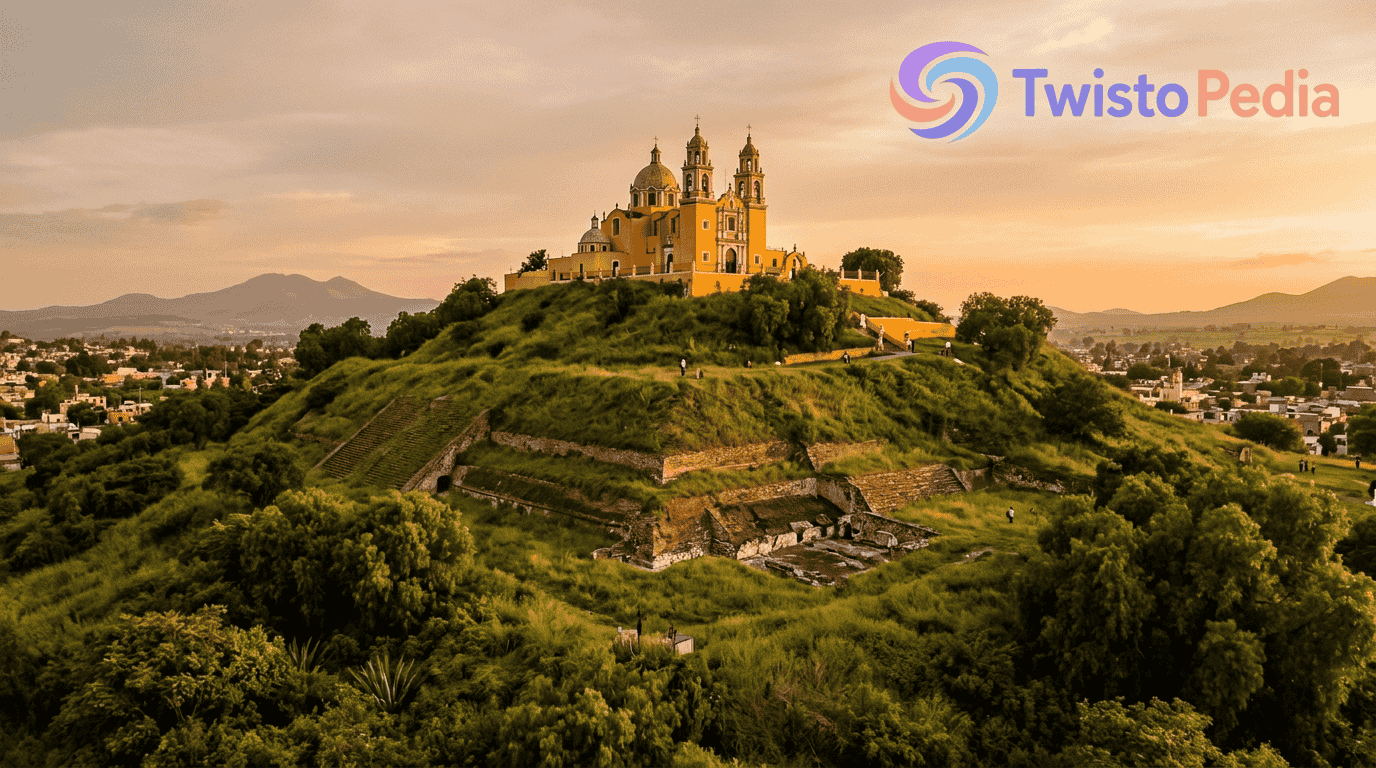
The Church of Our Lady of Remedies stands on top of the Great Pyramid of Cholula, creating one of the most unusual combinations of Indigenous architecture and colonial history in Mexico.
The church was built after the arrival of Spanish conquistadors, transforming the summit of an ancient Indigenous pyramid into a Christian religious location.
The Church And The Pyramid Connection
The summit structure is known as:
- Church of Our Lady of Remedies
- Nuestra Señora de los Remedios
- A colonial-era Catholic church
When Spanish forces reached Cholula in 1519, the pyramid was covered with vegetation and appeared like a natural hill. The Spanish later established a church on the highest point of the monument.
This transformation represents a major cultural transition:
| Before Spanish Arrival | After Spanish Arrival |
| Indigenous religious center | Christian place of worship |
| Mesoamerican ceremonies | Catholic traditions |
| Pyramid temples | Colonial church structure |
The location of the church is historically significant because it reflects the complex relationship between Indigenous heritage and colonial influence.
Today, the church provides visitors with views across the Puebla Valley while also reminding observers of the different historical periods that shaped Cholula.
Hidden Pyramid And Archaeological Discoveries
The Great Pyramid of Cholula remained hidden beneath layers of earth, soil, and vegetation for centuries, causing many people to believe the structure was simply a natural hill.
Modern archaeological investigations revealed that the mound contained one of the largest ancient monuments ever constructed.
Archaeological Discoveries Inside The Pyramid
Researchers discovered:
- Internal tunnels
- Ancient stairways
- Platforms
- Altars
- Earlier construction layers
- Buried architectural structures
The tunnel system allowed archaeologists to examine how the pyramid developed over thousands of years. More than five miles of tunnels were excavated through the monument, providing access to different construction stages.
These discoveries helped researchers understand:
- How ancient builders expanded the pyramid
- How religious spaces changed over time
- How different civilizations contributed to the monument
The hidden nature of Cholula is one of its most fascinating features. Unlike many archaeological sites that are immediately visible, this pyramid preserved much of its history beneath the surface.
Religious And Cultural Importance
The Great Pyramid of Cholula was one of the most important religious and cultural centers of ancient Mexico. It served as a sacred place where communities gathered for ceremonies, worship, and important social activities.
The monument was closely connected with Quetzalcoatl, the feathered serpent deity associated with knowledge, wind, and creation in many Mesoamerican traditions.
Religious Functions Of The Pyramid
The site was used for:
- Sacred ceremonies
- Religious practices
- Pilgrimage traditions
- Community gatherings
- Worship activities
The pyramid represented more than a physical structure. It reflected the beliefs, identity, and organization of ancient societies.
Different civilizations modified the monument according to their own traditions, meaning the pyramid became a record of changing religious and cultural practices.
Cultural Importance
The Great Pyramid of Cholula remains significant because it connects:
- Ancient Indigenous civilizations
- Archaeological research
- Mexican heritage
- Historical identity
- Modern cultural tourism
Its survival demonstrates how ancient monuments can preserve the stories of multiple generations.
Spanish Conquest And Transformation
The Spanish conquest dramatically changed Cholula’s history when Spanish forces arrived in 1519 under the leadership of Hernán Cortés.
Before the conquest, Cholula was a major Indigenous city with strong religious and political importance. After Spanish control was established, many Indigenous religious locations were transformed or replaced.
Changes After Spanish Arrival
The conquest resulted in:
- Political changes in Cholula
- Transformation of religious landscapes
- Introduction of Christian institutions
- Construction of the church on the pyramid summit
The Great Pyramid of Cholula became a symbol of cultural transformation because the ancient sacred site continued to exist while its surrounding religious environment changed.
The monument represents both the achievements of Indigenous civilizations and the impact of colonial history.
Tourism And Visitor Experience
The Great Pyramid of Cholula is now one of Mexico’s most important archaeological attractions. Visitors can explore the archaeological zone, view ancient structures, enter selected tunnels, and climb toward the summit.
The experience combines history, architecture, and landscape views.
What Visitors Can Explore
Visitors can experience:
- Archaeological tunnels
- Pyramid remains
- Museum exhibitions
- Ancient platforms
- Summit views
From the top of the pyramid, visitors can see the Puebla Valley and surrounding volcanoes, including Popocatépetl and Iztaccíhuatl.
The site offers a unique perspective because visitors can observe both ancient construction and colonial architecture in the same location.
Why People Visit Cholula
The pyramid attracts visitors because it provides:
- Historical education
- Cultural understanding
- Archaeological exploration
- Views of the surrounding landscape
- Connection with Mexico’s ancient heritage
The Great Pyramid of Cholula is not only an archaeological site but also a place where history remains part of everyday cultural life.
Cultural Events And Nearby Attractions
The area around the Great Pyramid of Cholula continues to maintain strong cultural traditions through festivals, museums, and historic attractions.
Nearby locations provide additional insight into the region’s religious and architectural history.
Nearby Attractions Include
- Regional Museum of Cholula
- Archaeological Zone of Cholula
- Church of Santa María Tonantzintla
- Historic areas of San Andrés Cholula
Cultural events and local festivals allow visitors to experience traditions that developed from centuries of Indigenous and colonial influences.
The surrounding area demonstrates that Cholula is not only an archaeological location but also a living cultural destination.
Other Post
How I Travel to Epic Adventures Beyond the Ordinary: My Guide