

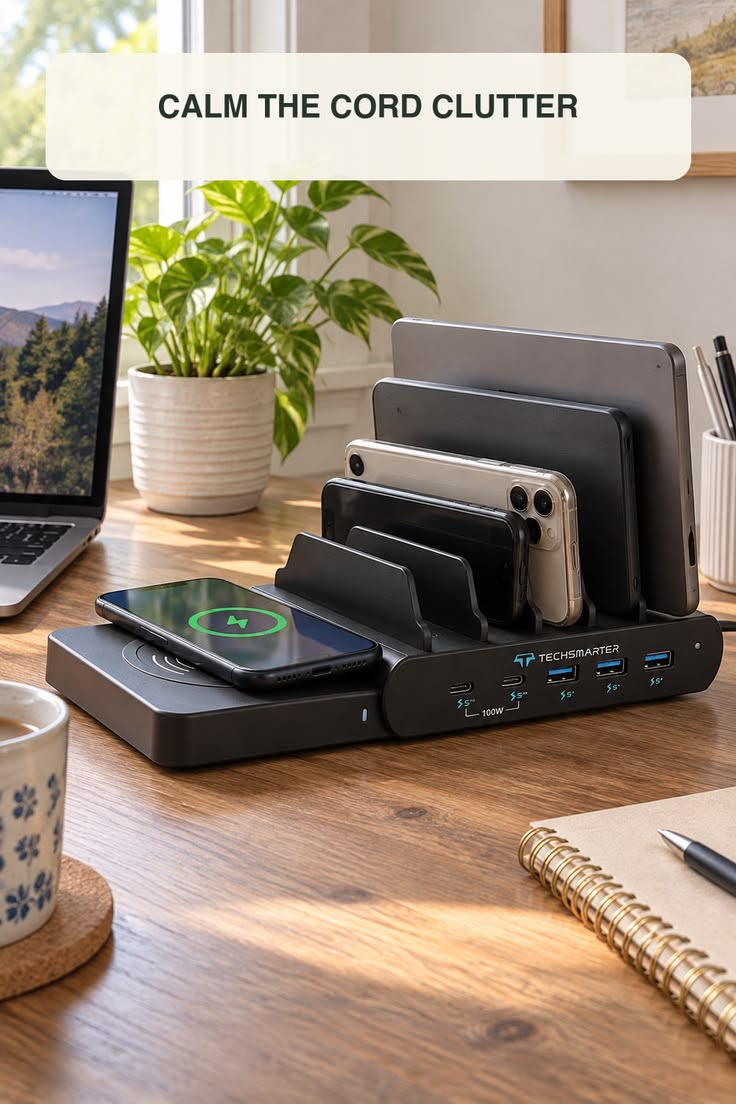
The best charging station for multiple devices is the one that fits your real device mix, not the one with the loudest spec sheet. In practice, a good setup balances phones, tablets, laptops, earbuds, total wattage, wireless pads, and device organization so you stop fighting clutter and start getting predictable overnight charging.
- What actually makes a charging station good for multiple devices?
- How do you choose the right charging station for your devices?
- Which charging stations compare best side by side?
- Which charging station is the best overall choice?
- What is the best budget charging station for multiple devices?
- What is the best charging station for Apple devices?
- Should you get a hybrid charging station with wired and wireless charging?
- What is the best charging station if you also need to charge a laptop?
- Who should buy a high-power desktop charging station?
- Is a USB-C charging station better for modern devices?
- What is the best travel charging station for multiple devices?
- Which low-cost charging stations are still worth buying?
- What works best for schools, offices, and large device fleets?
- How much charging power do you really need?
- How important is cable management and device organization?
- How many devices should one charging station handle?
- Does design matter when choosing a charging station?
- How do charging stations for multiple devices actually work?
- Which type of charging station is best for your setup?
- Common questions about charging stations for multiple devices
- What should you know about the Satechi Dock5 before buying it?
- How were these charging stations evaluated?
- Why should you trust these charging station recommendations?
I’ve found that buyers often fixate on the number of USB ports and miss the bigger issue: power management. A cheap multi-port block may look useful on a desk or nightstand, but once every port is active, output can drop, devices charge more slowly, and you wake up with something still half full. That’s why the best charging station for multiple devices usually wins on usable power, not just on raw port count.
The current market breaks into a few smart categories. A wireless charging station for multiple devices works well when you mainly charge a phone, watch, and earbuds. A usb charging station for multiple devices or usb-c charging station for multiple devices fits mixed gear better. If you need a family charging station for multiple devices, an ipad charging station for multiple devices, a portable charging station for multiple devices, or even a wall mounted charging station for multiple devices, the right answer depends far more on habits than hype.
What actually makes a charging station good for multiple devices?
A good multi-device charger works because it distributes power intelligently, supports the right standards, and avoids wasting space or energy. The difference between a forgettable hub and the best charging station for multiple devices usually comes down to how it handles shared output, charging performance, and compatibility under real load.
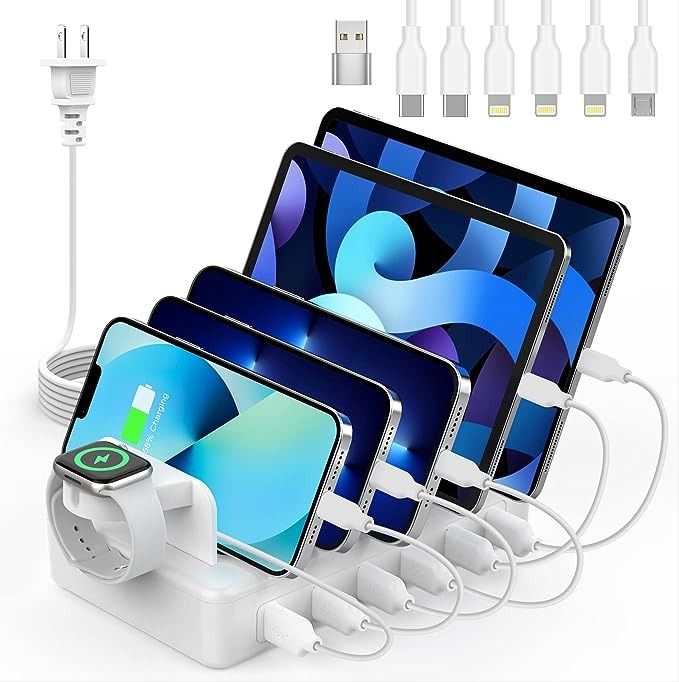
At the electrical level, one charger may feed power through AC power and each device’s own charger, while another uses built-in USB-C PD to negotiate the right delivery directly. In larger setups, higher-capacity carts may stage power in groups so devices can charge safely and avoid overloading circuits. That matters more than people think, especially when tablets and notebooks all connect at once.
I’ve also noticed that buyers underestimate how much wired chargers still outperform convenience-first models. A strong station can offer 60 watts, 2.4 amps per port, a shared output 12 amps, or even higher class delivery like 20W USB-C Power Delivery and up to 10W wireless pad support. By contrast, some wireless options remain slower than wired, even when they use polished systems like Apple MagSafe or the Belkin BoostCharge Pro at 15 watts.
How do you choose the right charging station for your devices?
The right buying process starts with device count, then moves to power, connector type, space, and charging style. If you follow that sequence, you’ll usually narrow the field much faster than if you shop by brand first.
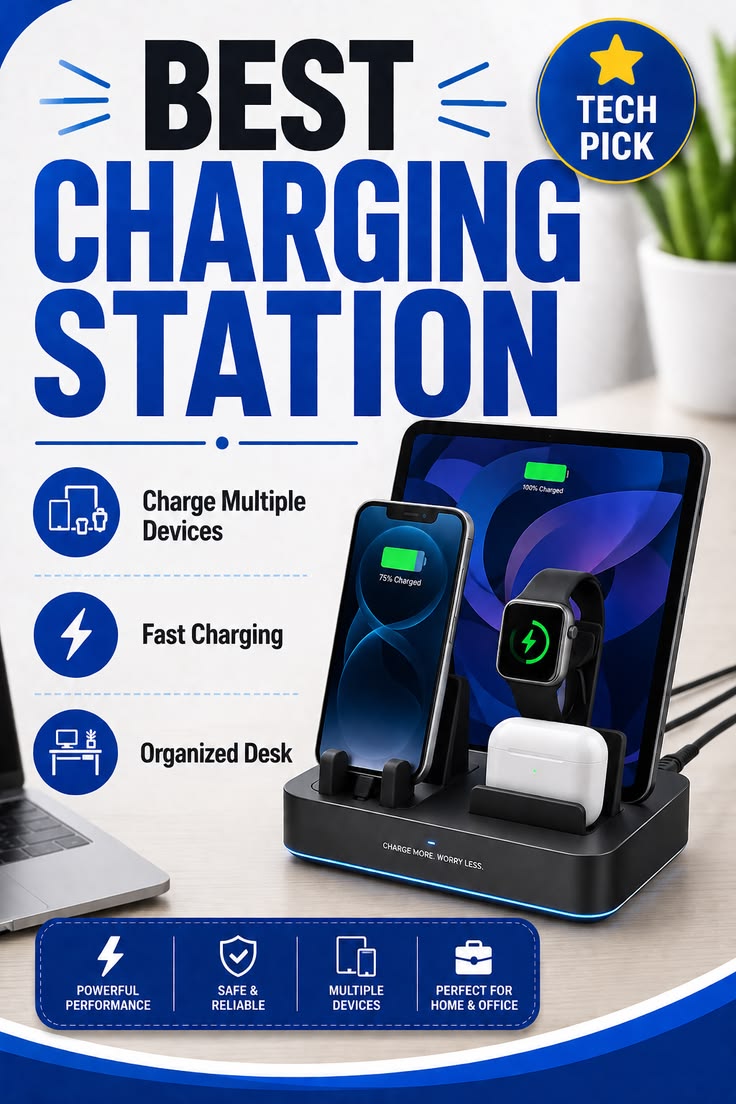
- Count your devices first. If you only need one to five devices, a compact station may be enough. If you regularly charge 10 to 20 devices, you’re already moving into shared-station territory. At 20 to 40 shared devices, you should stop looking at consumer docks and start considering carts or cabinets.
- Match the format to your gear. If your lineup includes laptops, a usb c charging station for multiple devices or laptop-oriented dock makes more sense than a phone-first stand. If you use mostly Apple accessories, a charging station for multiple devices apple setup or a charging station for multiple devices apple iphone configuration may be more efficient than a generic stand.
- Check everyday compatibility details. Power cable length, case tolerance, and platform-specific behavior matter. For example, some models ship with an included power cable around 48 inches, support Android phones with Qi wireless technology, and work with MagSafe-enabled iPhones without true magnetic alignment. Others deliver up to 10W Qi charging, 7.5W for iPhones, support phone case compatibility unless there are metal cases or magnetic clips, and can also handle AirPods, Galaxy Buds, Google Pixel Buds, and other Qi-compatible charging cases.
Which charging stations compare best side by side?
The strongest way to compare chargers is to line up power, port mix, device capacity, and intended use in one view. That makes it easier to see why a home charging station for multiple devices differs from a work desk dock or a travel-first foldable model.

| Model | Type | Max Output | Port / Pad Mix | Best Fit |
| DockHub Pro 15-in-1 (BYL-2519) | Dock | 100W PD pass-through | 5× USB-A, 2× USB-C | Laptop-centered desk |
| SIIG 90W 10-Port USB Station | USB Hub | 90W | 9× USB-A, 1× USB-C, Qi pad | Shared counter or family |
| SooPii Quick Charge 3.0 | USB Hub | 60W | 6× USB-A | Budget setup |
| Belkin BoostCharge Pro 3-in-1 | Wireless 3-in-1 | 15W phone pad | 3 wireless pads | Apple bedside setup |
| Anker MagGo 3-in-1 | Wireless 3-in-1 | 15W Qi2 | 3 wireless pads | Travel + Apple |
| Satechi Dock5 | Hybrid | about 74W | 2× USB-C, 2× USB-A, Qi pad | Mixed wired/wireless desk |
| UGreen Nexode 300W Desktop | GaN Desktop Hub | 300W | 4× USB-C, 1× USB-A | Power users, laptops |
| Plugable 10-Port USB-C Station | USB-C Hub | 100W shared | 10× USB-C | USB-C-only workflows |
| Twelve South Butterfly 2-in-1 | Wireless 2-in-1 | 15W MagSafe | 2 wireless pads | Minimal travel |
| Mophie 3-in-1 Travel Charger | Wireless 3-in-1 | 15W MagSafe | 3 wireless pads | Premium travel kit |
The broad pattern is pretty clear. If you need a fast charging station for multiple devices with notebook support, look at higher-output desk chargers and docks. If you want a decorative charging station for multiple devices or a simpler bedside setup, wireless pads and hybrid models are more practical.
Which charging station is the best overall choice?
The best overall choice is the SIIG 90W 10-Port station if your priority is charging many smaller devices neatly in one place. The reason the SIIG stands out is that it blends capacity, physical slots, and decent power into one footprint without drifting into enterprise hardware.
In testing, the SIIG 90W 10-Port USB Station posted an overall score 82 with charging performance 8.0, device organization 8.0, number of devices 9.0, and aesthetics 8.0. The unit has 10 USB ports, max power 90W, device storage yes, charge indicator lights yes, and included cables no. Each port can reach up to 2.4 amps, although the unit has a combined 18 amps total, so performance drops when every outlet is fully stressed.
From a practical standpoint, the SIIG works because the hardware matches everyday chaos. You get vertical holders, support for eight tablets or phones, a non-slip rubberized surface, and an optimal viewing position for a ninth device on the top area. Depending on version, you may see the older version 9 USB-A and 1 USB-C or the newer configuration 5 USB-A and 5 USB-C. Another comparison set describes it as 9× USB-A, 1× USB-C, 18W PD, plus a Qi deck 5–10W, up to 11 devices, 8 organizer slots, an LED ambient light, and a UL-certified 90W adapter. The tradeoff is simple: it’s strong for many small devices, but still cannot fast-charge laptops.
What is the best budget charging station for multiple devices?
The best budget pick is the SooPii Quick Charge 3.0 because it gives you real utility, included cables, and decent power without making you buy extras. For buyers who want the best usb charging station for multiple devices at a low entry cost, this is still one of the easiest recommendations.

The Soopii Quick Charge 3.0 carries a list price $34, an overall score 77, charging performance 8.0, device organization 8.0, number of devices 7.0, and aesthetics 7.0. It delivers 60W, or 5V/12A, across 6× USB-A, including 5× 2.4A smart ports and 1× QC 3.0. Some versions also add PD 20W USB-C newer variant support, which makes the platform a little more future-friendly than it first appears.
Where SooPii earns its place is the box contents. You get 6–8 short cables, often a mix of Lightning, micro-USB, and USB-C mix, plus 7 removable dividers, a watch charger holder, and an earbuds holder. In real use, that means fewer trips to order extra accessories. The downside is still worth noting: the base model remains USB-A only, the plastic build feels modest, and it is too weak for laptops.
What is the best charging station for Apple devices?
The best Apple-focused option is the Belkin BoostCharge Pro 3-in-1 if you want a polished, fixed bedside or desk charger for an iPhone, Apple Watch, and AirPods. The reason is straightforward: the Belkin combines device organization, verified fast charging behavior, and clean ergonomics in a way many generic stands still don’t.
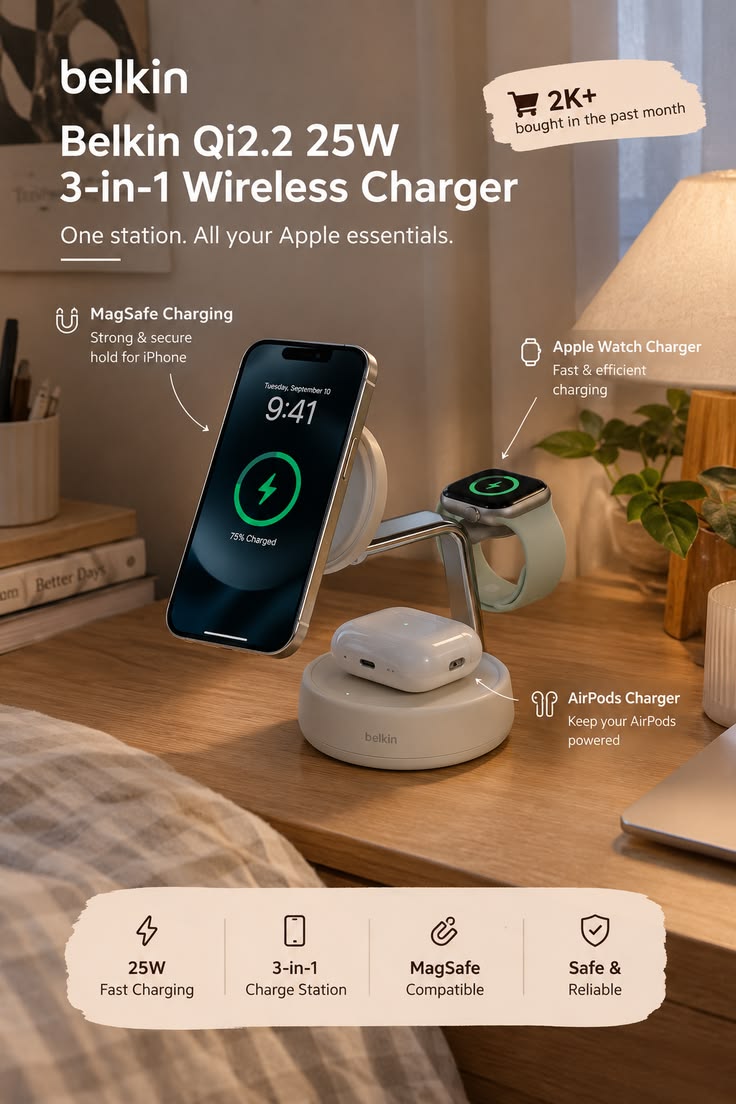
The Belkin BoostCharge Pro 3-in-1 shows a list price $150, an overall score 74, charging performance 7.0, device organization 9.0, number of devices 5.0, and aesthetics 9.0. It has 0 USB ports, max power 1.8W/14.9W, device storage yes, charge indicator lights yes, and included cables yes. On the wireless side, another comparison lists 25W combined, broken into 15W + 5W + 5W, over 3 wireless pads, with Apple Watch fast charging, a bundled USB-C cable, power supply, and 2 years of coverage plus a $2,500 Connected Equipment Warranty.
What makes Belkin especially relevant for Apple users is that it can deliver 15 watts to phone while keeping the layout simple and elegant. Later versions also introduced second generation, Qi2 technology, a smaller base, and an adjustable viewing angle. For someone wanting a charging station for multiple devices apple iphone setup that feels finished instead of improvised, this is the safer choice than many cheaper clones.
Should you get a hybrid charging station with wired and wireless charging?
A hybrid charger is the smartest choice when your setup includes both cable-first devices and a phone or earbuds you’d rather drop on a pad. In mixed households or shared desks, a hybrid often does more useful work than a pure stand or a pure wired dock.
The Satechi Dock5 Multi-Device Charging Station is the clearest example. In one review stream, it shows solid charging performance through a pair of USB-A ports at 2.4 amps each, a pair of USB-C Power Delivery ports with 20W maximum, and a wireless charging pad pushing up to 10W. Another comparison gives it an overall score 76, max power 74W, device storage yes, charge indicator lights yes, included cables no, and max total current 12.8A + wireless output.
The product page fills in the daily-use details: sale price $59.99, two USB-C PD, two USB-A, a built-in Qi wireless pad, 2× USB-A 12W each, 2× USB-C PD 20W each, plus a sleek aluminum design, built-in silicone dividers, and non-slip padding. In practice, the Dock5 makes sense for a wireless charging station for multiple devices buyer who still has gear that charges better over cable.
What is the best charging station if you also need to charge a laptop?
If a laptop is part of the setup, the best option is a dock-style charger with enough pass-through power and extra ports to eliminate a second brick. A phone-centric stand won’t solve a notebook workflow, no matter how pretty it looks.
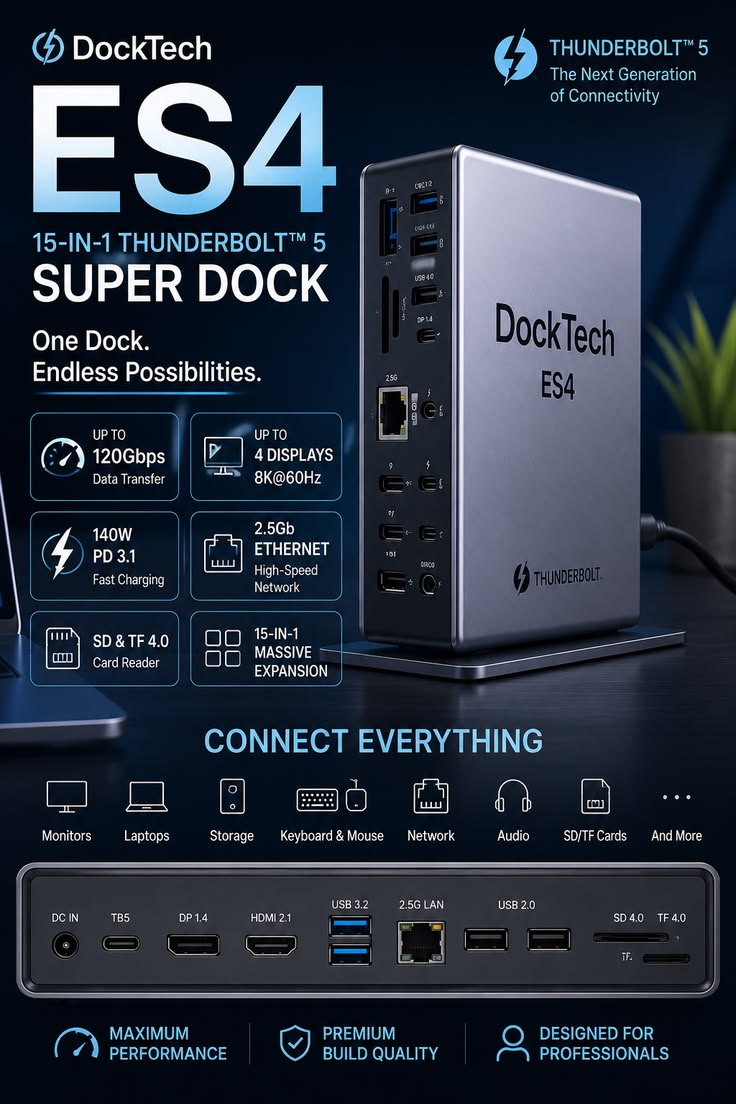
The DockHub Pro 15-in-1, model BYL-2519, is designed around that job. It is described as a best overall charging station, built around 100W USB PD pass-through, full speed laptop charging, support for a laptop plus up to 7 devices, 5× USB-A, 2× USB-C, and triple 4K@60Hz displays through 2× HDMI and DisplayPort. It also includes Gigabit Ethernet, SD, microSD, a 3.5mm audio jack, and an included 600 mm USB-C host cable.
That changes the buying logic. Instead of treating the charger as a simple power brick, you’re buying a work surface hub. The package adds a 30-day money-back guarantee, lifetime support, a price $169.97, and regular $199.99 positioning. My view is simple: if you want a usb-c charging station for multiple devices that also replaces adapters and display dongles, this form factor is far more useful than a decorative pad-based stand.
Who should buy a high-power desktop charging station?
A high-power desktop charger makes sense for people charging several demanding devices at once, especially when laptops are involved. If your setup includes multiple notebooks, tablets, and fast-charging phones, a 60W dock can feel undersized very quickly.
The UGreen Nexode 300W Desktop Charging Station is built for that heavier class of use. Its 300W ceiling is distributed across 4× USB-C and 1× USB-A, with output tiers of 140W, 100W, 45W, and 22.5W on USB-C, plus 22.5W on USB-A. It supports PD 3.1, QC, SCP, FCP, and AFC, and includes a 240W USB-C cable, 1.5 m, plus a 2 m AC cord.
This is the kind of charger you buy because you are tired of triage. The official pricing references $199.99 MSRP and roughly ~$140–200 street, with a 2-year warranty. For power users, the real attraction is not just the headline number but the ability to keep a laptop, another laptop, and accessories charging on one desk without the usual juggling.
Is a USB-C charging station better for modern devices?
A USB-C charging station is usually the better long-term choice if most of your gear already charges over USB-C or is moving that way. The reason is not fashion; it is simpler cabling, broader compatibility with current devices, and better fast-charge potential when the power budget is managed properly.
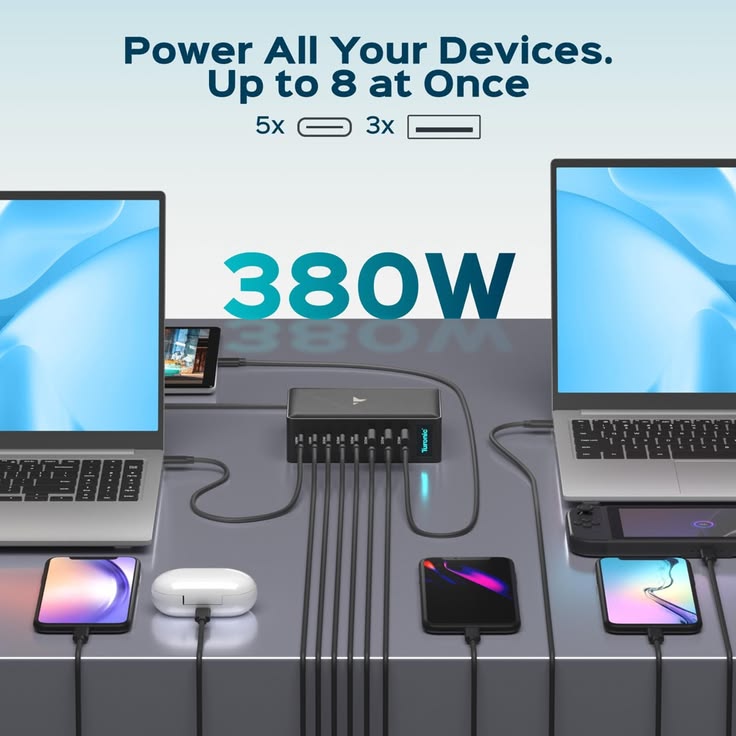
The most interesting example is the Plugable 10-Port USB-C Charging Station, model PS-10CC. It was highlighted as Best Charger, CES 2025, by Tom’s Guide, and it offers 100W shared across 10× USB-C with support for USB PD 3.0 and BC 1.2. The standout feature is PriorityShare, using left-to-right allocation so higher-priority devices start first.
That idea is more useful than it sounds. In mixed daily charging, not everything needs power immediately. The station adds LED status, 50% recycled aluminum, a 2-year warranty, and a price around ~$90. The only real caution is obvious: there’s no USB-A fallback, so older accessories may still need adapters.
What is the best travel charging station for multiple devices?
The best travel option depends on whether you want maximum compactness, a full Apple-friendly foldable, or the lightest two-device solution. Travel chargers live or die by size, not just by wattage.
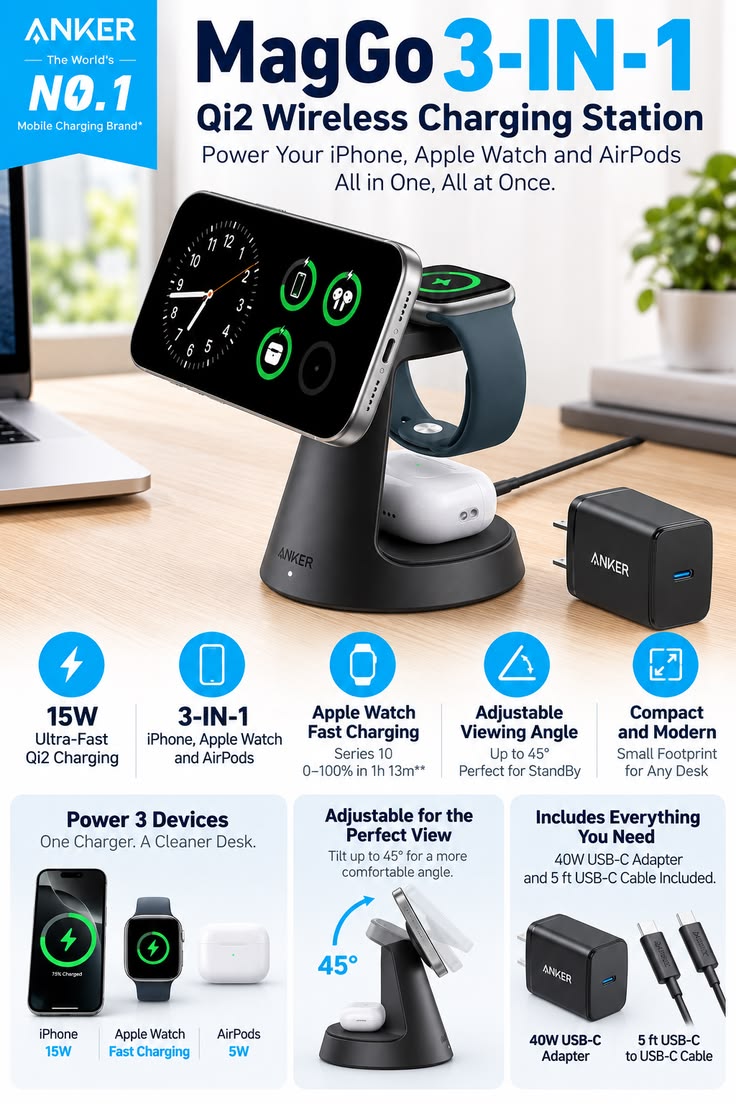
- Anker MagGo 3-in-1: Qi2-certified, supports 15W iPhone charging, Apple Watch fast charging, and a 5W earbuds pad. It folds to deck-of-cards size, weighs 6.9 oz, includes 5 ft USB-C to USB-C and a 40W PD charger, and carries 24 months of coverage.
-
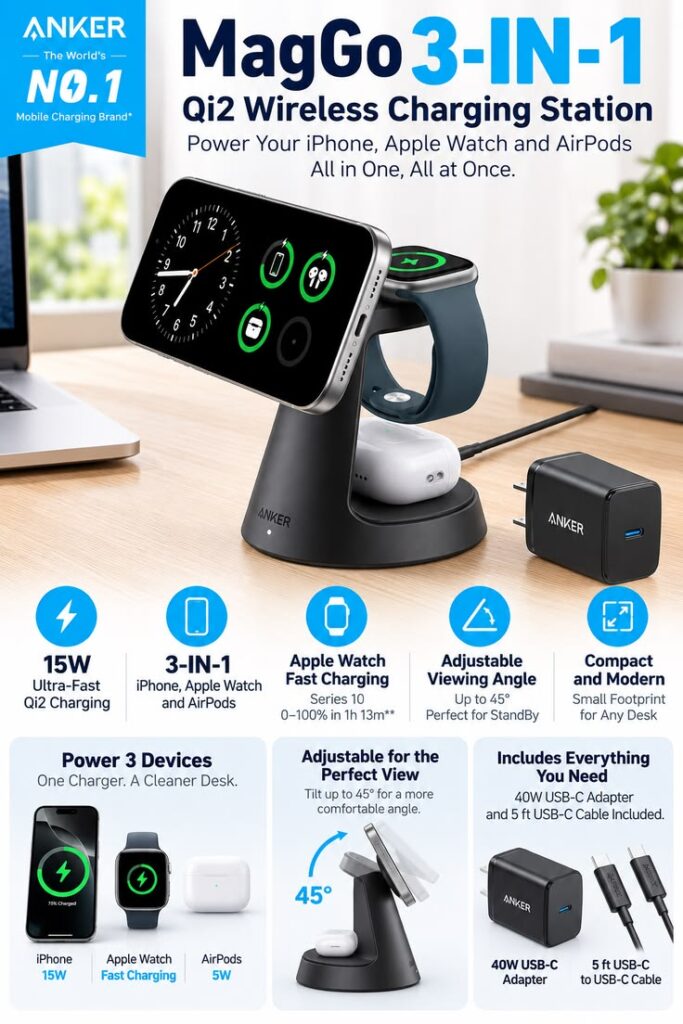
Anker MagGo 3-in-1 Qi2 - Twelve South Butterfly 2-in-1: includes a 15W Apple-certified MagSafe pad, an Apple Watch fast charger, a USB-C cable, 30W adapter, and 4 international plugs. It folds to 2.25 × 1 in.


Twelve South Butterfly 2-in-1 - Mophie 3-in-1 Travel Charger: provides 15W, 5W, and 5W for iPhone, Watch, and AirPods, includes a 30W PD adapter, a 40W Global Edition option, and a travel case, and folds to a 3.3-inch square.
-

Mophie 3-in-1 Travel Charger
From experience, the best travel charger is rarely the most powerful-looking one. It is the one you will actually pack, set up quickly, and use without hunting for an extra adapter in a hotel room.
Which low-cost charging stations are still worth buying?
Several lower-cost chargers are still worth considering, but each one makes a specific compromise. The mistake is expecting a cheap station to behave like a high-output dock; the smarter move is matching the budget pick to a narrow use case.
The Anker PowerPort 6 Wall Charger remains a practical bare-bones option with list price $30, overall score 60, charging performance 8.0, device organization 3.0, number of devices 7.0, and aesthetics 5.0. It has 6 USB ports, 60W, but no device storage, no charge indicator lights, and no included cables. It is compact and inexpensive, though inevitably a bit messy.
For single-device or light wireless use, the Anker PowerWave comes in at list price $26, overall score 53, and 5/7.5/10W output. The ZUBARR Wireless Charging Station lists at $50, scores 60, works with non-MagSafe devices, includes three LED lights, and tops out at 0.7W/5.0W, which explains why it is often described as slow. The Iseyyox Magnetic Wireless 3-in-1 Foldable also sits around $50, scores 57, folds to roughly 3 × 3 × 1 inches, and delivers 1.7W/7.3W for iPhones, Apple Watches, and AirPods.
What works best for schools, offices, and large device fleets?
For schools, offices, and large fleets, the right answer is usually not a consumer charger at all. Once you move past a handful of devices, security, staged charging, and physical handling matter more than whether the station looks elegant on a countertop.
The FUYL Smart Locker System is aimed at more controlled environments, offering 5, 8, 15, 23 bays, 36W USB-C PD per bay, Enhanced towers, and software features like FUYL Portal, remote management, activity logs, alerts, and configurable workflows. That’s a different category from a home dock; it is built for IT teams, schools, healthcare, and hybrid offices that need accountability.
For higher-capacity shared charging, the Carrier Charging Cart supports 20, 30, 40 devices, uses 110V AC outlets, ECO Safe Charge, optional USB-C prewired cabling, a welded steel cart, and a 4-digit combination padlock. The Joey Charging Cart handles 30 or 40 devices with a keyed padlock. Beyond those, there’s the Revolution Giga 40, built for up to 40 devices, AC charging, devices up to 13 inches, and 50% less floor space; the Bretford CUBE Toploader with up to 40 devices and Smart Agile Power; the Ergotron YES36 Adjusta at 24, 30, 36 devices with PowerShuttle; the PowerGistics Core Tower Series at 12 to 20 devices; and Tripp Lite cabinets from 16 to 32 devices using AC pass-through charging.
How much charging power do you really need?
The right wattage depends on what you charge at the same time, not what you charge individually. A station that feels fast for one phone can feel underpowered once a tablet, earbuds, and notebook join the queue.
| Device Type | Typical Need |
| Phone | 15–25W – Light fast charging |
| Tablet | 20–30W – Moderate charging |
| Laptop | 60–140W – High power / PD required |
A lot of confusion starts because people shop by labels like one-stop, electronics, or household convenience and ignore what happens when several items share the same budget. On a desk or nightstand, a charger may look tidy, but power management becomes the real story once every port is active.
That’s why even the top recommendation or budget pick language in buying guides should be filtered through your own setup. A guide may evaluate total power output, number of ports, wireless pads, charging protocols, USB PD, Quick Charge, Qi2, MagSafe, device organization, build quality, and price, but only you know whether your setup is mostly earbuds and phones or a pile of tablets and a notebook.
How important is cable management and device organization?
Cable management matters more than most buyers expect because poor layout quickly makes even a powerful station annoying to live with. A fast charger that creates a tangled mess often gets used less efficiently than a slower but cleaner setup.
In comparative testing, Belkin BoostCharge Pro and ZUBARR stood out for device organization, while among wired options the Soopii Quick Charge 3.0, Poweroni 6-Port, Satechi Dock5, and Hercules Tuff performed well. One practical reason is the inclusion of short 8″-10″ charging cables on some models, while the Satechi Dock5 does not include charging cables, which changes both cost and tidiness.
On the design side, extra touches matter. The SIIG can still organize many devices, but you may need to supply your own charging cables. Meanwhile, models with built-in silicone dividers and non-slip padding do a better job keeping screens upright and reducing that frustrating slide-and-slip behavior I see constantly on flatter hubs.
How many devices should one charging station handle?
A good charging station should handle the number of devices you actually plug in every day, plus a small buffer, without collapsing into slow charging or chaos. Buying too small creates frustration; buying too large can waste money and desk space.
At the smaller end, the SIIG 90W 10-Port USB Station is notable because it charges the most devices in its class with 10 USB ports. The Soopii Quick Charge 3.0, Poweroni 6-Port USB, and Hercules Tuff 6 Port are more modest, handling six devices simultaneously. The Satechi Dock5 is built around five devices, which is enough for many bedside or office setups.
The bigger question is what kind of environment you’re serving. The whole idea of a multi-device charging station is that it is a single unit that delivers power to three or more devices through USB ports or wireless pads. Once you start dealing with shared output, a 90W total budget can be split across several items, and a 10-port station with a 40W budget may still charge everything slowly. The practical divide remains useful: one to five devices, then 10 to 20 devices, then 20 to 40 shared devices.
Does design matter when choosing a charging station?
Design matters because a charger lives in visible space and gets touched constantly, but design should serve function rather than replace it. The most attractive station is still a bad buy if it cannot charge the right gear at the right speed.
Among cleaner-looking options, the Belkin BoostCharge Pro often gets attention for its simple magnetic stand approach for phones, watches, and headphones. That style sets a visual standard many users like, especially on bedside tables. Other strong-looking options include the SIIG 90W, Satechi Dock5, Anker PowerWave, and Apple MagSafe-style stands.
My take is that the best-looking designs usually hide their utility in small structural details. Integrated dividers, a cleaner look, a minimalistic look, and a sleek aluminum design tend to age better in real homes than flashy plastic shapes. If you want a decorative charging station for multiple devices, make sure “decorative” does not mean “underpowered.”
How do charging stations for multiple devices actually work?
Charging stations work by matching device demand to available power, then routing that power through the right connectors and standards. The visible product may look simple, but inside the decision tree is all about capacity, compatibility, and tradeoffs.
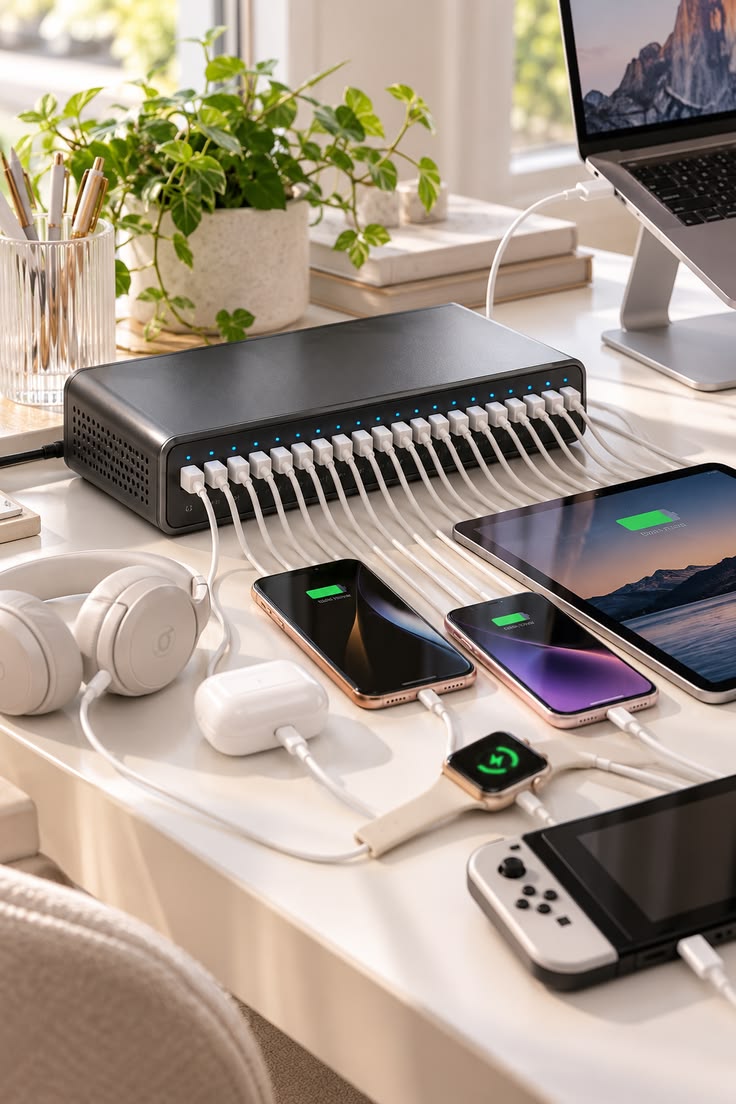
A smart way to evaluate them is to start with power output, upwards of 50 watts, or at least 2.4 amps per port for simpler USB models. Then look at the number of devices, total size, whether you want wired, wireless, or a mix, and whether your priority is faster charging speeds, better compatibility, or easier placement in a small room.
From there, you narrow by station type. If a laptop central device defines the setup, a dock makes sense. If the problem is simply six phones overnight, a wired hub is cheaper. If wireless stands appeal because of their clean look, remember they still rely on a charging coil and often trade speed for convenience. Then come the real-world issues: phone 15–25W, tablet 20–30W, laptop 60–140W, 10W per device limits under shared conditions, USB PD, Quick Charge, Qi2, MagSafe, slots, dividers, thick cases, open charging, lockable carts, cabinets, smart locker, mobility, carts, wall-mounted towers, and even staged charging for overnight charging.
Which type of charging station is best for your setup?
The best type depends on where the charger lives and how devices move through that space. A bedside Apple stand, a kitchen family hub, and a classroom cart solve completely different problems even if they all “charge multiple devices.”
| Setup | Best Fit | Why |
| K–12 classrooms | Joey Charging Cart, Carrier Charging Cart, PowerGistics Core Tower | Better for shared device return and storage |
| Offices, hybrid workplaces | FUYL Smart Locker System, Carrier Charging Stations, Anker Prime desktop charger | Good mix of secure access and desk charging |
| Hospitals, healthcare | FUYL, Tripp Lite | Better for controlled access and larger device sets |
| Events, hospitality | SIIG desktop dock | Handy for shared smaller electronics |
| Enterprise IT | Carrier 40, Revolution Giga 40, locking carts | Better for larger managed fleets |
A best travel charging station for multiple devices is not automatically the same as a home charging station for multiple devices. Likewise, an anker charging station for multiple devices may be perfect on a work desk yet wrong for a family charging station for multiple devices. The closer you stay to the real use case, the better the outcome.
Common questions about charging stations for multiple devices
A few questions come up again and again because buyers are really asking about compatibility, speed, and whether one product can replace several chargers. That is where the differences between station types become more obvious.
A best charging station for multiple devices is rarely universal. A wireless charging station for multiple devices suits lighter Apple-leaning or phone-centric use, while a usb-c charging station for multiple devices makes more sense when newer notebooks and tablets dominate. A charging station for multiple devices amazon search will show everything from travel folds to 20-port hubs, but the safer filter is still your actual device mix.
The same applies to edge cases. A diy charging station for multiple devices can work if the goal is organization alone, but it rarely solves negotiated fast charging cleanly. A best fast charging station for multiple devices needs enough shared wattage. A wall mounted charging station for multiple devices is useful where floor space is limited. And if you specifically want a best charging station for multiple devices apple setup, you’ll usually prefer fewer but more targeted pads over a generic hub with many low-value ports.
What should you know about the Satechi Dock5 before buying it?
The most important thing to know about the Dock5 is that it is a mixed-use organizer first and a laptop-class charger second. That makes it strong for phones, earbuds, and tablets, but not the right choice if you expect notebook-level power from every port.
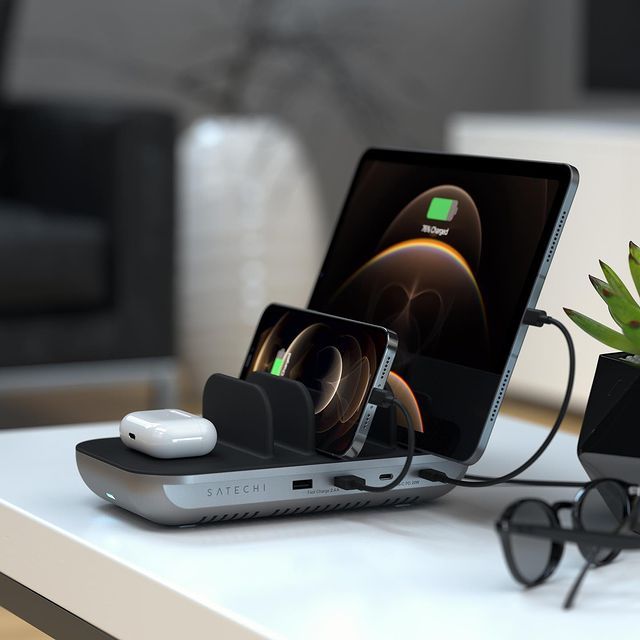
The Satechi Dock5 Multi-Device Charging Station is a strong hybrid when you want both cable and pad charging in one place. It is described in testing as having solid charging all manner of USB devices potential, and evaluation methods in this category often include low-power E-readers, wearables, smartwatches, large tablets, smartphones, unusual loads like illuminated dog collars, and cameras. Reviewers typically compared charging performance, checked maximum discharge rates, used a dummy load, a digital USB multimeter, and charge performance apps, then looked at how many devices it could organize, what additional features it offered, and how much visual appeal it had.
That matters because the Dock5 is best understood as a well-made everyday desk organizer with real charging ability rather than as a universal fast charger. If that matches your routine, it becomes much more compelling.
How were these charging stations evaluated?
The most reliable charging-station evaluations combine electrical testing, real-device charging, and hands-on usability checks. That kind of testing matters because spec sheets alone rarely show what happens when multiple ports run at once.
In stronger review programs, the testers are not just casual buyers. One lead reviewer, David Wise, has a B.S. in Robotics Engineering from MIT and experience with digital circuits, lithium batteries, and underwater autonomous robots. Another, Nick Miley, is a research scientist with a Master’s degree in Environmental Sciences from the University of Nevada, Reno, and also works as a photographer and videographer.
That blend of background is useful because charging gear sits between convenience and engineering. People who have spent years testing consumer products, writing findings, and working for nearly two decades across measurement-heavy reviews tend to notice things average buyers miss, especially around thermal behavior, port sharing, and real use under load.
Why should you trust these charging station recommendations?
You should trust any charging-station recommendation only when it explains the tradeoffs clearly and anchors claims in measurable details. Vague praise is easy; showing how a charger behaves across power, capacity, and organization is harder.
The strongest recommendations here come from a mix of side-by-side testing, spec-backed comparisons, and real-world product framing. One test framework even weights the results explicitly: charging all manner of USB devices is judged through compared charging performance, device handling, organization, and design rather than through marketing copy. Another source frames the problem through shared-family or office use, where 84% of U.S. elementary schools operate 1:1 programs and 90% of middle and high schools operate 1:1 programs, which shows how central dependable charging has become in structured environments.
That mix gives you a better base than any single affiliate list. You get consumer-scale observations, desk-level practicality, and higher-capacity fleet logic without pretending that one charger can do every job.