


The Pons Family launchpad is a working token launch platform run by an identified company, so the sources reviewed do not support calling it a scam, yet none of them reports an audit and any token launched on it can still collapse.
- What Exactly Is the Pons Family Launchpad?
- Is Pons Launchpad Legit, or Is It a Scam?
- Is Pons Backed by Robinhood or Robinhood Chain?
- Is the PONS Token Safe to Buy?
- How Do You Check a Token on Pons for Scam Signs?
- What Are the Risks of Buying New Tokens on Pons Family?
- What Does Graduation Actually Mean on Pons?
- How Is the PONS Supply Structured?
- How Has PONS Performed in the Market?
- Pons Family or Pools Trade: Which Launchpad Is Safer and Cheaper?
- What Should You Check Before Connecting a Wallet to Pons?
- What Is Pons Launchpad?
- Can Pons Launchpad Be Called a Scam?
- Are All Tokens on Pons Family Safe?
- How Can You Spot a Scam Token Quickly?
- Can You Lose Money on New Pons Tokens?
- How Do Pons Family and Pools Trade Differ on Cost?
- Is Pools Trade Run by Robinhood?
- Is the PONS Token the Same Thing as the Pons Launchpad?
Pons publishes its terms of use, names Pons Labs, LLC as operator, and carries risk warnings stating that it does not endorse any token or creator. Those are signs of a real product, not promises of safety. In my own screening routine, I treat them as the start of a check, never the end of one.
Scale is why the question matters. The platform has passed $1.75 billion in trading volume and more than 250,000 tokens launched, mostly as a memecoin launchpad on Robinhood Chain. Behind that activity sit extreme volatility and the constant rug pull risk, so confirm the correct domain, compare every contract address in a block explorer, and treat your own due diligence as mandatory. If a site posing as Pons demands secrets, terminate the process and close the tab.
What Exactly Is the Pons Family Launchpad?
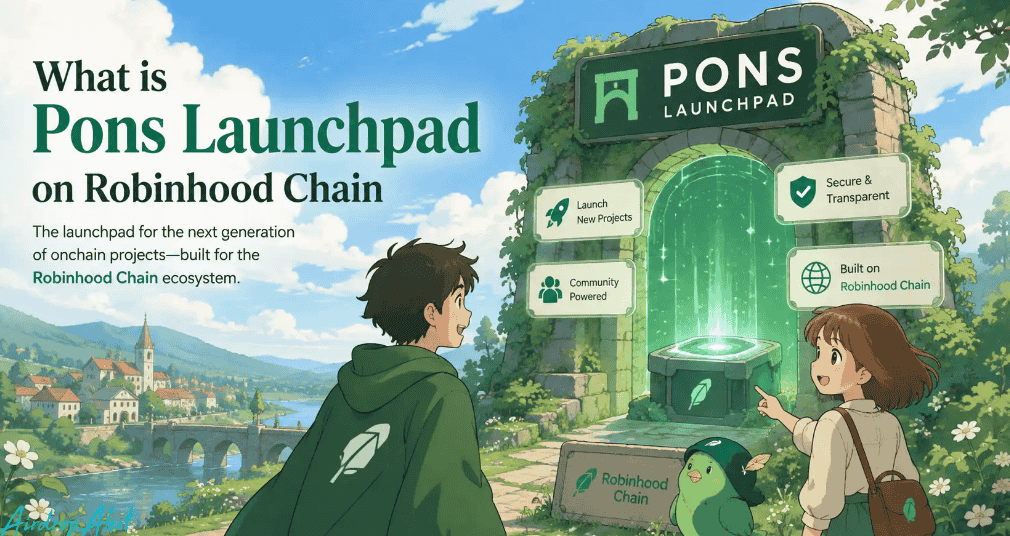
Pons Launchpad is a non-custodial platform on Robinhood Chain where anyone can create and trade tokens from a connected wallet, with no code required. A creator supplies a project name, a ticker, a description and an image, reviews the transaction details, then signs a wallet-approved transaction.
Because Pons never holds user funds, custodian bankruptcy is not the exposure. Its legal documents, effective July 16, 2026, also state it is not a bank or broker. The flip side is that Pons cannot reverse a mistaken transfer.
The platform rose fast. By mid-July it dominated daily token counts, and at one point it held roughly 80% of all launchpad volume on the chain. Reviewers call it the chain’s homegrown champion, and its culture shows in the community participation and social attention around sister tokens.
Whether PONS has a real use case beyond trading is a separate question. The burn mechanisms and the supply cap shape scarcity, but neither proves lasting demand.
How Does a Token Launch and Graduate on Pons?
Pons runs on a bonding curve: creators launch fixed-supply tokens, trading happens along the curve, and a token reaches graduation once it crosses a set threshold.
The creator connects a wallet, fills in token details and approves the launch; contracts then create the token and trading begins. Pons V2, live since August 4, 2026, added an ETH-based curve and a hand-off into a DEX pool at graduation, which means Pons now builds on third-party rails.
Creator earnings rely on fee-sharing: V2 pays creators in the launch pair, launch fees fund PONS buybacks, and token transaction fees are burned. Phemex lists access to launches, rewards and incentives only as possible token functions, not confirmed ones. Graduation itself is a technical milestone driven by mechanics, not a safety rating.
For contrast, a competing launchpad takes only a 0.25% liquidity provider fee, lets creators claim 0.05%, and forces the creator’s purchase into the same block as launch.
Is Pons Launchpad Legit, or Is It a Scam?
Pons Launchpad is legit as a working product but not as a safety promise, because the platform guarantees nothing about the tokens on it. The sources show an active site, an identified operator and risk warnings; they do not show that any token was reviewed.
Pons says it is not a bank, a broker or an investment advisor. Because it sits on a host chain, on-chain transactions are permanent. Platform quality is not network-wide quality, so every token contract needs its own review.
Locked liquidity helps, but verify it. Pons shows liquidity as locked and locks it at graduation, yet confirm the liquidity lock status and any time locks yourself. A rival design keeps liquidity locked for good, with trading fees autocompounding into its liquidity pools. Even a locked pool cannot stop a creator from selling, which is where concentration of ownership hurts.
Graduation sets only mechanical requirements; it is not a security certificate and reveals no team identity. Use contract scanners as a first pass whose value depends on your research quality. Heavy volume may reflect only rapid turnover. On fees, conventional launchpads typically charge around 1%, the yardstick the rival design undercuts.
Is Pons Backed by Robinhood or Robinhood Chain?
Pons is built on Robinhood Chain, but that chain association does not mean Robinhood issues, audits or backs any Pons token.
A token depends on its host ecosystem, including the network’s validation and consensus processes; Pons supplies only an interface on top. Independent teams can build there without implying support.
The chain’s history explains Pons’s size. NOXA, the earlier leader, halted issuance on July 11 after clearing over $12 million in protocol fees. Through July 2026, Pons absorbed that flow and hit 1.65 million trades in a single day. Volume matters less than value, though: market-cap calculations count only tokens in circulation, even when PONS showed about $108 million in 24-hour trading volume.
Competition keeps shifting, since Pools Trade now contests the same traders and broader liquidity may not follow either platform. Traders pattern-match against familiar formats, but an organic community counts for more than headline moves of hundreds of percent.
Is the PONS Token Safe to Buy?
The PONS token is actively traded, but no source reviewed proves it safe: liquidity, volume and a clean scan are not evidence of trustworthiness.
Phemex’s tokenomics review puts 70.9% of supply in the reported circulating figure, with a price near $0.41 at review time. Start from the token’s official page, since malicious contracts can appear under similar names. Many third-party services and compatible wallets touch a token, and each widens the places a mistake can happen.
Ask who holds the treasuries, whether liquidity locks exist, whether the contract was audited, and whether upgradeability or transfer restrictions apply. Phemex flags an information gap, because limited project details make direct checking essential.
PONS is not a Robinhood stock, and Robinhood says its chain runs apart from customer crypto accounts. Open blockchain networks let independent projects deploy without implied backing, and Phemex treats revenue participation and protocol access as unconfirmed rights.
How Do You Check a Token on Pons for Scam Signs?
Check every Pons token as one that must be vetted individually, because names and tickers are not unique and impersonators copy both. Work through these steps in order:
- Compare the contract with the listed address; the PONS token’s is 0x39dBED3a2bd333467115dE45665cC57F813C4571.
- Read the developer wallet history for repeated launches followed by large sales.
- Study holder distribution and related wallets, including any disclosed contributor allocation.
- Run an automated scanner and look for hidden functions, remembering a clean result proves little.
- Buy a tiny test amount from a dedicated wallet, then try to sell it back.
Next, judge the project itself: working social media links, a documentation portal, and no reliance on social-media screenshots. Phemex notes that impersonating tokens can appear, so a name or logo is never enough. Market data is time-sensitive, so refresh it before acting.
Launch volume is enormous. Pools Trade minted roughly 6,000 tokens on day one, beating Flap and Bankr’s daily figures. On any launchpad, a token created through its platform may sit beside thousands of lookalikes, and a price chart alone is not a test.
What Are the Risks of Buying New Tokens on Pons Family?
The main risks are sharp price swings, rug pulls, contract flaws, thin liquidity, manipulated volume, fake sites and total loss of capital; the table pairs several with a check.
| Risk | How it shows up | What to check |
| Price swing | PONS’s intraday range ran between roughly $0.28 and $0.44 | Size positions for loss |
| Contract control | Owner can alter or restrict trading | Contract administrator rights, blacklist or pause function |
| Weak exits | Slippage grows when orders outsize the pool | Test sells with small amounts |
| Imitation | Clone sites request approvals | Bookmark the verified domain |
Code is a separate risk. Smart contracts can block sales, and creators selling ownership drains demand even when liquidity is locked. The developer buy feature gives creators a head start, so inspect the creator wallet before buying.
Hype is another. Influencer promotion and fixed returns are red flags, and tokens such as FRONG can trade like casino chips. A sniper-bot can win launch-block advantages unless the format counters it; failed launches may be refunded under some designs, while conventional launchpads differ. Chain-wide volume fell over 32% in the week around the rival launch, a reminder that the market can cool underneath you.
What Does Graduation Actually Mean on Pons?
Graduation means a token reached its target on the bonding curve and moved into a locked pool; it is a mechanical step, not an approval.
Bittime’s creation page showed a threshold of 4.2 ETH. A token at the graduation stage can still carry risk, so demand proof of liquidity lock on-chain rather than trusting a label.
Graduation does not confirm verified fundamentals or long-term adoption, and memecoin risk remains. Supply questions continue too: about 29% of PONS’s maximum supply sat in non-circulating tokens, so vesting schedules and token unlocks matter. Fragmented liquidity and concentrated liquidity can also make exits harder.
Designs differ. A rival’s Instant Launch goes live at block one, charges a zero launchpad fee, and uses a Uniswap v4 liquidity pool where most of the fee compounds back. A bid-based launch that misses its target is refunded automatically.
How Is the PONS Supply Structured?
PONS has a maximum of 1 billion PONS, and about 708.8 million PONS were reported in circulation when Phemex reviewed it.
On that snapshot, market-data platforms showed a market capitalization near $289 million and a higher full-supply value near $408 million. Pons also runs a buyback-and-burn flywheel, with over 25% of supply already burned.
The unburned remainder still needs scrutiny. Look for minting additional tokens, staking rewards, a published roadmap, and burn addresses separated from the top ten or twenty wallets.
Concentrated ownership raises the odds of a sell-off, while unclear unlocks cloud price discovery. Judge PONS by fundamentals and your own time horizon, not by the headline cap.
How Has PONS Performed in the Market?
PONS has traded actively, but its volume is not proof of healthy demand.
Price tracking on CoinMarketCap places the token near the top of the leaderboard, alongside BRODIE and YOLO. The community is loud, yet trading is split across trading venues, and the PONS/WETH pair is the one Bittime monitored.
Read displayed numbers cautiously. A token with thin liquidity can look strong while being illiquid in practice, and low market depth widens spreads. Ask whether volume reflects organic demand or price manipulation through related wallets, and cross-check reputable market-data providers.
PONS is not the chain’s native coin and may not pay gas fees. No chart shows the price will not go down, so match position size to your risk tolerance; lower-fee venues promise better prices for traders, but the token’s risk does not change.
What Is PONS Actually Used For?
PONS’s confirmed role is limited: it is a capped token on Robinhood Chain, while governance and staking remain unconfirmed in the sources.
Phemex treats possible functions as unproven. V2 launch pairs include stablecoins and tokenized stocks, creators receive a fee share, and decentralized applications may support the token by choice. Bittime lists protocol fee usage transparency as a check.
| Area | PONS token | Native blockchain coin |
| Issuance | Defined by token contract | Defined by blockchain protocol |
| Network fees | May not pay gas fees | Usually pays transaction fees |
| Security role | Depends on host chain | Often involved in network security |
| Utility | Project-specific | Network-wide |
Because project details are not fully independently verifiable, rely on primary evidence such as the contract, and look for centralized controls or multiple signatures. Tokens on a rival pipeline reach MetaMask, Ledger, DEX aggregators and a routing API, and Robinhood says activity runs fully on-chain. Utility may follow a growth process, so keep high-risk activities separate from savings.
Pons Family or Pools Trade: Which Launchpad Is Safer and Cheaper?
Pons Family wins on proven culture and daily activity, while Pools Trade, built by Uniswap Labs and live from August 5, 2026, wins on fees and locked liquidity; neither vets tokens.
At its peak, Pons handled 54% of all transactions on the chain. Its model mirrors the Solana playbook, and Bittime’s page showed a launch fee of 0.0005 ETH.
| Feature | Pons Family | Pools Trade |
| Built by | Independent team | Uniswap Labs |
| Launch model | Bonding curve + graduation | Crowd Launch or Instant Launch |
| Launchpad fee | Standard model | Zero, only 0.25% LP fee |
| Liquidity | Locked at graduation | Permanently locked, autocompounding |
| Creator earnings | Paid in launch pair | Optional 0.05% |
The rival leans on the chain’s primary AMM, and Pons V2 integrates Uniswap V4, so each depends on the other’s rails. Overall DEX volume on the chain slipped in the week around the rival’s launch. Airdropalert calls Uniswap the biggest name in decentralized trading.
Pools Trade is cheaper for traders, and price impact stays modest when liquidity compounds. Its bids reward earlier bids, which blunts market manipulation. Neither blocks dumping; both attract short-term speculation, and a launch trading structure is no recommendation to buy.
What Should You Check Before Connecting a Wallet to Pons?
Before connecting, confirm the exact domain, because Phemex points to pons.family while Bittime and AirdropAlert cite ponsfamily.com.
- Use a self-custody wallet reserved for risky trades; a hacked wallet exposes everything in it.
- Never type a seed phrase; Pons says it never requests private keys or recovery phrases.
- Match the smart-contract identifier and open the official launchpad link only from official project pages, since fake sites copy the look.
- Decline unlimited token approvals, test small amounts first, and note each gas fee.
- Skip anything with a fake countdown, and demand proof for claims of association with Robinhood.
- Risk only what you can afford to lose, never your entire capital.
Degens pattern-match to speed; a careful trader slows down at exactly this step.
What Is Pons Launchpad?
Pons Launchpad is an active platform for launching and trading fixed-supply tokens on Robinhood Chain, backed by legal documentation and wallet-signed transactions. Its PONS token has a cap of 1,000,000,000 units. A token’s name says nothing about whether it has been verified, so check the contract first.
Can Pons Launchpad Be Called a Scam?
No source reviewed supports calling Pons Launchpad a scam outright, because it is live and every action is initiated through user wallets. Still, tokens come from third parties, and presence on Pons says nothing about audits or token selling capabilities. Check the domain before connecting a wallet.
Are All Tokens on Pons Family Safe?
No, Pons does not vouch for the security of any tokens launched on it. A convincing ticker PONS is not automatically the real one. Review admin functionality, treat clean scanner results as partial, and assume dangerous contracts exist until checked, since nothing shows the team verified.
How Can You Spot a Scam Token Quickly?
Start with the contract address, then the creator wallet, holders, liquidity and whether you can sell. Calling Pons itself a scam is not entirely accurate, but no guarantee covers a token’s contract, and complete loss of capital is possible. The project points users to pons.family/launchpad; verify the URL before signing anything.
Can You Lose Money on New Pons Tokens?
Yes, new Pons tokens can lose most of their value within minutes, and Pons warns they may become worthless. Set a stop loss and an exit plan before buying, ask for proof of locked liquidity, and never rely solely on a chart or a scanner.
How Do Pons Family and Pools Trade Differ on Cost?
Pools Trade (pools.trade) charges no separate launchpad fee, only the 0.25% provider fee, while Pons operates independently with its own fee model. Both support launching and discovering tokens and lock liquidity, and creators cannot drain either pool, though dumping remains possible.
Is Pools Trade Run by Robinhood?
No, Pools Trade is built by Uniswap Labs on Robinhood Chain, and Robinhood says its permissionless chain operates independently from customer brokerage accounts, so no commercial support is implied. A Crowd Launch collects bids over a four-hour window and needs a $10,000 fully diluted valuation. Any fully diluted valuation is only a calculation, not backing.
Is the PONS Token the Same Thing as the Pons Launchpad?
No, the PONS token is the native token linked to the platform, and buying it is not a requirement for using the launchpad. As a crypto token categorized under Robinhood Chain, it became one of the largest memecoins there, so holding it is a bet on continued dominance. The independent team’s maximum supply is 1 billion with a circulating supply near 708.8 million, and voting rights are unconfirmed. Check the documentation and the official project channel.