

- T Mobile Locked Phone Restrictions MVNO: Activation Policy And Device Eligibility
- Which MVNOs Are Affected?
- Why T-Mobile Is Enforcing The Restriction
- T-Mobile Locked Phone Unlock Requirements
- How To Avoid T-Mobile Locked Phone Restrictions
- MVNO Locked Phone And BYOD Challenges
- Solutions For MVNO Operators
- Make IMEI Checks Mandatory Before Payment
- Build Device Intelligence Into Your Onboarding
- Change Your Marketing Language
- Launch A Device Program
- Go eSIM-First
- Train Support As Carrier Policy Experts
- Device Locking And The Future Of MVNOs
A T-Mobile locked phone can create unexpected MVNO restrictions even when network compatibility looks suitable. The key issue is activation, because carrier systems may evaluate lock status separately from network technology, coverage, and device compatibility.
An MVNO can use T-Mobile infrastructure while applying separate eligibility checks during activation. Therefore, customers may have compatible frequencies, a working SIM, and strong coverage but still experience rejection because their device remains locked.
The practical difference between network access and device eligibility is frequently overlooked. A locked device may operate normally with its original carrier, yet fail when transferred to another MVNO using compatible underlying network infrastructure.
Before switching service, customers should check the IMEI, carrier, lock status, and intended MVNO. This verification can identify restrictions before payment, preventing unnecessary activation problems, support requests, and unexpected switching costs.
An unlocked device generally provides greater flexibility because customers can compare virtual networks, conventional carriers, pricing, and plans without depending entirely on one provider’s unlocking timeline, payment conditions, or changing activation policies.
T Mobile Locked Phone Restrictions MVNO: Activation Policy And Device Eligibility
The activation policy increasingly separates network compatibility from device eligibility. A T-Mobile locked phone may function normally on its original network while being rejected by an MVNO, even when both rely upon shared infrastructure.
Reports involving Samsung, Google Pixel, and other devices suggest enforcement developed gradually. This explains why customers with apparently similar phones can experience different activation results when using the same network-based virtual carrier.
Older customer experiences create confusion because some locked devices previously worked with participating MVNOs. Historical success does not necessarily indicate current eligibility, particularly when carrier activation systems become stricter or policies are enforced.
The underlying hardware is not necessarily defective when activation fails. Instead, the system can identify a locked phone, compare its eligibility against carrier requirements, and refuse registration before the customer’s selected MVNO service becomes active.
For customers changing providers, an unlocked device is the safer starting point. Confirm SIM compatibility, carrier restrictions, and activation requirements before switching, especially when purchasing used equipment or transferring service.
Which MVNOs Are Affected?
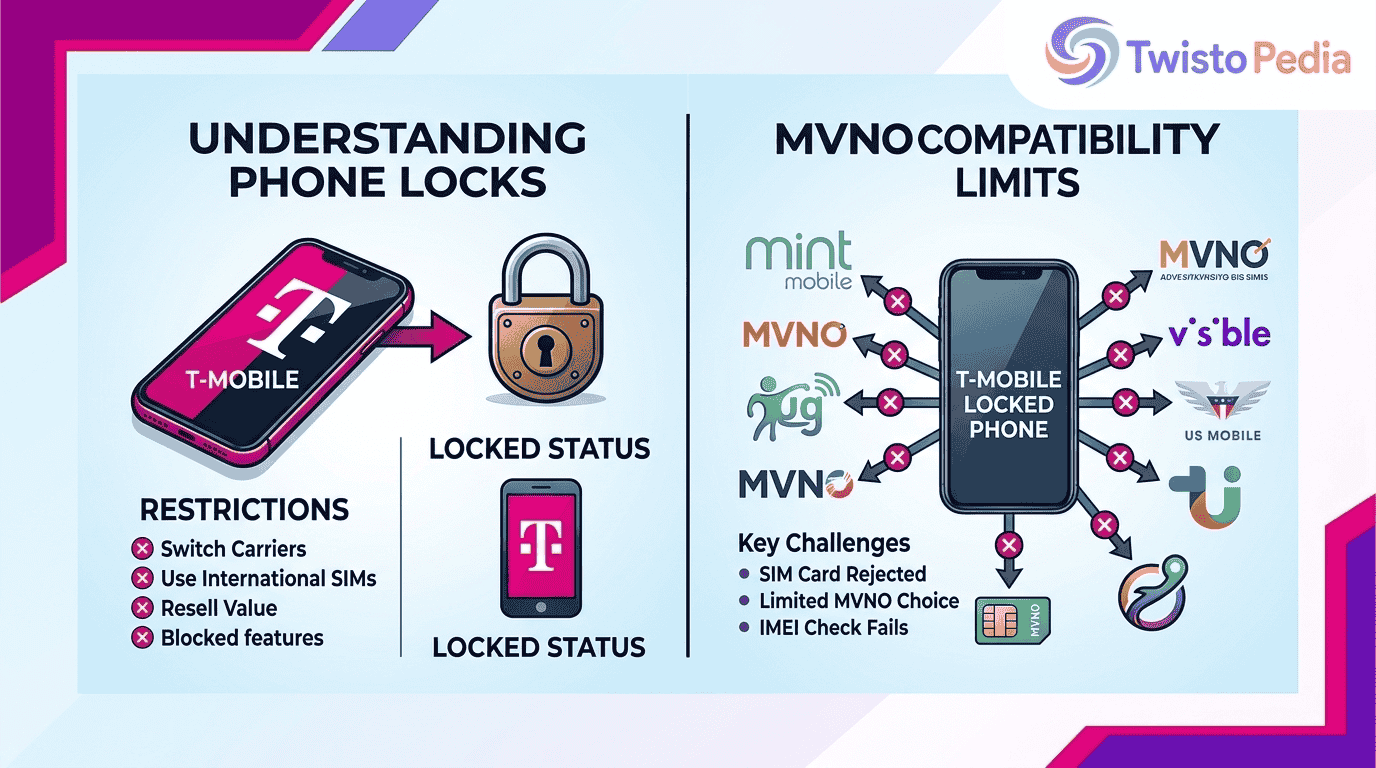
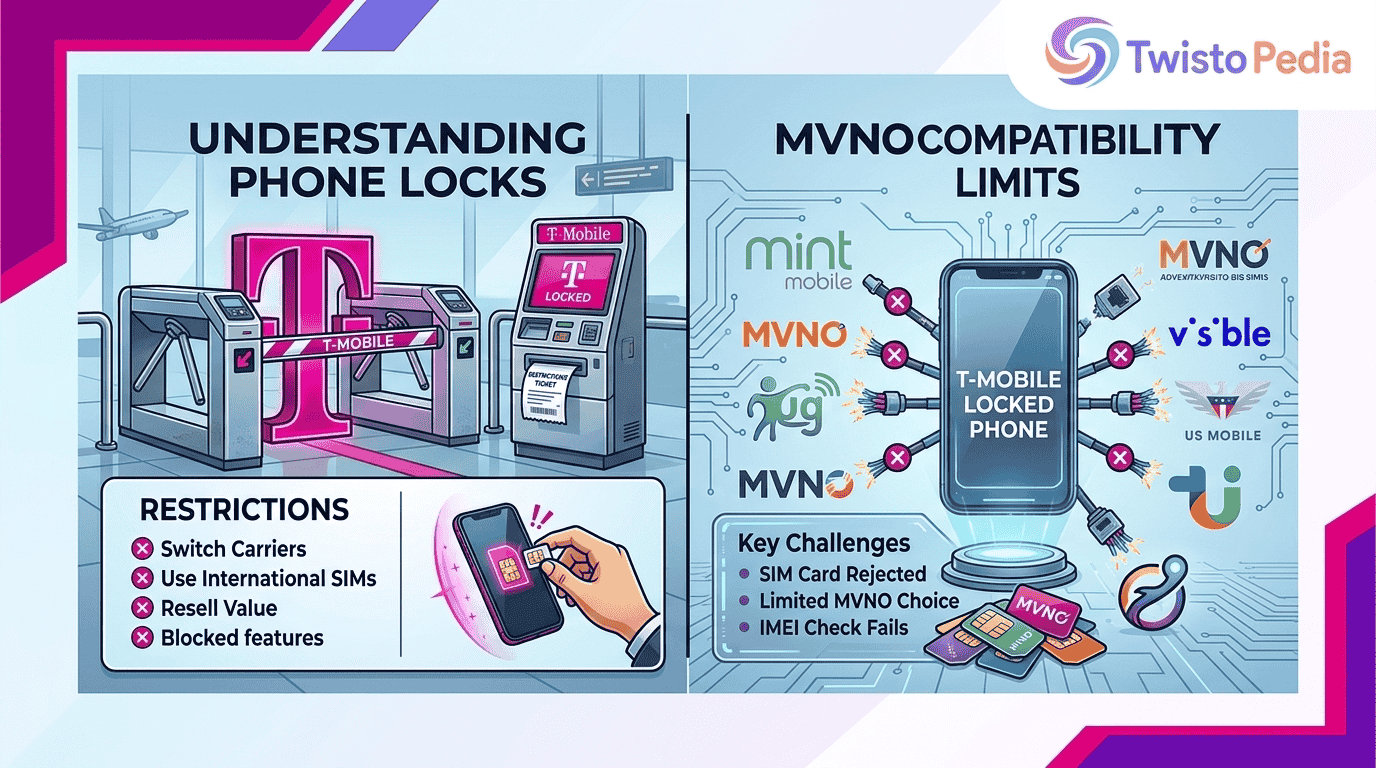
The restriction can affect MVNOs operating through T-Mobile infrastructure, including Mint Mobile, Tello, US Mobile, and Simple Mobile when the customer’s selected plan uses that underlying network for service.
The important factor is not simply the MVNO brand. Customers should determine which underlying network their specific plan uses, because activation rules can differ according to carrier relationships, device status, and applicable eligibility requirements.
A locked T-Mobile phone may therefore work with one service arrangement while failing with another. Checking device compatibility before switching remains more reliable than assuming shared network infrastructure guarantees unrestricted activation.
Customers should distinguish network coverage from activation permission. A phone may support necessary frequencies and receive excellent signal while remaining unusable because its carrier lock prevents registration with the intended MVNO.
When comparing plans, evaluate the device before focusing only on monthly pricing. An inexpensive MVNO plan provides limited value if the existing phone cannot pass activation requirements or requires additional unlocking steps.
Why T-Mobile Is Enforcing The Restriction
The restriction appears connected to stronger enforcement of an existing policy, rather than sudden hardware incompatibility. T-Mobile can evaluate whether a device remains locked before permitting activation through associated virtual services.
From a carrier perspective, device locking can support financing arrangements and encourage customers to satisfy payment or service obligations before moving elsewhere. Enforcement makes those conditions meaningful rather than merely administrative requirements.
For customers, the change may feel newly introduced because earlier activation behavior sometimes allowed locked devices onto compatible MVNO services. Historical access therefore does not necessarily establish permanent eligibility for every device.
An important issue involves the potential loophole created when a locked phone uses the same underlying network. Stronger activation controls can evaluate device eligibility separately from network compatibility during registration.
Customers should therefore avoid assuming successful historical activation guarantees future access. Carrier systems can change, and a previously workable configuration may eventually require an official unlock before MVNO activation.
T-Mobile Locked Phone Unlock Requirements
Unlocking a T-Mobile locked phone generally depends on carrier-specific unlock requirements involving device status, payment obligations, and service history. The exact pathway can differ depending on whether the phone is prepaid or postpaid.
A postpaid device commonly needs sufficient active service and a satisfied device balance. Customers should also ensure their account remains in good standing before requesting an official unlock from the original carrier.
Supported Android devices may offer the Device Unlock app, while other situations can require contacting T-Mobile support. After approval, the phone may require a restart before recognizing its new unlocked status.
Prepaid devices can involve longer eligibility periods or minimum usage requirements. Customers should verify the applicable rule for their exact device instead of relying entirely on generalized unlocking information from older sources.
Once officially unlocked, the customer gains greater flexibility when choosing an MVNO. However, unlocking does not automatically guarantee compatibility, so network bands, SIM support, and device eligibility should still be checked.
T-Mobile Postpaid Unlock
For T-Mobile postpaid service, unlocking generally requires meeting eligibility conditions connected to active service and the device’s financial status. A remaining device balance can prevent approval until applicable obligations are satisfied.
Customers should verify whether the required service period has been completed before requesting an unlock. The relevant line, account status, and device payment history can influence eligibility, timing, and approval.
Supported Android devices may provide an unlock option through the Device Unlock app. Depending on circumstances, an iPhone or another device may require assistance through support.
After selecting Permanent Unlock, customers should follow displayed instructions carefully. A restart may be necessary before the phone recognizes its unlocked status and becomes ready for another eligible carrier.
The safest approach is confirming completion before changing service. An unsuccessful unlock request can leave the device locked, meaning an intended MVNO activation may still fail despite compatible hardware.
T-Mobile Prepaid Unlock
T-Mobile prepaid unlocking follows different eligibility conditions and can require a longer waiting period. Customers should verify their activation date and applicable usage requirements before expecting the device to qualify.
A commonly referenced requirement involves waiting 365 days from activation or meeting a qualifying refill threshold. These conditions mean prepaid customers should plan carrier changes well before their intended switching date.
Another referenced pathway involves accumulating $100+ in qualifying refills. Because requirements can change, customers should confirm the current rule directly with T-Mobile before relying on older eligibility information.
After satisfying the applicable requirement, the customer can contact support and request an official unlock. Approval depends on the device meeting all relevant conditions rather than simply reaching a particular age.
Once unlocked, the prepaid device can provide broader carrier flexibility. Nevertheless, customers should separately verify MVNO compatibility, supported network frequencies, and activation requirements before transferring service.
How To Avoid T-Mobile Locked Phone Restrictions
The simplest strategy is purchasing an unlocked phone from the beginning. This removes dependence on carrier-specific unlocking timelines and preserves greater freedom when comparing conventional carriers and MVNOs for future service.
Customers who already own a T-Mobile-locked phone should check unlock eligibility before purchasing another service. Paying a device balance or completing required service obligations may be necessary before switching.
Buying directly from manufacturers can provide additional flexibility because many retail devices are sold SIM-free and carrier-unlocked. That approach reduces uncertainty when changing providers, testing plans, or moving between wireless networks.
An unlocked Samsung Galaxy, Google Pixel, iPhone, or comparable device can support broader carrier choices. However, unlocked status should still be combined with frequency checks, network compatibility, and activation requirements.
From a budgeting perspective, the cheapest phone is not always the cheapest long-term option. A higher upfront price for an unlocked device can preserve switching flexibility and reduce future activation complications significantly.
MVNO Locked Phone And BYOD Challenges
The BYOD model depends heavily on accurate device eligibility. When customers bring locked phones, an MVNO can spend marketing resources acquiring subscribers who ultimately cannot activate service successfully.
Activation failures create additional support volume because customers often blame the new provider rather than the original carrier. This can increase ticket counts, extend support interactions, and complicate otherwise simple onboarding processes.
There is also a financial consequence. Marketing may attract customers carrying incompatible devices, causing conversion rates to fall while cost per acquisition rises. Resulting pressure can affect provider margins and operational efficiency.
Brand trust is another overlooked issue. A customer who receives a SIM, inserts it, and encounters a lock-related failure may remember the MVNO as unreliable even when another carrier caused the restriction.
For BYOD programs, therefore, device verification should happen before payment whenever possible. Early IMEI validation can identify lock status, blacklist concerns, and other eligibility issues before activation becomes a customer-service problem.
Solutions For MVNO Operators
MVNO operators can reduce activation failures by moving device verification earlier in the customer journey. Checking IMEI, lock status, blacklist status, and network compatibility before checkout provides clearer eligibility information.
Device intelligence can improve onboarding. Real-time information about carrier identification, payment status, and device eligibility APIs helps operators distinguish technical network problems from restrictions caused by the original carrier.
Marketing language should become more precise. Providers can clearly explain that customers need an unlocked phone meeting relevant network requirements before beginning activation, rather than assuming every BYOD device qualifies automatically.
Some operators may reduce dependency on BYOD by offering their own device program. Unlocked refurbished phones, financing options, or affordable retail devices can provide alternatives when an existing phone cannot qualify.
Finally, support teams should understand carrier-specific unlock requirements and activation policies. Clear guidance can turn a frustrating failure into a manageable process, especially when customers need an official unlock before continuing.
Make IMEI Checks Mandatory Before Payment
Making IMEI checks mandatory before payment can prevent customers from purchasing service they cannot activate. The check should identify whether the device is locked, blacklisted, compatible, and suitable for the intended network.
An effective eligibility system should evaluate lock status separately from frequency compatibility. A phone can support every necessary network band while still failing activation because its carrier restriction remains active.
Checking eSIM support adds another useful layer. Although eSIM does not bypass a carrier lock, identifying support early can simplify legitimate activation for customers whose devices already satisfy eligibility conditions.
The strongest workflow performs these checks before checkout rather than after payment. Early validation reduces refunds, failed activations, support requests, and unnecessary frustration during onboarding for customers and providers.
For an MVNO, mandatory IMEI validation is more than a technical feature. It functions as a customer-protection measure that aligns device eligibility with the service being purchased and activated.
Build Device Intelligence Into Your Onboarding
Basic IMEI lookups provide useful information, but stronger onboarding can combine multiple signals. Device eligibility APIs can help identify carrier association, lock status, and other conditions before activation begins.
Real-time information is especially valuable because device status can change after payments, account events, or carrier actions. Static databases may therefore be less useful than systems receiving updated eligibility information.
An MVNO can integrate these checks directly into its onboarding flow. Customers receive immediate feedback instead of discovering incompatibility only after purchasing a plan or waiting for a physical SIM.
Carrier identification also helps support teams understand which provider controls the device. This makes it easier to explain whether the customer needs an unlock, another device, or compatible service.
The objective is not unnecessary friction. Proper device intelligence reduces friction by identifying problems before customers invest money and time into an activation that cannot proceed successfully.
Change Your Marketing Language
Clear marketing language can prevent many BYOD misunderstandings. A phrase such as “Bring Your Phone” may sound universally permissive even when carrier locking makes certain devices ineligible.
A more precise message is “Bring Your Unlocked Phone.” This communicates an important requirement without overwhelming customers with technical explanations about carrier policies, network architecture, or activation systems.
The distinction protects customer expectations. Someone purchasing an MVNO plan should understand that an existing T-Mobile locked phone may require an official unlock before service can begin.
Marketing pages can explain the requirement alongside an IMEI checker. Customers then receive a direct path from advertising to verification instead of discovering restrictions after completing payment.
For providers, clearer language may initially reduce some conversions, but it can improve qualified conversions. Customers understanding eligibility beforehand are less likely to encounter failed activation and unnecessary support interactions.
Launch A Device Program
A device program can help an MVNO reduce dependence on uncertain BYOD inventory. Instead of relying entirely on customer-owned phones, providers can offer devices already verified for intended service.
Unlocked phones create a straightforward starting point because the provider controls initial eligibility assessment. This can make activation more predictable than accepting an unknown device with an unresolved carrier lock.
Refurbished devices can provide lower-cost alternatives. When properly tested and verified, they give customers another option besides expensive new hardware while preserving compatibility with the provider’s intended network.
Financing providers can further reduce upfront barriers. Options such as $0 down arrangements may allow customers to obtain suitable devices without paying the entire retail cost before beginning service.
A device program also creates operational control. Instead of troubleshooting every possible BYOD condition, the MVNO can standardize supported models, software requirements, activation procedures, and customer support around known device configurations.
Go eSIM-First
An eSIM-first strategy can simplify distribution because customers do not always need a physical SIM shipped to them. Activation can become faster when the device and service are already eligible.
However, eSIM does not remove a carrier lock. A locked phone can remain restricted regardless of whether activation uses an electronic profile or a traditional physical SIM card.
That distinction should be communicated clearly. Customers sometimes assume changing the SIM format changes the device’s carrier status, but the underlying lock remains attached to the device’s eligibility.
For eligible unlocked devices, eSIM can reduce shipping costs and shorten activation time. Customers can receive service instructions digitally rather than waiting for a physical SIM to arrive.
This makes eSIM useful as an operational improvement, not a workaround for T-Mobile locked phone restrictions. Providers should combine it with proper device verification and unlock-status checks.
Train Support As Carrier Policy Experts
Support agents should understand carrier-specific unlock requirements instead of treating every failed activation as a generic technical problem. Correct diagnosis helps customers identify whether their phone needs an unlock or replacement.
Training should cover both postpaid and prepaid scenarios because eligibility conditions can differ significantly. Agents should know when customers must satisfy payment, service-duration, or account requirements before requesting an unlock.
A well-trained support team can explain the next step without promising that an MVNO can override another carrier’s lock. That distinction prevents unrealistic expectations and reduces repeated customer contacts.
Agents should also recognize when a device alternative makes more sense. If unlocking is unavailable or inconvenient, recommending a compatible unlocked phone can provide a faster path to service.
This approach turns support into a practical eligibility guide rather than a reactive troubleshooting desk. Clear explanations can protect customer trust even when the underlying carrier policy cannot be changed.
Device Locking And The Future Of MVNOs
Device locking increasingly affects the future of MVNOs because activation eligibility now matters alongside network coverage, pricing, and customer acquisition. The issue is becoming structural rather than merely a temporary inconvenience.
As carrier enforcement becomes more consistent, MVNOs may need stronger verification systems and clearer onboarding. Customers will increasingly expect providers to identify device restrictions before they purchase plans.
The broader wireless ecosystem is therefore moving toward greater emphasis on device intelligence. Lock status, carrier identity, payment conditions, and network compatibility can all influence whether a customer successfully activates service.
From an acquisition perspective, device restrictions can create hidden friction. Marketing may generate demand, but customers carrying incompatible devices can produce failed conversions, additional support costs, and weaker overall customer trust.
The practical future is not necessarily fewer MVNO choices. Instead, successful providers may become better at verifying devices, explaining restrictions, offering unlocked alternatives, and making activation eligibility transparent before customers commit financially.