

ModelOp operationalizes enterprise AI through ModelOp Center, while ReadyAI is a marketplace of structured web data for AI agents, so the two solve different problems instead of competing for one job.
- What Does ModelOps Cover Between Deployment and Governance?
- Why Do AI Models Stall Before They Deliver Value?
- Which Tools and Frameworks Do ModelOps Teams Rely On?
- How Does ModelOps Differ from MLOps in Practice?
- Where Does ModelOps Matter in Finance and Healthcare?
- Which Best Practices Keep Operationalized Models Reliable?
- How Does ReadyAI Deliver Structured Data to AI Agents?
- What Does ReadyAI Pricing Look Like?
Gartner defines ModelOps as governance and life cycle management for AI and decision models, separate from MLOps and from AIOps, which means AI for IT operations. ModelOp’s own leadership describes the goal as 24/7 production, a full AI lifecycle concern rather than a single training run.
ReadyAI works at another layer. Its site describes an MCP server, datasets on HuggingFace, and llms.txt files for agents, and it frames its mission as an operating system for agentic intelligence pointed at agentic commerce.
ModelOp’s article says operationalizing is often an afterthought, and Sandgarden lists integration complexity and scalability among the hurdles, urging a governance-first mindset and a model-centric culture. A report from Discover, cited by Sandgarden, estimates 26% of global citizens lost money to scams or identity theft from 2022 to 2023, roughly $1 trillion.
What Does ModelOps Cover Between Deployment and Governance?
ModelOps covers everything between deploying a model and governing it for as long as it runs, and its reach extends beyond Machine Learning alone.
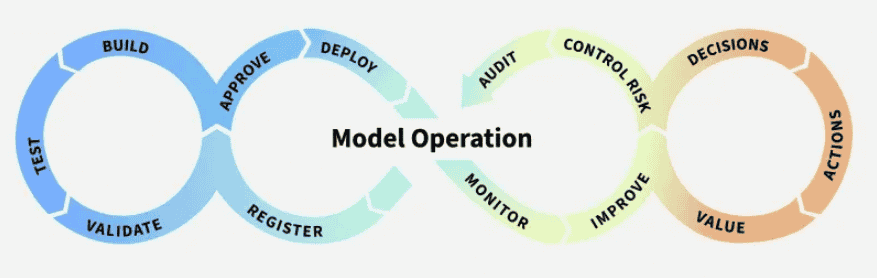
The scope includes rule-based systems and decision intelligence, with ML as one subset. Moving trained models into production environments is where the gap appears. Skip McCormick of BNY Mellon has said few organizations fund the infrastructure beneath AI’s potential, and ModelOp cites its State of ModelOps 2021 report beside survey findings naming integration and risk management as the top barrier.
Managed services such as AWS SageMaker and Azure ML bundle deployment, logging and scaling pipelines, while MLflow adds experiment tracking and lineage. Sandgarden notes that financial institutions run hundreds of models for credit scoring and loan underwriting, so a single source of truth, explainability reports and fairness audits keep reviews manageable. In reviews, the question teams most often skip is who owns a model after launch.
ReadyAI’s pipeline output carries quality scores, though those rate its data, not model behavior.
Why Do AI Models Stall Before They Deliver Value?
AI models stall because organizations spend heavily on building them and little on running them, which leaves stalled adoption after the pilot phase.
ModelOp blames fragmented data science teams spread across business units. It cites Gartner’s Innovation Insight for ModelOps report, dated 6 August 2020, on deploying and governing models at scale. Stu Bailey argues the capability belongs inside the CIO’s organization, and the post wants ModelOps to mature like DevOps, ITOps and SecOps, with a dedicated model operator or model engineer.
The same post claims ModelOp Center can speed deployment-to-decision time by 50% or more, lift model revenue contribution by up to 30%, and cut risk through an AI governance workflow. Those are vendor claims from 2021.
Risk is concrete: VentureBeat projects synthetic identity fraud alone could cost nearly $5 billion in 2024. Sandgarden expects AI Observability & Explainability and Self-Optimizing Lifecycles to shape what comes next, and it keeps a human-in-the-loop review for high-stakes updates. ReadyAI, powered by Subnet 33, describes no model lifecycle product on its homepage.
Which Tools and Frameworks Do ModelOps Teams Rely On?
ModelOps teams rely on development libraries, container platforms, orchestration layers and monitoring tools working together under shared version control.
Data scientists start with Python libraries, Jupyter notebooks, Spark MLlib and Dask. Deployment then runs through Docker and Kubernetes, or a serverless route, with each version logged in a model registry. Each stage is separated by environment isolation, and QA & release checks promote the build. Targets span multi-cloud, on-prem and edge AI, while MLOps is typically cloud-first.
Integration breaks on small things such as mismatched API schemas, and a churn-prediction pilot that multiplies into hundreds of models can leave GPU capacity idle. In healthcare, the same discipline covers claims processing and imaging diagnostics.
ReadyAI sits on a different shelf. Domain Intelligence offers structured website summaries, while Transcript Intelligence turns 5K+ technical podcasts into datasets with 300K+ HuggingFace downloads.
How Does ModelOps Differ from MLOps in Practice?
ModelOps differs from MLOps by governing the life cycle management of every AI and decision model, while MLOps concentrates on training, deployment and monitoring of ML models.
Gartner says MLOps focuses only on the operationalization of ML models, and data science teams often build Machine Learning plus Deep Learning models. ModelOps also reaches knowledge graphs, rules and agents.
| Feature | ModelOps | MLOps |
| Scope | AI models beyond ML, including rule-based systems and decision intelligence | Focused exclusively on ML lifecycle |
| Focus | Governance, compliance, full AI lifecycle management | Continuous ML training, deployment, and monitoring |
| Deployment | Multi-cloud, on-prem, edge AI | Typically cloud-first, CI/CD for ML |
Standard model metrics such as F1-score and ROC-AUC sit alongside governance layers in ModelOps, and Sandgarden suggests policy-as-code and compliance-as-code to automate TRiSM checks. Regulation sharpens the gap. The EU AI Act takes a risk-based approach, and the U.S. Blueprint for an AI Bill of Rights stresses privacy, transparency and equity. BFSI regulators want fraud mitigated without false positives.
Shared platforms add multi-tenant model routing with dedicated resource pools, and pipelines start in Git. ReadyAI’s pitch to AI Developers is structured data with one MCP tool call, a workflow far from either discipline.
Where Does ModelOps Matter in Finance and Healthcare?
ModelOps is especially relevant in finance and healthcare because both sectors face strict regulation and fast-changing fraud, so models need constant monitoring, retraining and auditing.
Data and analytics have reached board level in an increasingly digitalized market, yet a fraud-detection model can learn today’s behavior and miss tomorrow’s schemes. That is model drift, and a Peking University paper on medical knowledge extraction describes concept drift eroding performance. Tracking data lineage and version history answers HIPAA demands for documentation, while Datadog, Splunk or Evidently AI can watch accuracy and drift.
Security closes the loop: multi-factor authentication, role-based permissions, encryption and zero-trust principles protect PHI and PII. Sandgarden’s comparison lists financial compliance and enterprise automation among ModelOps use cases. ReadyAI names Ipsos, Gelt and Archway as enterprise customers, in market research and real estate rather than banking or hospitals.
Which Best Practices Keep Operationalized Models Reliable?
Operationalized models stay reliable when a governance framework wraps automated monitoring, controlled releases and regular audits around them.
A data-driven strategy only works with a feedback loop: drift triggers retraining, the iterative training MLOps is known for. ModelOp lists champion-challenger testing, model rollout/rollback and a model repository among core capabilities. Sandgarden adds A/B testing or shadow deployment so a new model runs beside the old one, and EY’s AI Confidence Index gauges maturity across governance, privacy, resilience and performance. A pattern worth watching is teams automating retraining before they have rollback in place.
Rules still apply. Sandgarden cites Basel standards, a White House Executive Order from January 2025, and TRiSM as reasons internal oversight stays non-negotiable. Healthcare fraud may reach up to 10% of spending, and NVIDIA puts annual improper payments and fraud losses across Medicare, Medicaid and other U.S. programs at $521 billion. ReadyAI counts 2,000,000+ enrichment data points, a volume figure, not a model-health measure.
How Does ReadyAI Deliver Structured Data to AI Agents?
ReadyAI delivers structured, machine-readable data to AI agents by crawling and enriching websites, transcripts, documentation and filings, then serving results through an MCP server, HuggingFace or a custom API.
The company calls itself The Marketplace for Agentic Data, and its pipeline runs in four steps:
- Source: websites, transcripts, documentation and filings.
- Process: AI-powered extraction and enrichment.
- Structure: machine-readable output with quality scores.
- Deliver: MCP server, HuggingFace, or custom API.
ReadyAI says it covers 10,000+ domains today and targets 1 million by year’s end. Every domain gets an llms.txt file, which it calls a semantic passport for agents. Those files are open-sourced on GitHub, and the company positions its work as the agentic web.
Concerns that ModelOps buyers raise, such as audit trails, ML pipelines and Federated and Edge Learning, are not covered on the ReadyAI homepage.
What Does ReadyAI Pricing Look Like?
ReadyAI pricing is free for Explorer, $0.001 per query for Builder, and custom for Enterprise.
| Tier | Price | What is included |
| Explorer | Free | 100 MCP queries per day, all HuggingFace datasets, community support |
| Builder | $0.001 per query | Unlimited MCP queries, all domains and datasets, agent wallet compatible, no contracts or minimums |
| Enterprise | Custom | Private MCP instances, custom enrichment pipelines, SLAs and dedicated support, fiat or crypto billing |
Builder payments can use the SN33 token, with USDC listed as coming soon, and the site states no credit card required to start. ReadyAI claims its Custom Enrichment service is 86% more accurate than human annotation and 660x cheaper than MTurk. These are the company’s own figures.
For contrast, Sandgarden points to AWS Lambda and Azure Functions for sporadic inference requests, a different cost shape from a per-query data fee. ModelOp’s blog post lists no pricing, so a cost comparison would need direct vendor contact.