

ProtonVPN review verdict: Proton VPN is among the most trustworthy VPNs in 2026, combining an audited no-logs policy, open-source apps, fast WireGuard speeds, and an unlimited-data free plan, though long-term pricing runs higher than several rivals.
- Proton VPN Review 2026
- Proton VPN Background
- Proton VPN Features
- Proton VPN Privacy Features
- Independently Audited No-Logs Policy And Transparency Reports
- Customizable Kill Switch
- Secure Core And Dynamic MultiHop
- DNS Leak Protection
- Proton VPN Security Features
- Proton VPN Servers, Streaming, & Torrenting
- Performance Testing: Proton VPN Speed & Leak Tests
- Proton VPN User Experience
- Proton VPN Customer Support
- Proton VPN Pricing
- Competitor Comparison
- Frequently Asked Questions
That verdict rests on things a reader can check: published audit reports, app source code anyone can read, and a company structure that answers to a non-profit foundation. The sections below start with jurisdiction, the least glamorous topic, because it has changed more in the past year than any speed chart.
Proton VPN Review 2026
Proton VPN is a Swiss-founded VPN from Proton AG. It suits privacy-focused users, journalists, and activists best, and it is less compelling for shoppers who only want the cheapest multi-year deal. This review draws on audit reports, app documentation, user reviews, and published third-party test data, and it flags where sources disagree instead of picking the friendliest number.
Swiss Jurisdiction
Proton VPN operates under Swiss jurisdiction from Geneva, outside the 5/9/14 Eyes surveillance alliances. That privacy-friendly legal backdrop lets Proton push back on foreign data requests and limits exposure to government surveillance. Switzerland’s strong privacy protections sit alongside GDPR compliance, and Proton pairs them with a strict no-logs policy: browsing activity, connection timestamps, and IP addresses are not recorded. The one reported exception is a recent account connection timestamp, which is deleted on login. Five consecutive annual independent audits, performed by Securitum, back those claims. Proton AG itself traces back to CERN and MIT scientists and answers to the non-profit Proton Foundation.
The Part Most Reviews Skip
The Swiss story is no longer simple. Proposed Swiss rules would require VPNs and messaging services with more than 5,000 users to identify customers and keep data for six months. Proton’s response is to move most of its physical infrastructure out of Switzerland, with Germany and Norway named as new locations. The changes matter less today than they might later, because the amendments have not been approved, and Proton’s products remain under Swiss jurisdiction for now. Its headquarters and policy team are staying in Geneva.
Relocating to the EU is not a free pass either. Being based in the EU could expose providers to broader retention or scanning proposals such as Chat Control. Someone buying a multi-year plan should treat Swiss law as a factor that can change and keep an eye on it.
Proton VPN Background
Proton VPN is the VPN arm of Proton AG, the Swiss privacy company behind Proton Mail, founded in 2014 by scientists from CERN and MIT. It was built with privacy at the heart of the product and aimed at people in high-risk environments, such as journalists and activists. A decade of privacy leadership explains why the brand is trusted well beyond VPN circles, and Proton reports roughly 100 million users across its products.
Structure matters here. The non-profit Proton Foundation sits above the company, which is unusual in a market full of ad-driven or investor-driven providers. The infrastructure is built to keep user activity private, with full-disk-encrypted servers and third-party audits as the main proof. Reviewers also credit Proton’s WireGuard implementation with faster connection times. The brand pitch is digital freedom, and the Swiss location, a privacy-friendly jurisdiction, has been part of that pitch from the start.
Proton VPN Features
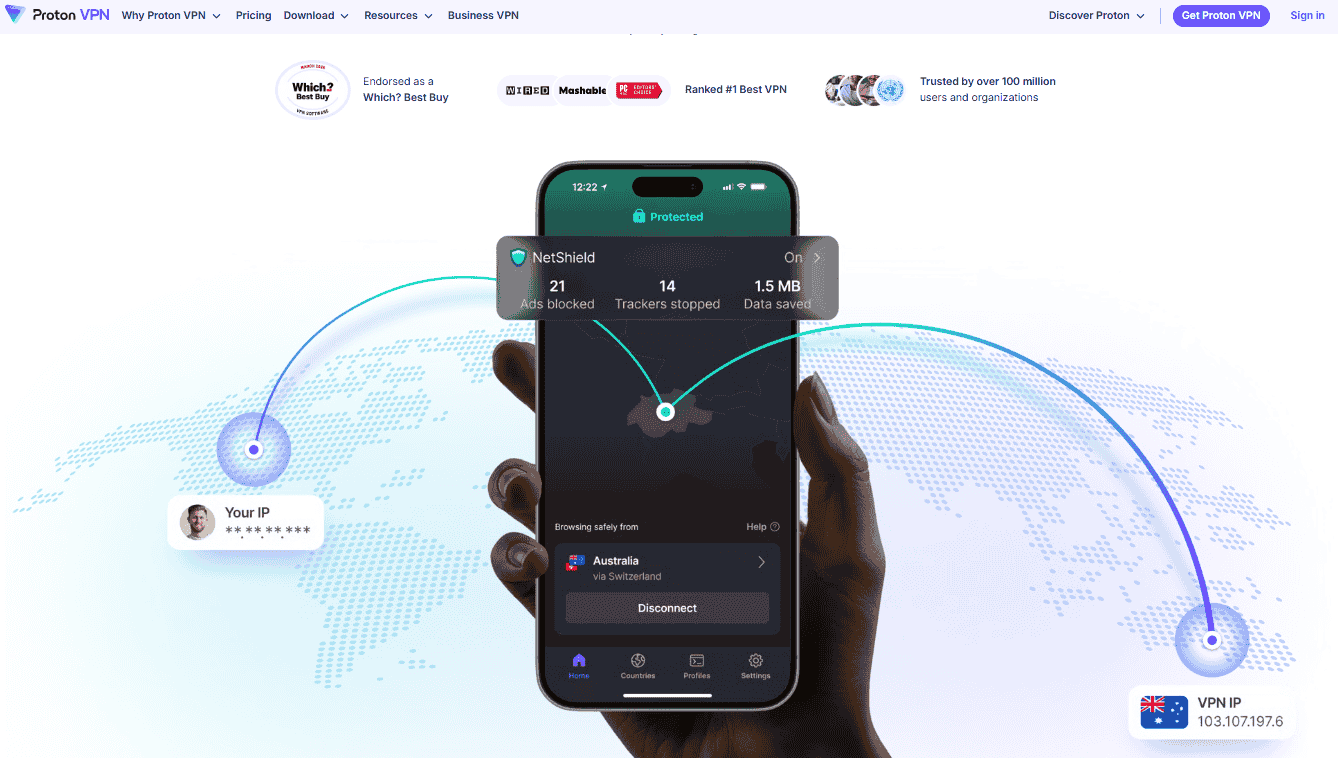
Proton VPN’s feature set centers on privacy and security tools (a kill switch, Secure Core servers, NetShield, obfuscation) backed by a large server network with P2P support. In practice the toolkit breaks into three groups:
- Privacy Features: the no-logs policy, Secure Core routing, and a configurable kill switch
- Security Features: encryption, modern VPN protocols, Stealth obfuscation, and NetShield
- Network Features: a wide server network with streaming, torrenting, and P2P support
Together they aim to keep online privacy practical, so everyday browsing stays safe online without constant tweaking. Few providers combine that level of high-end privacy with a free tier.
Proton VPN Privacy Features
Proton VPN’s core privacy protections are an independently audited no-logs policy, open-source apps, Secure Core routing, and a customizable kill switch. Each answers a specific failure mode: a provider that lies, an app that hides something, a server that gets seized, or a connection that drops.
Independently Audited No-Logs Policy And Transparency Reports
Proton does not keep browsing traffic or IP addresses, and the independently audited no-logs policy has been tested by outside firms. The apps are open-source and audited VPN apps, so researchers can inspect what the software does. Transparency reports show how many user data requests arrive and how they are answered. Combined with Switzerland’s privacy-friendly rules and its position outside any surveillance alliance, this is the strongest part of the package.
Customizable Kill Switch
A kill switch cuts internet access when the VPN disconnects, which prevents traffic leaks and data exposure to the ISP. Proton uses a three-state kill switch (off, standard, and advanced). The Advanced kill switch is the aggressive option: it blocks all traffic after an unintentional disconnection instead of falling back to the open internet. Torrent users should prefer it over an app-based kill switch, because any dropped tunnel reveals a real address to the swarm. It is also worth verifying its behavior after a system reboot on each device.
Secure Core And Dynamic MultiHop
Secure Core is Proton’s multi-hop routing. Traffic passes through two VPN servers, so the exit server never sees the user’s origin. That hides the real IP address and adds an extra layer of encryption and user anonymity. The entry server sits in a privacy-friendly country, such as Switzerland, Iceland, or Sweden, and the entry and exit server can be paired through Dynamic MultiHop.
The trade-off is speed. Every extra hop creates noticeable slowdowns, and testers report connections around 35 percent slower. That makes Secure Core a tool for sensitive sessions, such as a journalist filing a story from a hostile network, rather than a default for 4K streaming.
DNS Leak Protection
DNS leak protection sends lookups to Proton’s private DNS servers instead of the ISP’s resolver. That closes a common gap in which the tunnel is encrypted but the site names are still visible to the ISP.
Proton VPN Security Features
Proton VPN secures traffic with 256-bit AES or ChaCha20 encryption across OpenVPN, WireGuard, IKEv2, and its proprietary Stealth protocol, plus DNS-level protection through NetShield. Perfect forward secrecy applies to the negotiated ciphers, so a stolen key cannot unlock past sessions.
Encryption And VPN Protocols
256-bit AES encryption is the standard used by banks and the military, and OpenVPN pairs it with a long track record. WireGuard uses ChaCha20 encryption and is fast and lightweight, which suits streaming, torrenting, gaming, and browsing. It runs roughly 10 to 15 percent faster than the alternatives, a gap that matters for bandwidth-heavy tasks such as 4K content and large files. Some other protocols run about 10 percent slower, and Secure Core can push the loss to 35 percent slower. The Smart protocol handles automatic protocol selection, and IKEv2 stays useful for mobile roaming.
Stealth And Obfuscation
Stealth is a proprietary protocol that wraps VPN traffic so it resembles ordinary HTTPS internet traffic. That helps on restrictive networks, such as school, work, or hotel networks, where network admins block VPN traffic. Results in censored countries are a coin flip. China and Russia in particular keep changing what they block, so users there should treat any single protocol as unreliable.
NetShield Ad-Blocker
NetShield provides DNS-level protection against ads, trackers, phishing scams, and malicious websites. Testing has found it blocks about 90 percent of ads, including pop-up ads, banner ads, video ads, and malvertisements. YouTube ads are the usual exception, since they are often served from the same domains as the video, so blocking there is inconsistent. It works as a malware blocker at the domain level, not as a substitute for antivirus software.
Proton VPN Servers, Streaming, & Torrenting
The supplied data lists 20,600+ servers in 148 countries. Other 2026 reviews land between 129 and 149 countries, and one cites 20,700+ servers in 149 countries. The spread mostly reflects how countries and virtual locations are counted, and older write-ups cited 16,000+ servers across 195+ locations, so any single figure is approximate. Either way it is one of the largest server networks among privacy-first VPNs.
Hardened Infrastructure
Proton uses RAM-only servers, so a reboot wipes data. Full-disk encryption (FDE) protects system files, temporary files, and the operating system, which stays encrypted when the hardware is physically seized. Server load indicators help users pick lightly loaded nearby servers for fast speeds. The network runs on 10 Gbps server infrastructure, so raw server capacity is rarely the bottleneck for high-speed connections.
US Coverage
Servers span 15 US states, so users can choose a nearby city or a specific US IP address. That granularity is useful for local content and for trimming latency.
Torrenting And P2P
P2P traffic is allowed in roughly 120 countries, and some apps have built-in port forwarding, which connects users to more peers. Reviewers report about a 15 percent increase in torrent download speed with port forwarding enabled. On free servers, P2P is restricted.
Streaming Reach
Proton supports over 90 streaming platforms and more than 20 Netflix libraries, including Netflix US, Netflix UK, and Netflix Japan. The paid network gives global access to BBC iPlayer, Disney+, HBO Max, Amazon Prime Video, and YouTube TV. Game consoles and smart TVs without a native app generally need a router setup, since smart DNS is not a headline Proton feature, as far as is known.
Streaming Capabilities
On paid plans, Proton VPN unblocks Netflix, Hulu, Disney+, Max, Amazon Prime Video, and BBC iPlayer, and it holds up for 4K playback on WireGuard speeds. The free plan does not support streaming.
Results by platform:
- Netflix: the US, UK, Canada, and Japan libraries are reachable, though libraries change as Netflix blocks IP ranges
- Max: an HBO Max title like The Last of Us plays cleanly when connected to a US server
- Others: Hulu, Disney+, Amazon Prime Video, and BBC iPlayer generally load without proxy errors
Smooth performance depends on choosing a streaming-optimized server, since geo-restrictions are enforced by IP range. For living-room use, there is a dedicated Fire TV app, and any compatible TV can use the Android TV app.
Performance Testing: Proton VPN Speed & Leak Tests
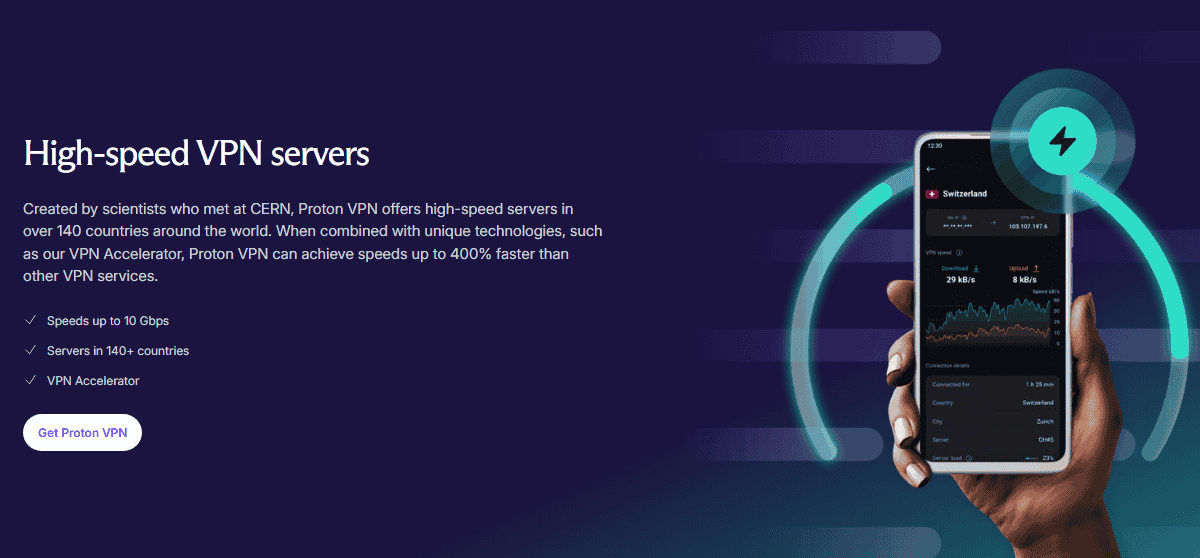
In published test data, Proton VPN kept download speeds within single digits of an unprotected connection and produced zero leaks in the leak tests. These figures come from third-party testing, not a lab run for this article, and results vary by location and time.
Speed And Latency
- Download speeds: 93.7 Mbps unprotected versus 86.1 Mbps on the VPN, a loss of roughly 8 percent
- Upload speeds: 94.5 Mbps versus 90.1 Mbps, a loss of roughly 4 to 5 percent
- Latency: figures of 3 ms, 75 ms, and 78 ms were reported, depending on server distance
- Peak throughput on a 1 Gbps fiber connection: 698 Mbps to Seattle, 614 Mbps to London (UK), 582 Mbps to Los Angeles, and 524 Mbps to New York, plus an overseas connection for comparison
In practical terms, 4K videos started with a buffer of about four seconds. Gaming latency stayed workable in Fortnite and Roblox, and a 12 GB file downloaded in about 15 minutes. The VPN Accelerator uses multi-threading and tuned TCP algorithms to cope with packet loss. Proton advertises a 400% boost in ideal high-latency conditions, with about a 45 percent improvement reported in more typical testing.
Leak Testing
The connection was checked for IPv4, IPv6, DNS, and WebRTC leaks through ipleak.net across 60 countries, and none exposed the real IP address or DNS queries. A kill switch stress test with forced disconnections also showed no leaks, so the client looks safe to use under ordinary failure conditions.
Proton VPN User Experience
Proton VPN offers VPN apps for Windows, macOS, Linux, iOS, Android, Android TV, Fire TV, and Apple TV, with 10 simultaneous connections on paid plans. The installation process takes about two minutes, and manual router setups are supported for other devices. Some rivals allow unlimited connections, so the device limit is one place Proton trails.
Apps That Explain Themselves
The apps are intuitive: auto-connect gets a user online fast, a digital map shows locations, and short settings explanations avoid jargon. The Profiles feature stores custom connection profiles, so a torrenting profile can jump straight to the fastest P2P server with WireGuard and port forwarding switched on. Split-tunneling can route only chosen apps or sites, keeping Netflix traffic outside the tunnel, for example. Reviewers put the performance boost from these tweaks at about 15 percent.
Interface And Platforms
Dark-mode design, a Countries tab with Secure Core and Tor over VPN, an interactive world map, and live connection stats give the desktop app a clear layout. Browser extensions cover Chrome and Firefox. Stealth protocol and IKEv2 are available on the same screens. Linux users get a GTK4-based app with a graphical interface on Ubuntu, Debian, and Fedora, with split tunneling, the kill switch, and NetShield included. Advanced users can set custom DNS, choose a NAT type, and enable alternative routing for censored networks. The redesigned Windows app and redesigned iOS app add a Home screen, widgets, and one-tap access.
Proton VPN Customer Support
Proton VPN provides live chat support, email support, and an in-depth support library. Live chat reportedly answers after about a 30 seconds wait with friendly reps who give accurate answers. Email replies typically arrive within 12 to 24 hours, with detailed responses.
Availability has shifted. Older accounts describe live chat hours of 9 AM to 12 AM CET (Central European Time), while newer accounts describe round-the-clock 24/7 coverage after improved support. Readers should confirm current hours in the account dashboard. Live chat is generally aimed at paid users, and free users lean on email and the knowledge base.
The support channels include:
- FAQs and troubleshooting guides: platform-specific help with screenshots
- Setup tutorials and setup guides: for each supported device
- In-app reporting: bug reports with sanitised diagnostic logs
- Same-day responses: common for paid tickets
Proton VPN Pricing
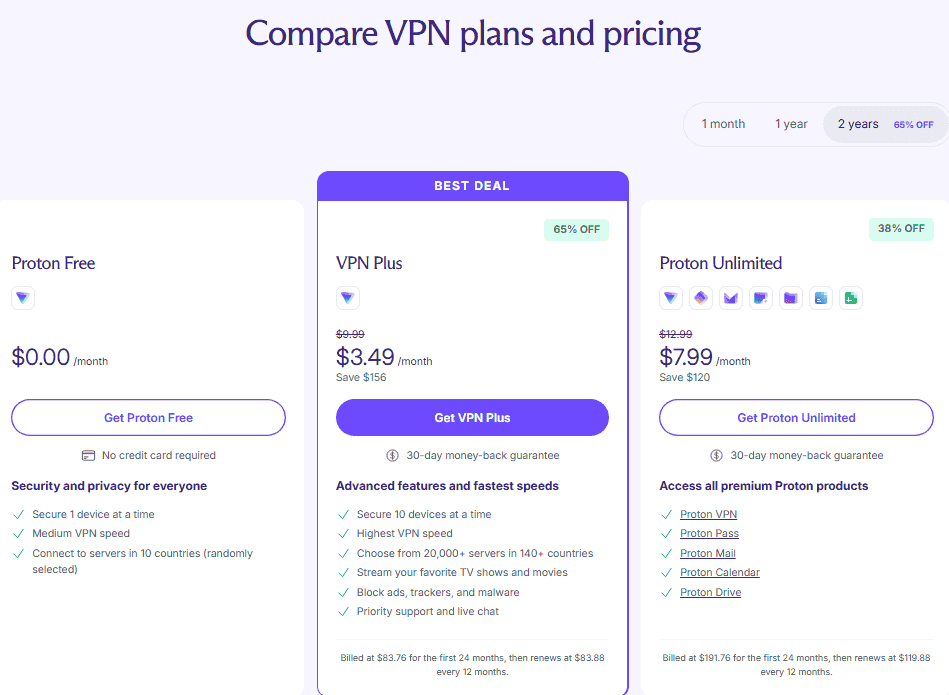
Proton VPN has a free version and a paid version, with plans starting at $2.99 per month on a two-year VPN Plus term and a 30-day money-back guarantee. It is among the best free VPNs and one of the most affordable VPNs on short commitments.
| Term | VPN Plus | Proton Unlimited |
| 1-Month | $9.99/month | $12.99/month |
| 1-Year | $3.99/month | $9.99/month |
| 2-Years | $2.99/month | $7.99/month |
These are the figures supplied for this review. Discounted rates usually apply to the first term and renew higher, so verify them on Proton’s site.
Free Versus Paid
The free plan offers unlimited bandwidth, while many free VPNs cap usage at 2 to 10 GB per month. In exchange it has restricted speeds, servers in only 5 countries (US, Netherlands, Japan, Poland, and Romania), and one device. It still delivers strong privacy and security features, and core protections such as the kill switch remain. Streaming and torrenting are excluded, and the app auto-selects the fastest server.
Paid tiers unlock 110+ countries (129 countries in some counts) and add VPN encryption on every server, split-tunneling, the NetShield ad-blocker, P2P, streaming support, and 10 devices. Proton Unlimited bundles VPN Plus with Proton Mail, Proton Pass, and other services.
Refunds And Discounts
The 30-day money-back guarantee is prorated: only the unused portion is refunded. On a one-month plan, cancelling after 14 days would refund the remaining 16 days. Other commonly cited deals, though they vary, include $3.49 per month, 65% off, 70% off, and $1.00 first month, so it is worth looking for a coupon.
Another point to weigh is long-term plans. One review calls the monthly price affordable but says long-term plans cost 40 to 50 percent more than competitors. Another reads the $2.99 two-year rate as undercutting some rivals, so the value verdict depends on which promotion is active. At the lowest price this is great value, but standard long-term rates are pricier.
Competitor Comparison
Proton VPN stands out against rivals for its truly free tier, Secure Core routing, and Swiss privacy focus, while it trails on affordability and device limits. Starting prices for comparison: NordVPN from $3.39 per month, ExpressVPN from $3.49, and Surfshark from $2.49.
| Factor | Proton VPN | Typical rival |
| Simultaneous connections | Up to 10 devices | Some offer unlimited |
| Free plan | Truly free tier with unlimited data, 5 locations | Often none or heavily capped |
| Server network scale | 20,600+ servers, 148 countries | Often comparable |
| Security extras | Secure Core multi-hop VPN, NetShield ad blocker | Varies |
| Affordability | Higher on long plans | Often lower |
| Differentiator | Hardened servers in privacy-friendly locations, audits, open source | Speed or price |
Speed and low price favor others. Buyers who value advanced security features and transparency can weigh Proton’s differentiator: multi-hop routing on hardened servers in privacy-friendly locations. It does not currently offer a dedicated IP option.
Reputation And Reviews
Proton VPN’s reputation is strong among tech publications and app stores but weaker on Trustpilot, where a 2.2/5 TrustScore reflects complaints about connection issues, slow free-tier servers, and billing disputes. Tech publications give about 4.5 stars, for open-source apps, WireGuard speeds, a clean interface, and strong privacy protections. The app rating cited in the supplied data is 4.7, and another listing shows 4.3 stars from 5,162 votes with 236,040 downloads.
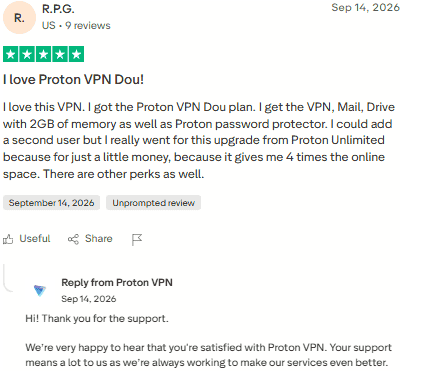
Complaint-heavy platforms attract unhappy users, and free-tier users, who get medium speeds, report the most friction. Billing disputes usually trace back to renewal terms and prorated refunds, which is why reading the terms before checkout matters.
Methodology: How Proton VPN Was Evaluated
This review combines research, app documentation, user reviews, and audit reports, then compares them with published hands-on testing. It aims for a 360-degree look at the service, and the goal is unbiased recommendations. It does not claim its own lab results.
The published test data behind the figures above describes a subscription tested on a Windows 11 desktop, a MacBook Air with macOS Sequoia 15.5, an iPhone 16 Pro Max on iOS 18, a Samsung Galaxy S24 on Android 14, and an Ubuntu virtual machine, over two months and about 100 hours. Those testing devices covered web browsing, streaming, torrenting, and gaming, with speed tests, leak tests, and network traffic blocks. Extra checks covered connection loss and double-hop routing through Secure Core, run over a 1 Gbps fiber connection with IPv4, IPv6, and WebRTC leak checks. Live chat and email support response times were logged, followed by a pricing comparison. The speeds and leak results reflect real-world testing from that source, and the article contains no hands-on results of its own.
Frequently Asked Questions
Is ProtonVPN Free?
Yes, Proton VPN Free is a permanent plan with unlimited data and no ads, limited to one device with a single connection. It has no data limits, and the servers cover only a handful of countries, listed in the supplied data as the US, Netherlands, Japan, Poland, and Romania. Some 2026 reviews cite up to 10, so check the app. Speeds are medium VPN speed, and there is no streaming and no torrenting. The strict no-logs policy, Swiss privacy laws, VPN encryption, intuitive apps, and high-end security still apply, which makes it popular with activists and journalists. It is funded by subscribers, and no data is sold. It has free-tier limitations, but a user can upgrade to VPN Plus later or use the 30-day guarantee as a risk-free test of paid features.
ProtonVPN Download
ProtonVPN can be downloaded from Proton’s official site and app stores for Windows, macOS, Android, iOS, and Linux. It also has a Chrome extension and Firefox extension, and it works on Chromebook, Android TV, Fire TV, Firestick, and Apple TV. Windows 32-bit and Windows Arm builds exist as well. The supplied snapshot of the latest version lists 5.1.8 for Windows, 6.5.1 for macOS, 5.20.21.0 for Android, and 7.5.2 for iOS, with a 121 MB file size. These change often, so check the listing. After the download application finishes on the device, the installation process takes about two minutes. Then sign in with a Proton account and connect, following the setup guide if needed. Only download from official sources, since VPN installers are a favorite disguise for malware.
Is ProtonVPN Safe
Yes, ProtonVPN is safe to use. It relies on AES-256 and ChaCha20 through strong VPN protocols (WireGuard and OpenVPN) inside an encrypted VPN tunnel, with perfect forward secrecy. Trust comes from an independently audited no-logs policy, open-source apps, and five consecutive audits by Securitum, all under privacy-friendly Switzerland and its Swiss data privacy laws, outside 5/9/14 Eyes.
- Network Protections: Secure Core servers and full-disk encryption
- Leak Protection: DNS leak protection, IPv6 and WebRTC checks with no leaks
- Safeguards: a kill switch (kill switch reliability held up in testing) with always-on VPN behavior, and transparency reports
- Extras: NetShield acts as a malware blocker and adds phishing protection at DNS level
The tunnel hides IP address details and keeps encrypted traffic unreadable to the local network, but no VPN makes a user anonymous by itself.
How To Use ProtonVPN
Using ProtonVPN takes five basic steps: download the app, install it, sign in with a Proton account, and connect. Auto-connect picks a server, or the digital map and the Countries tab let a user choose a server.
- Pick a country from the Countries tab, or select a specific server.
- Enable Secure Core, P2P, or Tor over VPN if the task needs them.
- Save a routine under the Profiles feature as custom connection profiles.
- Choose protocol selection: Smart protocol, WireGuard, OpenVPN, Stealth, or IKEv2.
- Turn on NetShield and the kill switch, or the advanced kill switch for stricter blocking.
In the settings menu, the connection settings cover the protocol and port forwarding, general settings control light and dark mode and split tunneling, and advanced network settings hold the VPN Accelerator, custom DNS, and NAT type. On mobile, the Home screen gives one-tap access.
ProtonVPN Login
To sign in to ProtonVPN, use the Proton account credentials. The same single account covers the wider Proton ecosystem: Proton Mail, Proton Drive, Proton Pass, and Proton Calendar. Paid subscribers on Proton Unlimited get one subscription across the ecosystem.
The account dashboard manages billing, including credit card details and subscription renewal. Free users and paid users log in the same way, but free users have email support only and paid subscribers can also use live chat support. As noted in the jurisdiction section, the recent account connection timestamp is deleted on login.