

An ActiveCampaign review has to start with the basics: ActiveCampaign is a cloud-based marketing and sales automation platform that blends email marketing, a built-in CRM, SMS, and WhatsApp messaging into one system used by roughly 180,000 businesses in 170 countries. Independently researched and not sponsored, this guide draws on G2, Capterra, and TrustRadius data (research updated through late 2025 and verified against current 2026 listings) to give business owners an honest, ahead-of-the-curve look at what the tool actually does well — and where it stumbles.
- ActiveCampaign Review
- What Makes ActiveCampaign Different
- Key Features Overview
- Create Forms and Popups to Generate Leads
- Send Email to Share News, Educate and Sell
- Use Marketing Automation for Lead Capturing and Nurturing
- Use Sales Automation to Close Deals Faster
- ActiveCampaign Key Features
- Automate Every Marketing Channel
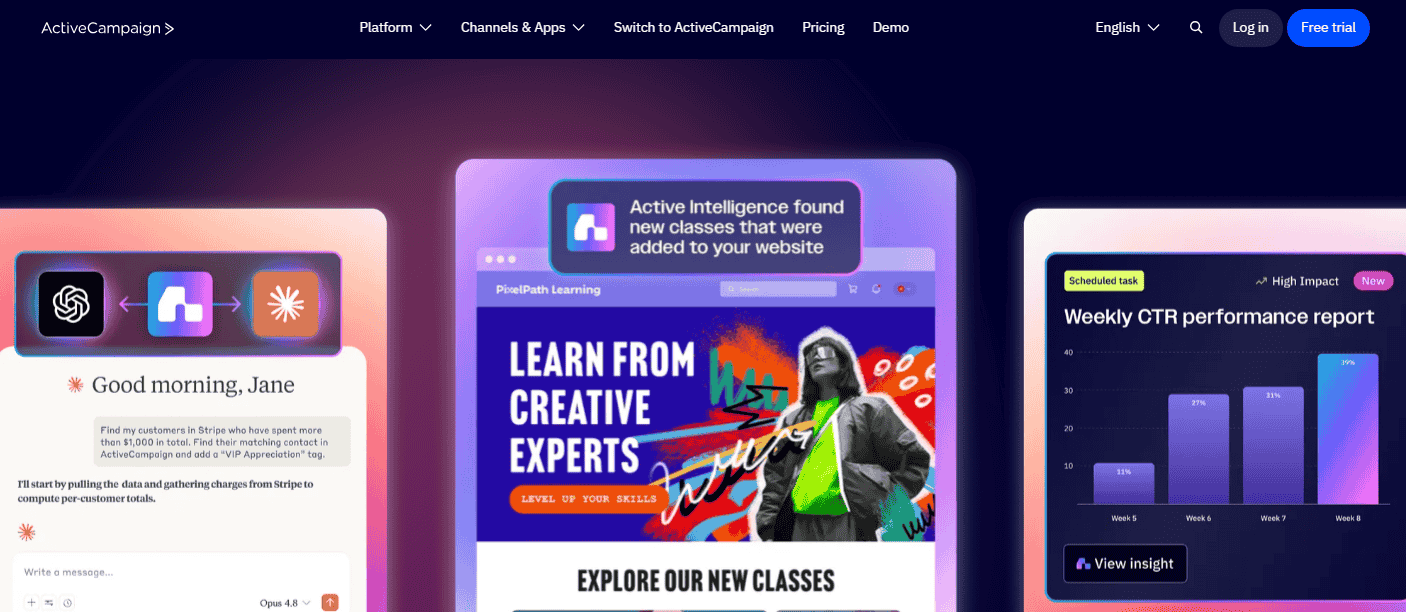
- Active Intelligence and AI Features
- Take Action on Your Marketing Data in ChatGPT and Claude
- Ease of Use
- Email Editor
- Email Template Library
- Marketing Automation
- List Management and Segmentation
- Analytics and Reporting
- Landing Pages
- Integrations
- Deliverability
- Pricing
- Pros and Cons
- Customer Support
- How Can I Learn to Use ActiveCampaign?
- Who ActiveCampaign Is Really For (SMB, Mid-Market, Enterprise Fit)
- How ActiveCampaign Compares
- ActiveCampaign Alternatives
- Conclusion
- FAQs
- What is ActiveCampaign?
- How much does ActiveCampaign cost?
- What are the main features of ActiveCampaign?
- Who are ActiveCampaign’s main competitors?
- Is ActiveCampaign good for small businesses?
- Can I use ActiveCampaign for free?
- What are the best ActiveCampaign alternatives?
- Is ActiveCampaign a CRM?
- Does ActiveCampaign have a mobile app?
- ActiveCampaign login
- ActiveCampaign Partner Portal
- ActiveCampaign login with email
- Activehosted ActiveCampaign
- ActiveCampaign CRM
Marketing automation has come a long way since ActiveCampaign launched back in 2003 as a fairly simple email service provider. Today it markets itself as an “autonomous marketing platform,” powered by AI agents that draft your next campaign, watch your market each week, and hand you an informed decision instead of a blank dashboard. Whether that ambition holds up under real B2B and B2C use is the question this review answers.
ActiveCampaign Review
ActiveCampaign is a subscription-based SaaS platform that automates cross-channel customer journeys — email, SMS, WhatsApp, and CRM sales activity — using AI agents that plan, build, and optimize campaigns on their own. It was founded in 2003 by Jason VandeBoom out of Chicago, Illinois, and started life as a fairly modest, on-premises email marketing tool before evolving into the cloud-based, AI-first system it is now.
The company has grown considerably since then. It’s privately held, has raised roughly $360 million across Series A, B, and C rounds (including a $240 million Series C in 2021 that pushed its valuation to about $3 billion), and now employs somewhere around 800–850 people across offices in North America, Europe, and Latin America. Revenue was reported near $165 million as of 2021, and the company has kept expanding its footprint since.
What Makes ActiveCampaign Different
Unlike a basic newsletter tool, ActiveCampaign was built for the “inherent complexity” of running marketing and sales together. It’s positioned as a one-stop shop for small businesses (SMB), mid-market teams, and enterprise organizations that want fewer vendors to manage — sales, transactional messages, and marketing automation living under a single roof.
| Attribute | Detail |
| Founded | 2003 |
| Headquarters | Chicago, IL, USA |
| Pricing | $15–$145/month (paid tiers only) |
| Free Plan | None — 14-day free trial instead |
| Platforms | Web, iOS, Android, Chrome Extension |
| G2 Rating | 4.5 out of 5 (14,000+ reviews) |
For experienced marketers who already treat marketing automation as a business priority, the depth is a selling point. For someone who just wants to send basic newsletter campaigns, the feature set — and the price tag — can feel like overkill. That tension shows up again and again throughout this review.
Key Features Overview
ActiveCampaign’s core promise is that email marketing and marketing automation tools shouldn’t just move messages — they should improve your return on investment by owning the relationship across every channel you touch, not just Facebook or Twitter but your own owned email lists. Everything from images and gifs to plain text can go into a campaign, and once built, automations quietly take over recurring tasks so your team can focus on higher-level marketing decisions rather than repetitive busywork.
Personalization runs through the whole platform — names, dates, preferences, and behavior all feed into well-timed, personalized messages. Four types of forms, a drag-and-drop landing page builder, and 500+ pre-built automation templates give most customer journeys a starting point rather than a blank page. On the sales side, deals carry dollar values, next steps, and expected close dates, turning contact cards into an automated, trackable sales process instead of a loose spreadsheet.
Create Forms and Popups to Generate Leads
ActiveCampaign offers four form types — Inline, Floating Bar, Floating Box, and Modal — each built to capture leads directly on your website. The form editor lets you adjust dimensions, layouts, colors, fonts, and animations, plus set a thank-you prompt once someone submits.
What’s genuinely useful here is the direct line from form to automation: hitting the “Trigger Automation” button inside the form editor drops you straight into the automation editor, so a new subscriber sign-up can kick off a welcome sequence immediately. It’s a small workflow shortcut, but it removes a step that a lot of competing form builders leave disconnected from their automation tools.
Send Email to Share News, Educate and Sell
Campaigns are built from the Campaigns menu, where you choose between a one-off newsletter, an autoresponder, a drip sequence, or an A/B test comparing two variants. ActiveCampaign ships over 300 templates, including pre-built options for birthday messages, post-purchase upsells, and webinar sign-ups.
The drag-and-drop builder organizes content into nine block types — images, buttons, videos, social links, and custom code among them — with detailed color and sizing controls for each element. You pick your contact list and email type as the final step before sending.
Use Marketing Automation for Lead Capturing and Nurturing
Marketing automation in ActiveCampaign runs on a visual, recipe-based editor where triggers, conditions, and actions connect into a sales funnel that runs without manual intervention. You can filter recipe templates by industry or language, then customize them with tools like product-interest tagging, site tracking, and abandoned-cart triggers.
Lead scoring works by adding points for behavior — a campaign link click, say — and those scores feed into if/else conditions that split a single automation into different paths. Multiple start and end points, tags, titles, and tasks all live inside the same builder, which supports both email and SMS steps in one sequence.
Use Sales Automation to Close Deals Faster
The built-in CRM manages contacts from a single location, storing phone numbers, email addresses, mailing addresses, and a full history of a lead’s activity inside one contact record. Every deal tracks its value, status, and lead score, so sales reps can see progress at a glance rather than digging through email threads.
Because sales automation and marketing automation sit in the same system, communication with a lead can be triggered automatically as their deal status changes — a distinct advantage over pairing a separate CRM with a separate email tool.
ActiveCampaign Key Features
- Active Intelligence workspace — AI agents that plan, build, and optimize campaigns
- Visual automation builder — multi-step, behavior-triggered workflows across email, SMS, and WhatsApp
- Built-in CRM — deals, pipelines, tasks, and sales activities
- Advanced segmentation — tagging by behavior, demographics, engagement, and custom fields
- Email marketing — templates, A/B testing, dynamic content, predictive sending
- Ecommerce automation — native Shopify, WooCommerce, and Square integrations for storefronts
- Website and event tracking — page views, visits, and conversion events feeding lead scoring
- Reporting and analytics — campaign metrics, automation performance, and revenue attribution
- 1,000+ app integrations — including Stripe, PayPal, Salesforce, Microsoft Dynamics 365, Google Ads, Meta, LinkedIn Ads, Twilio, Zendesk, and WordPress
- Mobile app — iOS and Android access to contacts, deals, tasks, and campaign performance
- 900+ pre-built automation recipes — spanning marketing, sales, and customer lifecycle workflows
Automate Every Marketing Channel
ActiveCampaign treats WhatsApp less like a broadcast tool and more like a conversation — “meet customers where they are” is the underlying philosophy, with powerful SMS messaging landing in seconds and always-on campaigns running quietly in the background. Combined with 1,000+ app integrations, the entire marketing stack — CRM, ecommerce, social, and analytics — can live inside one autonomous system.
Active Intelligence and AI Features
Active Intelligence is ActiveCampaign’s suite of AI agents, and it works from Memory of your account plus Custom Instructions you set, meaning each new workflow builds on the last instead of starting fresh. Its External Intelligence layer tracks outside signals — website updates, competitor moves — and Scheduled Tasks handle recurring work autonomously with minimal setup required from you.
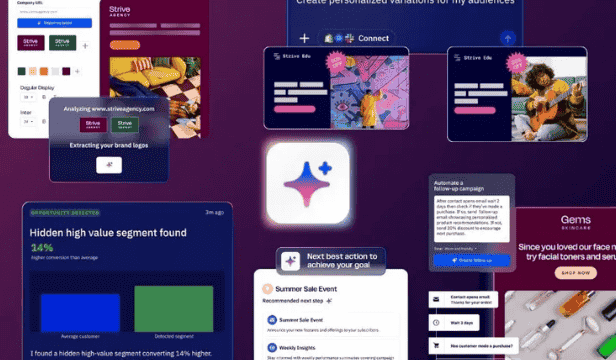
There’s also a Campaign Reference feature that studies your best-performing emails and your Brand Kit to keep new campaigns on-brand, rather than generating generic copy from a blank page.
Take Action on Your Marketing Data in ChatGPT and Claude
ActiveCampaign now lets you connect your account data to ChatGPT and Claude so campaign history and account context are available in one tab, without exporting a report or copy-pasting numbers into a prompt. In practice, this means you can ask a real question about your marketing performance directly inside those AI tools and get an answer grounded in your actual account — not a guess.
Ease of Use
ActiveCampaign’s interface is clean, with a left sidebar for navigation, but the platform’s depth means there’s a real learning curve for absolute beginners. Category explanations and help articles are laid out clearly, and the Content Manager acts as a central hub for storing, organizing, and sharing assets across campaigns.
It’s not a complicated tool once you’re oriented — but newcomers coming from a lightweight email service will notice the jump in what’s available to configure.
Email Editor
The email editor is fast, with a clean drag-and-drop design supporting regular campaigns, RSS-triggered sends, and autoresponders. Six different structural layouts, countdown timers, eCommerce product blocks, and reusable custom content blocks give experienced builders plenty of flexibility, while a real-time preview and direct HTML code editing cover both ends of the skill spectrum.
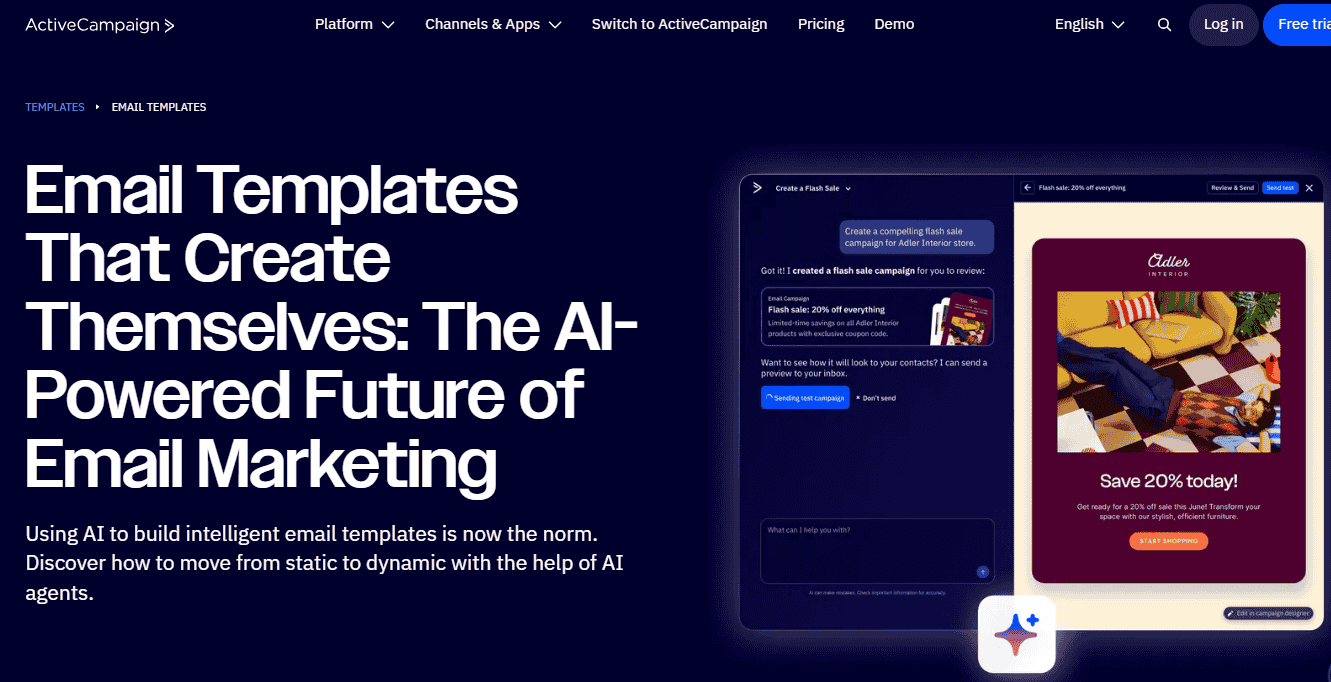
Personalization tags pull in a subscriber’s name, location, or job title automatically, and conditional content can show different messaging to different contacts inside a single campaign using if/then/else logic. A/B testing supports up to five variations, plus true multivariate testing when more than one element needs comparison — useful for teams doing real-time collaborative testing rather than guessing.
Email Template Library
ActiveCampaign ships 250+ responsive, customizable templates, neatly named and organized by use case — abandoned cart, holiday, newsletter, and feedback requests among them. Every template previews on both mobile and desktop before you commit, and Enterprise customers get access to a free, one-on-one custom template design service using their own logo, brand colors, and copy — a premium touch most competitors reserve for a separate paid add-on.
Marketing Automation
With 750+ automation recipes categorized by industry, ActiveCampaign avoids the trap of generic, one-size-fits-all automation — the small differences between industries actually change what a “good” automated sequence looks like. The visual builder supports multiple triggers, if/then logic, split paths, A/B testing, and even basic math operations, so a simple automated welcome email and a genuinely sophisticated multi-week journey can both live in the same tool.
Automations can update the CRM directly — adding a deal, adjusting a deal score, or leaving a note for the sales team — which keeps marketing and sales working from the same data instead of two disconnected systems.
List Management and Segmentation
Importing contacts is straightforward via CSV upload or copy-paste, and native connections to Google Sheets, Calendly, Typeform, BigCommerce, Gravity Forms, Wufoo, Pipedrive, and GoToWebinar mean new contacts can flow in automatically from tools you already use.
Segmentation goes beyond basic list splitting: the segment builder supports multiple conditions at once — website visits, job function, customer lifetime value, geographic location, products purchased — for genuinely hyper-targeted campaigns. Tags can be applied automatically through automation, and a Search or Advanced Search function makes finding a specific subscriber or prospect fast even inside a large database.
Analytics and Reporting
The Campaigns Performance report covers the standard metrics — open rates, click-to-open rates, click rates, unsubscribe rates, forward rates, and bounce rates — while ecommerce stores connected via Shopify, WooCommerce, Magento, or Square get revenue tracking tied directly to specific campaigns and automations. Deal reports, contact trend data, and chat conversion numbers round out the picture, though genuinely custom reporting is reserved for Enterprise plan users.
Landing Pages
Sixty-two responsive landing page templates sit under the Website tab, with a dedicated landing page builder that lets both beginners and advanced users arrange elements freely rather than being boxed into outlined sections. PayPal integration adds Buy Now and Shopping Cart buttons directly to a page, and the built-in dashboard tracks page views, conversions, and conversion rate before you publish.
Integrations
ActiveCampaign connects to 940+ apps, either through native integrations or Zapier, covering everything from Salesforce and PayPal to WordPress, Eventbrite, Google Analytics, and Unbounce. That’s an impressive number for an email marketing platform, and it’s a big part of why ActiveCampaign gets described as “connects to the places you work” rather than a closed system.
Deliverability
Independent deliverability testing (Emailtooltester among the sources) has consistently found ActiveCampaign lands in the main inbox at popular providers like Gmail and Yahoo, and it picked up a best email deliverability award back in January 2023 that’s held up in subsequent testing. List-cleaning tools and spam-testing features help maintain that high deliverability rate over time, which matters more than almost any other single feature if your emails aren’t reaching subscribers’ inboxes in the first place.
Pricing
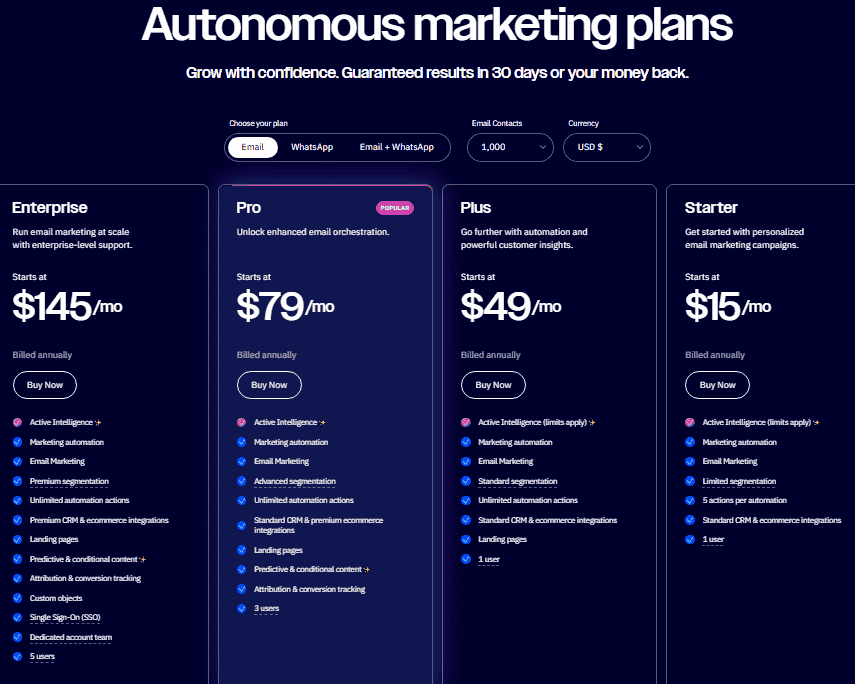
ActiveCampaign uses a tiered, contact-based pricing model with four paid plans — Starter, Plus, Pro, and Enterprise — starting at $15/month for 1,000 contacts, with no free-forever plan but a 14-day free trial.
| Plan | Starting Price (1,000 contacts) | Best For |
| Starter | $15/month | Small businesses, tight budgets, basic drag-and-drop email |
| Plus | $49/month | Growing teams needing CRM, landing pages, and multichannel automation |
| Pro | $79/month | Predictive sending, attribution tracking, larger contact counts |
| Enterprise | $145/month | Custom objects, SSO, dedicated account team, custom contracts |
Costs scale with your contact count — a list twelve times larger can mean roughly twelve times the monthly bill on the same tier — so the “$15/month” headline number is really an entry point, not a ceiling. Annual billing typically saves 10–20%, and a non-profit discount is available separately. Add-ons like SMS and enhanced CRM features carry additional charges, and transactional email is handled through a separate bundle (Postmark) rather than being bundled into the core plans. ActiveCampaign generally does not offer refunds outside specific circumstances, so it’s worth testing thoroughly during the trial window before committing to an annual contract.
Pros and Cons
Pros
- Powerful, flexible automation builder covering simple campaigns and advanced conditional workflows alike
- 300+ email templates and 500+ automation recipes to start from
- Easy deal tracking and deal scoring inside the native CRM
- Rich segmentation with genuine behavior and attribute-based tagging
- 900+ app integrations spanning ecommerce, CRM, analytics, and support tools
- Reliable, high-volume deliverability
- Responsive support team with extensive documentation and training resources
Cons
- Steeper learning curve than simple email tools — the interface can feel overwhelming to first-time automation users
- Pricing increases noticeably as your contact database grows
- Advanced features and useful add-ons sit behind higher tiers
- Reporting can feel limited without a separate BI tool for complex analysis
- Large lists with nested workflows can slow performance
- Phone support is limited, and lower tiers rely mainly on email and chat
Affordability and Pricing Structure
Starting at $19/month for the cheapest active plan (post price-change), ActiveCampaign isn’t the most expensive marketing automation tool on the market, but it isn’t the cheapest either — and the debate over its affordability usually comes down to what you’re actually buying. For businesses that would otherwise pay separately for a marketing platform and a sales CRM, the bundled option delivers real value; for a business that only needs one half of that equation, it can feel like you’re paying for capability you’ll never use. The 14-day free trial is the best way to settle that question before committing.
Signup Forms
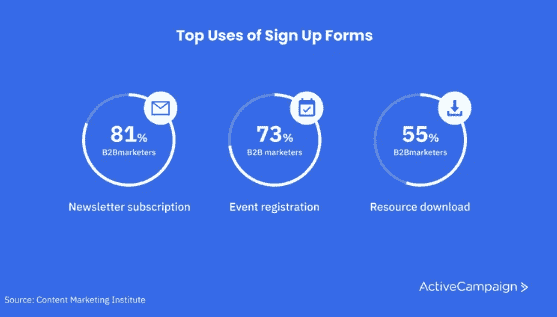
The four form types cover most common needs, but genuinely custom fields, auto-embedded Shopify store forms, and discount-code purchasing nudges are paywalled behind the Plus plan and above — a limitation for anyone on the Starter tier who wants more than name, phone number, and a basic image or CAPTCHA field.
Spam and Design Testing
Spam testing returns a simple pass-or-fail message rather than actionable pointers on what to fix, which limits how useful it is for troubleshooting. Design testing across clients like Gmail, Yahoo, Apple Mail, and Outlook is available, but the free allowance is thin — five free previews per month on the Lite/Starter tier, unlimited only at Enterprise, with paid test packs available in between.
Customer Support
ActiveCampaign markets “24/7” chat and email support, but the fine print is narrower: the Customer Experience Team’s live coverage generally runs Monday through Friday, 3am to 11pm Central Time, plus a shortened Sunday window. That’s not true around-the-clock coverage, and it’s worth knowing before you rely on it during a weekend campaign launch. The support team itself is genuinely knowledgeable, and the self-service knowledge base, tutorials, and webinars fill in a lot of the gap — but there’s no phone support option.
How Can I Learn to Use ActiveCampaign?
Getting started is relatively easy thanks to a guided sign-up wizard and intuitive dashboard navigation, even though the platform’s full feature set takes longer to master. A help button in the bottom-right corner opens a live chat session or the help center directly from wherever you’re working, which accelerates onboarding without requiring a big time commitment before your trial converts. Most users can learn campaign setup and basic reporting quickly; CRM usage and advanced automation take longer to feel natural.
Who Is ActiveCampaign For?
| Industry | How It’s Used |
| Technology | Onboard new users, reduce churn, track in-app events |
| Blogger/Influencer | Grow subscribers with lead magnets and automated new-post emails |
| Education | Score candidates by student interests using lead scoring |
| Agency | Manage client relationships, task tracking, and brand content |
| Small Business | Recover lost income, automate sales process, personalize outreach |
| Entertainment/Events | Automate communication with fans and ticket buyers |
| Travel/Hospitality | Automate reservation, arrival, and departure communication |
| Non-Profit | Manage donor lists, welcome series, and awareness campaigns |
| Healthcare | Automate appointment reminders and follow-up satisfaction surveys |
| Real Estate | Organize listings, track leads through the sales funnel |
| Fitness/Nutrition | Track website behavior for automated product recommendations |
Who ActiveCampaign Is Really For (SMB, Mid-Market, Enterprise Fit)
ActiveCampaign fits small and midsize B2B and B2C organizations — particularly agencies and online-first businesses — that want accessible automation without a full-scale enterprise marketing cloud. Marketing Managers, Demand Generation Leaders, Sales Managers, and Agency Owners tend to get the most value. It’s a weaker fit for early-stage businesses that only need a simple newsletter tool, and for organizations with very large, low-value email lists where per-contact pricing punishes scale; those cases sometimes need a more price-sensitive or deeply customized deployment instead.
How ActiveCampaign Compares
ActiveCampaign sits above simple email tools like Mailchimp or Constant Contact in automation flexibility and native CRM functionality, but below full-scale marketing clouds like Adobe Marketo Engage in raw enterprise configuration depth. Against Klaviyo — which is ecommerce-focused and store-centric — ActiveCampaign offers broader B2B pipeline and lifecycle capability rather than pure store revenue optimization. Against HubSpot Marketing Hub, ActiveCampaign generally wins on price and automation flexibility at the SMB and mid-market level, while HubSpot pulls ahead on deeper native reporting and a more standardized CRM experience for larger teams.
| Platform | G2 Rating | Review Count |
| ActiveCampaign | 4.5/5 | 14,468+ |
| (Capterra) | 4.6/5 | 2,544 |
| (TrustRadius) | 8.3/10 | 933 |
ActiveCampaign Alternatives
- HubSpot Marketing Hub — more all-in-one, higher pricing, less maintenance for teams that want less configuration work
- Klaviyo — dedicated ecommerce email solution starting around $20/month, strong revenue tracking and analytics for online stores
- Mailchimp — more affordable, minimal learning curve, intuitive interface, but lighter automation depth
- Brevo (Sendinblue) — starting near $9/month, decent all-around offering for tighter budgets
- GetResponse — competitive automation at roughly half the price for comparable contact counts
Customer Testimonials
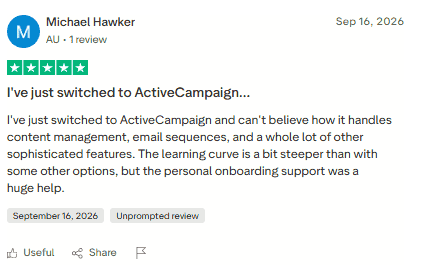
Real feedback tends to echo a similar arc: an overwhelmed, hesitant business owner who wasn’t sure the right AI tools would actually deliver what they wanted and needed, followed by relief once the guesswork was removed and results improved. One frequently cited example describes a 20% engagement rate increase over six months, and another points to $76,000 in additional revenue traced back to two automated emails, a signup form, and a tagging-based automation sequence — a good illustration of how the smaller features compound when they’re connected rather than used in isolation.
Conclusion
ActiveCampaign is more than an email marketing tool — it’s a combined marketing suite and sales suite built around automated workflows, full customer journey management, and a genuine sales CRM in one subscription. It suits seasoned marketing teams and eCommerce store owners who want customized campaigns, hundreds of templates, and robust automation options across a wide range of business use cases, and it earns that reputation through genuinely powerful features rather than marketing spin. The trade-off is real: higher prices than a basic tool, and enough software complexity that it can feel intimidating for absolute beginners. For a business that just wants simple email marketing, it may be a risky, over-built choice — but for anyone ready to grow into pre-built sequences and deeper automation, most reviewers report a positive overall experience, with the platform guiding users toward real results without causing a headache along the way.
FAQs
What is ActiveCampaign?
ActiveCampaign is a cloud-based marketing automation and CRM platform that builds personalized, automated customer journeys across email, SMS, WhatsApp, and other channels, using an AI-powered automation engine alongside a sales CRM and a large integration ecosystem to segment audiences, trigger behavior-based workflows, and track revenue impact from a single system.
How much does ActiveCampaign cost?
ActiveCampaign uses tiered, contact-count-based pricing starting at $15 per month for 1,000 contacts on the Starter plan (billed annually), rising through Plus, Pro, and Enterprise tiers that add more advanced automation, reporting, and support. Optional add-ons like SMS and enhanced CRM cost extra, and both monthly and annual billing are available.
What are the main features of ActiveCampaign?
Core features include an AI-assisted visual automation builder, email marketing with templates and A/B testing, a built-in CRM with sales pipeline management, advanced segmentation, lead scoring, website and event tracking, ecommerce automation, SMS and WhatsApp messaging, revenue and attribution reporting, and 1,000+ integrations with tools like Shopify, Salesforce, and Google Ads.
Who are ActiveCampaign’s main competitors?
Its main competitors include HubSpot Marketing Hub, Mailchimp, Klaviyo, Brevo (Sendinblue), Constant Contact, and Adobe Marketo Engage — with HubSpot and Marketo competing more directly for enterprise-level deep automation, and Klaviyo competing specifically for ecommerce use cases.
Is ActiveCampaign good for small businesses?
Yes, for small and midsize businesses that need real automation rather than just basic email tools — the Starter and Plus plans, accessible pricing, onboarding assistance, and pre-built recipes let small teams launch effective campaigns quickly. It’s a heavier tool than very simple businesses or highly price-sensitive teams may need, though.
Can I use ActiveCampaign for free?
No, ActiveCampaign is not free software, but it offers a 14-day free trial to test features and evaluate whether it fits your business before you commit to a paid plan.
What are the best ActiveCampaign alternatives?
Commonly cited alternatives include Moosend, Klaviyo, Omnisend, MailerLite, and GetResponse, each trading off some automation depth for better affordability or usability depending on the use case.
Is ActiveCampaign a CRM?
Yes — alongside its marketing tools, ActiveCampaign includes a genuine built-in CRM for managing contacts, leads, and deals, with pipeline management, lead scoring, and sales automation designed to streamline sales efforts alongside marketing.
Does ActiveCampaign have a mobile app?
Yes, ActiveCampaign offers a mobile app for iOS and Android that lets users schedule and send campaigns, review automation and email campaign details, and track key metrics on the go.
ActiveCampaign login
Logging in happens through ActiveCampaign’s standard sign-up and dashboard navigation flow; new users are guided through a setup wizard, with live chat and a help center available if account access issues come up during accelerated onboarding.
ActiveCampaign Partner Portal
ActiveCampaign runs a certified agency partner program, connecting agency owners into its broader integration ecosystem — though specific portal mechanics weren’t part of the source material reviewed here and are best confirmed directly with ActiveCampaign.
ActiveCampaign login with email
Account setup and login use a standard business-email-based sign-up flow through ActiveCampaign’s account creation process, tied to the contact information provided at signup.
Activehosted ActiveCampaign
“Activehosted” refers to ActiveCampaign’s earlier identity, dating back to its 2003 founding as an on-premises email marketing tool before it evolved into today’s subscription SaaS platform.
ActiveCampaign CRM
ActiveCampaign’s built-in CRM lets teams manage contacts, leads, and deals, track deal values and status through a sales pipeline, apply CRM tags, and use lead scoring and sales automation to streamline sales activities — with premium CRM integrations (including Salesforce and Microsoft Dynamics 365) and custom objects available on higher plans.
Other Post
MailerLite Review: Is It Worth in 2026? Features, Pricing, Pros & Cons
Brevo Review 2026: Cost, Features And Is It Worth it?
10 Best Startup Accounting Software Tools: Costs, Features & Growth
Beyond Demographics: A Practical Framework for Behavior-Based Email Segmentation
Bootstrapped Startup Funding Alternatives: What Founders Can Use