

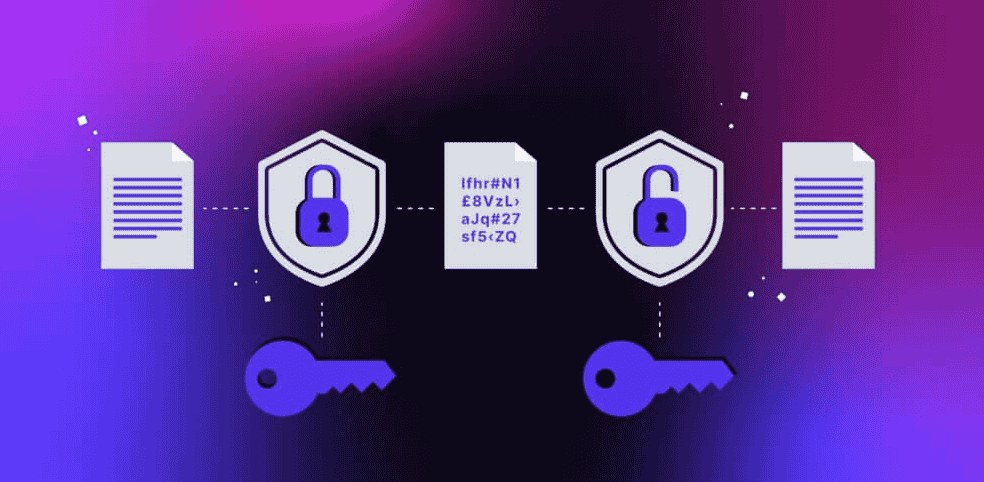
Encryption methods fall into symmetric encryption, which relies on one shared secret, and asymmetric encryption, which relies on a linked pair of keys, with hashing as a third, key-free technique. Each approach turns information into unreadable text that only the intended party can reverse.
- What Does Encryption Actually Do to Your Data?
- Why Bother Encrypting Anything at All?
- How Does Encryption Turn Readable Data Into Ciphertext?
- Which Types of Encryption Exist and How Do They Differ?
- Is Hashing the Same Thing as Encryption?
- Which Encryption Methods Do People Use Most in Practice?
- What Encryption Standards Should You Know About?
- Where Do You Meet Encryption in Everyday Life?
- What Makes Encryption Hard to Get Right?
- How Do You Build a Sound Encryption Strategy?
- Where Is Data Encryption Heading Next?
- How Does Encryption Work in the Cloud?
- Which Regulations Shape an Organization’s Encryption Strategy?
- Does Encryption Alone Guarantee Data Integrity?
- How Does Encryption Help With Compliance Requirements?
- How Does Encryption Work Alongside AI?
Both cybersecurity professionals and IT experts start from these families, because end-to-end encryption and full disk encryption simply apply the same ideas to conversations or to storage. The practical goal never changes: keep hackers away from content and protect privacy.
Adoption is already widespread. SealPath reports that Over 90% of online traffic is encrypted in the majority of nations. Much of that shift traces back to SSL, which Netscape introduced in 1995; its concepts live on in TLS.
What Does Encryption Actually Do to Your Data?
Encryption converts readable data into a secret code that only the holder of the right key can turn back into usable information. The original message is called plaintext, and the scrambled result is ciphertext.
Splunk describes that result as randomized data and notes that interpreting it requires a unique cryptographic key. Put simply, encryption scrambles content so that only authorized personnel can read it; everyone else sees noise. The procedure behind this is a set of rules for solving problems, and here the problem is how to conceal information reliably.
Designs differ in their dimensions. The Three Way cipher, designed by Joan Daemen, uses a fixed length block that matches its key size exactly, which makes it distinctive among symmetric ciphers.
Why Bother Encrypting Anything at All?
People encrypt because information that travels or sits unprotected can be read or altered by anyone who reaches it, and that need is older than computers. The ancient Greeks used a device called the Scytale to cipher text, and Splunk traces the Caesar cipher to 58 BCE.
In the digital age, the same instinct covers everyday acts. Every online transaction, every time you surf the web, and every decision to send an email involves some form of encryption. Online shopping is the clearest case, because payment information is encrypted to protect card details from interception.
Choosing a method still comes down to security requirements. Splunk and SealPath note that one early-1990s block cipher accepts keys of up to 448 bits and sits in the public domain, while Serpent, a contest finalist, was recognized for its defense against various attacks.
How Does Encryption Turn Readable Data Into Ciphertext?
Encryption turns readable data into ciphertext by running a message through algorithms and keys, so that a transformation occurs which only matching decryption keys can undo.
Techminder compares the result to a secret language, with the key acting like a password that unlocks the hidden message. SealPath adds that advanced mathematical functions create a pair of related yet distinct keys, so a message locked with one can only be opened by its partner.
Two layouts dominate. In a same key layout, the sender and receiver both hold one secret. In a paired layout, a public key locks the content and the matching private key unlocks it, which SealPath credits with solving the problem of transmission over the internet without exposing a secret.
Encryption also applies at different moments, such as data in transit and data at rest. Shareppy cites Signal as an application where each instant message stays encrypted between the two ends of the conversation.
Which Types of Encryption Exist and How Do They Differ?
Encryption divides into two main types: symmetric methods use one secret for both locking and unlocking, while asymmetric methods use a related pair of keys.
Shareppy lists AES, DES and Blowfish as symmetric examples, and RSA, DSA and ECC as asymmetric ones. The Advanced Encryption Standard is a more secure successor to DES, and Splunk calls Elliptic Curve Cryptography a relatively new asymmetric method.
| Feature | Symmetric encryption | Asymmetric encryption |
| Keys used | One shared secret key | A public key and a private key |
| Speed | Faster in practice | Slower because of extensive calculation |
| Key sharing | The key must reach the receiver securely | The public key can be shared openly |
| Example algorithms | AES, DES, Blowfish | RSA, DSA, ECC |
Splunk notes that Twofish encrypts data in 16 rounds regardless of key size, using a more complicated key schedule. Shareppy names SHA-256 as the most common hash algorithm, which sits outside the symmetric and asymmetric split.
Newer options blend the families. Splunk lists homomorphic and format-preserving encryption as advanced techniques, while SealPath says optimal enterprise protection uses hybrid encryption. Whichever route is chosen, key management decides how safe the secrets stay.
Is Hashing the Same Thing as Encryption?
No, hashing is not encryption, because hashing uses no key and a hash cannot be reversed to recover the original input.
Splunk describes hashing as a technique that converts inputs of any size, such as files or messages, into a fixed value. Because no key is involved, complete secrecy cannot be guaranteed, whereas encryption instead makes information appear as random data.
What hashing does offer is verification. Hash functions act as a fingerprint for data integrity checks: if content is tampered with, the output changes, and if the output matches, the content stayed unchanged. That makes hashing handy for comparing documents quickly.
Credential protection shows the difference clearly. SealPath says a password is hashed and stored, then hashed again at each login for comparison, while Splunk lists UNIX passwords among items an older block cipher can encrypt. Verification also matters for connections: the handshake in TLS and SSL establishes a secure connection and verifies the server’s identity, according to SealPath.
Which Encryption Methods Do People Use Most in Practice?
The most common encryption methods are the symmetric and asymmetric families, and the right pick depends on the job at hand.
Splunk says secret key encryption, also called private key cryptography, suits larger data sets while producing smaller ciphertexts than the original file; the opposite is true of public key cryptography.
Real deployments follow that split. Splunk ties the most frequently used symmetric method to Wi-Fi security, VPNs and SSL/TLS protocols, an early-1990s symmetric cipher to e-commerce platforms and password management systems, and its successor to file and folder encryption. A newer asymmetric method covers one-way email encryption.
Asymmetric methods also prove vital in secure peer-to-peer network communications, according to SealPath. Splunk warns that cyberattacks are becoming more sophisticated while computing technology continues to change, so every method must be revisited over time.
What Encryption Standards Should You Know About?
The standards worth knowing are the Advanced Encryption Standard for protecting data and the TLS protocol that replaced SSL for protecting connections.
SealPath explains that the standard was selected through a rigorous process run by NIST, and Splunk often calls it the gold standard because its predecessor, which used a 56-bit key, was vulnerable to brute-force attacks.
| Cipher | Key detail | Notable use |
| AES | 128-bit, 192-bit, or 256-bit keys on 128-bit data blocks | Used by many government bodies worldwide, including in the US |
| DES | 56-bit key | Older design, largely superseded |
| Triple DES (3DES) | Applies DES three times with three different keys | Used by applications like Firefox and Microsoft Office |
On the connection side, SealPath says the HTTPS prefix signals that a website connection is encrypted, while S/MIME is one technology that leverages asymmetric encryption to secure email. These standards protect communication channels, one of the places where Splunk says organizations choose to encrypt confidential information.
Where Do You Meet Encryption in Everyday Life?
Encryption appears in daily life whenever you message someone, shop, bank online, or store files on a device.
Techminder says apps like WhatsApp use encryption so that only you and the person you are chatting with can read your messages. SealPath adds that encryption also secures online banking and even satellite TV, and it offers a locker analogy for one-key methods and a mailbox analogy for paired keys.
Payments and devices offer further examples. Without encryption, anyone could view or tamper with credit card numbers; Splunk says one older block cipher encrypts ATM pins, and SealPath says the compact Three Way design suits smart cards. Splunk adds that a newer asymmetric method also appears in cryptocurrency signing for Bitcoin or NFTs, and Shareppy names BitLocker and VeraCrypt as tools that encrypt an entire hard disk.
Habits matter as much as tools. Organizations encrypt confidential information in databases, and Techminder advises that you always use strong passwords and keep software up-to-date to close weak spots. If you must use public Wi-Fi, avoid sensitive transactions unless your connection is encrypted.
What Makes Encryption Hard to Get Right?
Encryption is hard to get right because attackers use it too, every design has limits, and people make mistakes.
Encryption also serves attackers. In March 2022, Ryan Kovar of SURGe, Splunk’s in-house research team, reported that the median ransomware variant can encrypt nearly 100,000 files totaling 53.93GB in 42 minutes and 52 seconds.
Design limits matter too. Splunk says RSA depends on prime factorization of large prime numbers, and SealPath adds that a powerful enough computer able to factor them could theoretically break it. Blowfish’s 64-bit blocks may leave it vulnerable to certain attacks, and the 96 bits block of the Three Way cipher may pose compatibility issues with systems built for 128-bit blocks.
People and processes create exposure as well. Splunk notes that human error in key storage can put important data at risk, which is why protecting sensitive information also depends on training. Techminder advises regular updates to protect against security vulnerabilities, and the key exchange problem of symmetric methods remains a reminder of why secrets must travel carefully.
How Do You Build a Sound Encryption Strategy?
A sound encryption strategy starts with defining requirements and ends with accepting that encryption is one layer among several.
The financial case is documented. SealPath cites the Ponemon Institute as finding that businesses can save an average of $1.4 million per attack by implementing robust encryption and cybersecurity measures. Strategy also has to cover the data life cycle, from storage to movement.
- Define requirements. Assess current security needs before buying a solution.
- Sort your data. Group it by importance, regulation, and how often it is used.
- Choose the right tooling. Look for encryption at several levels, central policy control, and automated key lifecycles.
- Plan for deployment obstacles. Allow time for legacy systems and consider outside help.
- Build a security habit. Train staff on key storage and best practices.
- Recognize the limits. Pair encryption with other defenses.
Execution is where plans often stall. Splunk warns that key retrieval and backup and restoration can prolong a recovery operation, and that older systems may rely on outdated encryption algorithms, so expensive system upgrades and changes to application back-ends may follow. Choosing ECC’s shorter keys can ease some of that load, since Splunk calls it faster than RSA.
Splunk recommends deploying in collaboration with IT, operations and management teams so the strategy fits the modern workplace. It also notes that frameworks require proper key management along with audit trails.
Where Is Data Encryption Heading Next?
Data encryption is heading toward methods built to withstand stronger attackers while still protecting information that has to be processed.
The pressure is real. Splunk notes that modern systems can generate millions or billions of possible key combinations, and that advancing computing could pose an existential threat to today’s techniques. Techminder adds a practical cost: encryption needs processing power, and anyone who loses their key will probably lose their data.
AI is part of the answer. Splunk says AI can spot abnormalities, analyze threat trends, and help show when a method is no longer safe, while AI models can work on encrypted information without exposing it, preserving data confidentiality.
The stakes extend beyond individual accounts. SealPath says encryption protects national security and critical infrastructure, and counters data breaches, identity theft and cybercrime. Splunk suggests partnering with a third-party IT provider for deployment and building a culture of security among employees.
How Does Encryption Work in the Cloud?
Encryption in the cloud secures data both at rest and during transit, and the best tooling manages that protection from one place. Splunk says strong solutions encrypt data both on-premises and in the cloud, and offer a centralized management dashboard, audit logging and RBAC. Teams should classify their data first, because sensitive records fall under strict rules around data residency. Trusted platforms such as Google Cloud and AWS use FPE, which keeps the format of the data: a phone number like 012-345-6789 becomes 313-429-5072. The format survives, but the digits are randomized.
Which Regulations Shape an Organization’s Encryption Strategy?
Regulations and frameworks, GDPR among them, shape encryption strategy by requiring personal data protection, which in practice means encrypting information. Meeting compliance requirements also means preventing unauthorized access to protected records. Reviewing cybersecurity frameworks, running a threat assessment and evaluating security posture helps teams map which rules apply to them. On the technical side, SealPath says the IETF approves TLS 1.2 and TLS 1.3, and file tools such as AxCrypt and 7-Zip, listed by Shareppy, support file-level protection.
Does Encryption Alone Guarantee Data Integrity?
No, encryption alone does not ensure data integrity, which is why it is often paired with hashing. A hash gives a hash value, and any change in the data alters that hash value. SealPath says even a single character change produces an entirely different hash, and the one-way nature means the original cannot be rebuilt from it. A hash collision, where two inputs give the same output, is highly unlikely but possible. Common roles include integrity controls, document verification and digital signatures, plus password storage, data retrieval and lookups by ISBN. Shareppy names bcrypt for password protection in web and mobile applications.
How Does Encryption Help With Compliance Requirements?
Encryption helps meet compliance requirements by protecting sensitive data, maintaining privacy and blocking unauthorized access. Frameworks such as HIPAA and PCI DSS require protection both in storage and in transmission, with strict rules around auditability. In cloud deployments and multi-tenant environments, encryption keeps information indecipherable even if it is accessed improperly, which also supports customer trust. Standards must keep up, too: SSL 3.0 is now obsolete because of vulnerabilities, and next-generation quantum-safe algorithms show how methods evolve. Organizations that ignore this drift risk failing the very audits they set out to pass.
How Does Encryption Work Alongside AI?
AI works alongside encryption by spotting patterns, helping to automate key creation and storage, and improving the efficiency of encryption processes, though it supplements other defenses rather than replacing them. Splunk gives healthcare data as an example of information that frameworks require organizations to encrypt, so any AI workflow touching such records must preserve that protection. Traditional tools still carry the daily load: PGP and GnuPG support email security, while Shareppy says Signal protects each phone call, and messaging apps more broadly rely on encryption too. Splunk also reminds readers that firewalls and endpoint security remain necessary because encryption cannot keep attackers out alone.