



The best encoder for hotel IPTV is a purpose-built multi-channel hardware encoder that runs around the clock and turns local video into IPTV channels for every guest room. An encoder converts video and audio into a compressed digital stream, takes raw video and audio signals from a camera or receiver, and sends them over a network so TVs, phones, or computers can play them. That same job powers internet streaming for churches and IPTV startups, but a hotel is a tougher audience.
- What Is an IPTV Encoder and Why Do Hotels Need One?
- Which Codecs and Streaming Protocols Matter for Hotel IPTV?
- Should You Use a Hardware or Software Encoder in a Hotel?
- Which Professional Encoders Suit Large Hotel Headends?
- Which Affordable Encoders Work for Small Hotels?
- How Do You Choose the Right Hotel IPTV Encoder?
- Are Software Encoders Worth Considering for Hotel IPTV?
- Where Does the Encoder Sit in a Hotel IPTV Headend?
- Why Move a Hotel From Cable TV to IPTV?
- How Does an IPTV Encoder Actually Work?
- What Features Should You Look for in a Hotel IPTV Encoder?
- Hardware or Software Encoder: Which Should You Pick?
- Are There Budget-Friendly IPTV Encoder Options?
- Can an IPTV Encoder Handle Several Cameras at Once?
- Can IPTV Encoders Be Used for More Than Live TV?
- What Is SRT and Why Do IPTV Encoders Use It?
- Can You Stream Over 4G or 5G With an IP Streaming Encoder?
Hotel guests spot snow and pixelation within seconds, and the same headend also has to carry a welcome message, food and beverage ordering, and hotel introductions. In my own checklist I settle five questions first, and only then look at installation context and brand names.
What Is an IPTV Encoder and Why Do Hotels Need One?
An IPTV encoder is the hardware that compresses data from a video source and sends it across an IP network, which is why hotels leaving coax TV need one in the headend.
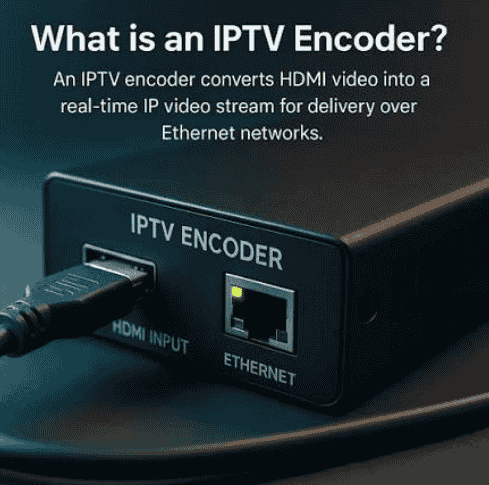
Older plants rely on modulators, long runs of coaxial cable, and a fixed channel lineup, and FMUSER reports guests complaining about live sports games that take ages to load. IPTV answers with HD live TV and interactive pages such as dining and shopping, though smart TVs from LG, Samsung, Sony bundle their own IPTV platforms that, FMUSER warns, need strong network infrastructure.
Two codecs cover nearly every case. H.264 (AVC) is the baseline, playing on older devices and reaching a broad audience, while H.265 (HEVC) is ~50% better than H.264 in compression efficiency, according to OBSBOT.
Cheap boxes with a single HDMI input suit one feed, and software suites accept unlimited sources, yet running either on regular hardware is rarely efficient for a whole property. Your existing infrastructure decides how much has to change.
Which Codecs and Streaming Protocols Matter for Hotel IPTV?
For hotel IPTV, the codecs and protocols that matter are the ones your IP networks, room devices, and encoder all share, so multiple streaming protocols and generous connectivity options count for more than one flashy spec.
An uncompressed 1080p60 feed is far too big to move around, and encoding squeezes it into a data stream that a LAN-based system can carry comfortably. x264 is the usual software route, entry-level boxes stop at up to 1080p, and SD feeds from legacy channels gain signal stability once they travel as IP.
Wrong settings show up as lip-sync drift or CDN rejections when a stream leaves the local network. Match the codec to older smart TVs, because H.265 reaches equal quality at roughly half the bitrate, and favor open standards for interoperability.
For transport, Secure Reliable Transport is the standard for IPTV contribution, since its packet recovery copes with variable packet loss. FMUSER’s gateway output board covers DVB-T/T2, ISDB-T, and ATSC, while some encoders add NDI|HX3 and multi-streaming for AV-over-IP work.
Should You Use a Hardware or Software Encoder in a Hotel?
Hotels should rely on purpose-built hardware for channels that never go off, because a unit built for one job avoids the buffering that creeps in when a computer juggles other work.
OBSBOT’s guidance is that streams running around the clock need a box that does one thing. The Epiphan Pearl Nano at $1,495 targets fixed installations: PoE+ carries power and data over a single cable, and Epiphan Edge lets technicians monitor units remotely. For rooms that cannot go dark, look for redundant power supplies, a feature Plume lists on one premium model. In FMUSER’s design, the FMUSER FBE208 converts local audio and video into IP, and a proper server rack keeps the gear cool and organized.
| Software tool | Platforms | Typical fit |
| OBS Studio | Windows, macOS, and Linux | Highly configurable, hands-on setup |
| vMix | Windows only | Full production suites |
| Wirecast | Windows and Mac | Enterprise broadcasts with support |
Software tools suit events, but a lobby feed that crosses congested connections or unpredictable connections still needs stable streams, which is easier to guarantee on purpose-built gear. A plug-and-play box tempts small properties, yet check its input options, the source device it expects, and its IP-based delivery to the headend first. FMUSER adds that cloud-based IPTV stops working without an internet connection, which is why LAN designs avoid it.
Which Professional Encoders Suit Large Hotel Headends?
Large hotel headends are best served by specialized rack units that provide a 4-channel IPTV encoder, 8 channels, or 16 channels per unit, because dozens of independent network channels overwhelm single-input boxes, and OBSBOT says the same pattern applies to hospital TV systems.
OBSBOT’s roundup includes four hardware units, and the hardware encoders in that class share one trait: each runs independently of any computer, which helps reliability and low latency. They differ in flexibility, and some handle multiple cameras and different angles in one chassis, though a hotel rarely needs that.
The FMUSER FBE700 shows another route. This IPTV gateway accepts a codec board and an IPTV Network Input Board, converts RF to IP, and doubles as the headend server, which removes the need for separate satellite and UHF receivers, a leaner route than a laptop-plus-capture card rig. Look for multi-destination output, plus RTSP and RTP support, so the stream lands where the headend expects it.
Entry-level lists stop at around $500 and often show no support for 4K resolution, which is one reason big properties outgrow them. Treat these dedicated devices as infrastructure rather than accessories.
Which Affordable Encoders Work for Small Hotels?
Small hotels can get by with affordable solutions that keep the essential features, namely stable encoding and basic inputs, at a lower price than rack gear.
IPTV TheFox’s 2026 roundup is written for U.S. buyers and keeps every pick under $500, promising stable 1080p@60fps output. Plume’s cheaper picks stress high-quality video encoding and ease of use, while the Blackmagic Web Presenter HD at $589 adds 4K-to-1080p downconversion and streams over a network cable, USB tethering, or, per OBSBOT, direct tethering to a mobile phone.
The best value pick depends on budget, so weigh compatibility with your TVs, customization, future-proofing, and whether the system is scalable as rooms are added, as FMUSER advises. Even low-cost boxes can publish to websites, and in bandwidth-limited setups a lighter bitrate keeps the stream steady.
How Do You Choose the Right Hotel IPTV Encoder?
Choose a hotel IPTV encoder by working backward from network capacity: each channel needs approximately 2 Mbps, so 300 guest rooms watching at once call for 600 Mbps through a gigabit switch.
CAT6 cables are rated up to 1 Gbps, and VLANs with traffic segmentation keep IPTV from fighting other services over shared network cabling. For perspective, one raw 1080p60 feed would eat roughly 3 Gbps, which is exactly why encoding comes first.
Treat the encoder as mission-critical, like stadium displays and corporate signage, and leave occasional streams to lighter tools. Because boxes also serve video conferencing, online education, and corporate communications, ask whether a unit can be reused, and remember that viewer formats such as DASH add delay for guests.
Cross-check every claim: read reviews, compare features, and stay wary of overzealous installers who push the priciest rack. If remote feeds will ride cellular connections over 4G or 5G, plan loss recovery up front.
Are Software Encoders Worth Considering for Hotel IPTV?
Software encoders are worth considering for occasional broadcasts and testing, though not as the only engine behind an always-on hotel system.
OBSBOT lists three software options, and each is a device or application that leans on the host machine’s CPU or GPU, which directly affects encoding stability. Running them on regular computers also brings configuration overhead, though hardware is not immune: Plume flags a complex setup on one premium unit and a steeper learning curve on another.
Software earns its keep elsewhere. A built-in switcher handles audio mixing and camera switching, takes IP streams, and supports ISO recording, while one hardware unit can feed up to 6 simultaneous streams. For delivery, software can speak HLS, push to YouTube or other social media destinations, and use AV1 in software-only OTT programming workflows. Check platform ingest rules before going live.
When a link carries remote production traffic, Secure Reliable Transport recovers lost packets so the signal survives. Weigh project urgency too: a software trial can start today, while hardware needs delivery time.
Where Does the Encoder Sit in a Hotel IPTV Headend?
In a hotel IPTV headend, the encoder sits between your local video sources and the network, turning them into IP for the IPTV system that delivers live TV streaming to the rooms.
OBSBOT is blunt that streams running 24/7 need a hardware appliance. The Magewell Ultra Encode AIO, listed at $899, is 1 RU, records over NFS or SMB, and supports 32 Mbps per stream; if your cameras output it, confirm 12G-SDI support as well. Low-delay transport such as LAN multicast over Ethernet suits a closed network.
Capacity comes first. Keep the combined bitrate at or below 70% of your available upload bandwidth, which gives these minimums:
| Scenario | Bitrate per stream | Minimum upload |
| One 1080p H.264 stream | 5 Mbps | 7 Mbps |
| four 1080p streams from a multi-channel unit | 5 Mbps each | 30 Mbps |
Hitting those numbers protects the smooth viewing experience guests expect. The coax-era gear, multiplexers, distribution amplifiers, and CA cards for access control, gives way to IP and web-based management, while personalized recommendations, paperless ordering, and call-less service ride the same path. Bring in a system integrator early, since the encoder is only one link in that chain.
Why Move a Hotel From Cable TV to IPTV?
Hotels move from cable TV to IPTV because a pricey subscription fee per room and aging wiring keep climbing while IPTV adds interactive services.
FMUSER notes that even five-star hotels once ran cable, guests complain about white noise on screen, and maintenance fees and complaint management fees keep rising. IPTV delivers content with minimal lag, and guests reach in-room entertainment through set-top boxes on their remotes.
FMUSER’s LAN design draws on these inputs:
- FBE308: a tuner IRD that turns satellite RF into IP; CAM versions unlock encrypted channels from a content provider such as DStv.
- SBE302 with a UHF Yagi antenna: picks up local terrestrial broadcasts.
- Satellite dish with an LNB: step up to a quad LNB (4 ports) or 8-way LNB for more channels.
- FBE010 STB: the room box running an APK that lets guests interact.
Everything lands in the IT room, where management software links to the PMS for billing and personalization, and closed IPTV networks keep the whole chain on a local network.
How Does an IPTV Encoder Actually Work?
An IPTV encoder ingests video from a source such as HDMI, applies a codec, wraps the stream in a transport protocol, and sends compressed digital packets to the IPTV hardware server. In FMUSER’s design it converts raw MP3/MP4 content into IP format, so everything arrives in a digital format that middleware and an EPG can manage. One weak link in that chain, whether input, codec, or network, shows up on every guest TV.
What Features Should You Look for in a Hotel IPTV Encoder?
Prioritize video encoding standards first, then robust performance and a clear web interface. The encoding process gains from GPU acceleration, and NVENC, AMD AMF, and Intel QuickSync are the three options OBS supports. Plume’s premium picks are the Haivision Makito X4, VITEC MGW Ace, and Teradek Vidiu Pro, while FMUSER notes hotel IPTV can reach UHD with Dolby and surround sound.
Hardware or Software Encoder: Which Should You Pick?
Pick hardware for always-on hotel channels, and choose software only when you have a capable host machine and accept some risk. Software on a general-purpose PC can crash, update itself at a bad moment, or lose cycles to a background process stealing CPU. It fits events on a dedicated machine, and OBS offers a rich plugin ecosystem but no support line. Wirecast from Telestream adds a premium SLA option, and with vMix Mac shops need another option.
Are There Budget-Friendly IPTV Encoder Options?
Yes. Plume points to the Kiloview E1 and AJA HELO, and IPTV TheFox prices the URayCoder HDMI Video Encoder at 249–279, with the Kiloview N60 and D1110 Video Decoder/Encoder also on its list. Against the high expense of premium units, software costs less: vMix runs $60 (Basic HD) to $1,200 (4K Pro), and Wirecast costs ~$599/year, with a watermark on its free trial. Whatever you pick, do your supplier evaluation and lean on trusted partners.
Can an IPTV Encoder Handle Several Cameras at Once?
Yes, many encoders accept several cameras, and the OBSBOT Talent 2, priced at $2,099, takes 16 video inputs and adds a 7″ AMOLED touchscreen plus a Tail Air remote. That matters when great video from several sources must be mixed with live feeds at the same moment. On the software side, vMix adds instant replay, virtual sets, and chroma key.
Can IPTV Encoders Be Used for More Than Live TV?
Yes, IPTV encoders also serve VOD libraries built from video files, along with audiences far beyond hotels. Small businesses, solo streamers, and content creators use multi-platform streaming to reach Twitch and others, while Wirecast covers a CEO town hall or investor call with lower-thirds. Hotels add interactivity, music channels, and scrolling text to the same system.
What Is SRT and Why Do IPTV Encoders Use It?
SRT keeps IPTV streams stable over unstable connections by recovering dropped data mid-transmission. Typical latency is 0.5–2 seconds, against 3–5 seconds for RTMP and 6–30 seconds for viewer-delivery formats. UDP can run under <500 ms on a LAN, yet SRT’s recovery is what makes it the safer contribution link.
Can You Stream Over 4G or 5G With an IP Streaming Encoder?
Yes, an IP streaming encoder can stream over mobile networks, and SRT’s loss recovery makes that practical. The Talent 2 uses Smart Network Bonding alongside Wi-Fi 6, and hot-swappable NP-F batteries keep it running in the field. For a cheaper field kit, the DDMALL HEV-10 costs 269–299, is USB-powered, and is palm-sized.