


SANS, short for the SysAdmin, Audit, Network, and Security Institute, is a respected cybersecurity training and research organization founded in 1989. Anyone typing sysadmin audit network security sans into a search bar usually wants that exact answer, plus a clear picture of why this leading organization carries so much weight with security teams worldwide.
- What Is SANS? SysAdmin Audit Network Security Explained
- History and Evolution of SANS Training Courses
- Goals and Objectives of SANS
- Cybersecurity
- Compliance
- Professional Certifications
- Risk Management
- SANS Training Programs and Certifications
- The Role of SANS in Cybersecurity: Training, Standards, Research, and Threat Intelligence
- Provide Training and Certification
- Develop Industry Standards
- Provide Threat Intelligence
- SANS vs. NIST: Understanding the Differences
- What Is the Difference Between NIST Policy and Standard?
- Cybersecurity Standards
- Network Security
- Security Policies
- Final Thoughts
- Frequently Asked Questions
Here’s the short version. The SANS Institute delivers hands-on information security training, backs it with certification exams, and gives away a large amount of free research. Practitioners have called it the “university of cybersecurity” for years. Few places pack so much practical expertise into a single week of courses.
Stephen Northcutt, one of the early figures behind the institute, helped shape its teaching style around a simple idea: teach the crucial skills people will actually use on Monday morning. That focus explains why SANS certifications stay so sought-after. It also explains why individuals at every stage of their cybersecurity learning journey keep coming back.
In the ever-changing world of cybersecurity, the evolving cyber threat landscape rewrites the rules almost every quarter. A preeminent institution has to keep its knowledge fresh and tie it to cybersecurity best practices that hold up under pressure. Here’s what this guide covers:
- What SANS is and where the name came from
- How its cybersecurity training and certification paths work
- The real differences between SANS and NIST, two names people mix up all the time
- Practical answers to the most common questions about taking a course
What Is SANS? SysAdmin Audit Network Security Explained

SANS is the SysAdmin Audit Network and Security Institute, a globally recognized organization that trains, certifies, and supports cybersecurity professionals through hands-on courses, GIAC exams, and free research. It started in 1989 and has grown into an industry leader that many of the world’s leading organizations rely on to build their security teams.
What the Four Letters Actually Mean
The acronym tells you a lot about where the institute came from. It wasn’t born as a pure “security” shop. It was built to bring different technical roles into one room.
| Letter | Original Audience | What It Covers Today |
| SysAdmin | System administrators | Hardening servers, patching, and keeping systems up-to-date |
| Audit | Auditors and compliance staff | Verifying that controls work as promised |
| Network | Network engineers | Segmentation, traffic analysis, and how to monitor what moves |
| Security | Security analysts | Ways to detect, defend against, and respond to cyberattacks |
Alan Paller founded the institute so IT professionals from different corners of the server room could share what really worked. The early technical conferences were full of presentations from working practitioners, not vendors. That pioneering format still defines the SANS experience today!
Why It Earned the “University” Nickname
Stephen Northcutt, who later led the SANS Technology Institute, helped turn that sharing culture into structured cybersecurity education. The “university of cybersecurity” label fits well. SANS runs training and certification programs, publishes original research, and has become a global reference point for what strong cybersecurity training looks like.
Where GIAC Fits In
GIAC, the Global Information Assurance Certification body, is the sister organization that turns SANS training into verifiable security expertise through proctored exams. Many hiring managers treat a GIAC certification as an industry standard signal of competence.
Security leaders who hire often say the real value lies in proof of practical, hands-on security expertise, not memorized trivia. In a complex digital landscape full of sophisticated threats, that difference matters a lot.
History and Evolution of SANS Training Courses
SANS training courses grew from a single 1989 gathering for system administrators into a global leader in cybersecurity training, now offering over 60+ specialized courses across beginner to advanced levels. Delivery has evolved too, moving from traditional classroom settings to a mix of in-person and virtual platforms.
Here’s the twist most people miss: the biggest change wasn’t the topics. It was how people learn them.
| Era | What Changed |
| 1989 | The first conference brought SysAdmin and audit professionals together to swap hard-won tips |
| Late 1990s | GIAC launched in 1999, attaching certification to training for the first time |
| Early 2000s | The catalog expanded into deeper network and security topics as worms tore through the internet |
| 2010s | Online, self-paced options made learning flexible for working professionals |
| 2020 Onward | Live virtual classes went mainstream, and the classroom became optional |
| Today | Over 60+ specialized courses serve organizations and individuals at every level |
People who have tracked the catalog for years notice a pattern. SANS tends to add courses when the cyber threat landscape shifts, not just when a topic becomes trendy. Cloud defense, industrial control systems, and threat hunting tracks appeared as ever-evolving cyber threats made old playbooks look thin.
That habit keeps the material up to date with industry trends. It also turns SANS into a training hub where teams learn to safeguard data and networks with robust cybersecurity defenses built for current threats, not last decade’s.
Goals and Objectives of SANS
The core goal of SANS is to give individuals and organizations the skills and knowledge they need to protect their networks and data from cyber threats. Everything else, from the specialized courses to the certifications, serves that one mission.
As an internationally recognized leader in cybersecurity training, the institute works toward a few clear objectives:
- Build job-ready skills through over 60+ hands-on courses
- Validate those skills with a certification employers can trust
- Share research and tools freely so smaller teams aren’t left behind
- Keep the original SysAdmin Audit Network Security spirit alive, with practitioners teaching practitioners
Seasoned instructors often argue that the real objective isn’t the certificate at all. It’s the moment a student goes back to work and fixes something real using what they learned that week.
Cybersecurity

Cybersecurity is the practice of safeguarding systems, networks, and sensitive information from cyber attacks that aim to infiltrate, manipulate, disrupt, or extort funds from a target. SANS treats it as both an art and science: part technical controls, part human judgment.
Plenty of teams still believe a good firewall equals good security. Experienced defenders strongly disagree!
The Layers That Actually Matter
- Prevention: Firewalls, encryption, and user authentication stop the easy attacks
- Detection: Threat detection and vigilant monitoring of user activities catch what prevention misses
- Response: Swift response procedures limit damage once something slips through
- Governance: Policies, programs, and risk assessments keep everything aligned
A Real-World Scenario
Picture a mid-sized retailer hit by ransomware on a Friday night. The attackers didn’t break the firewall at all. They logged in with a stolen password and moved quietly for weeks.
The cyber onslaught itself lasted only hours, but business operations stopped for days. Incident responders who handle cases like this say the same thing again and again: the vulnerabilities were known, the alerts existed, and nobody was watching.
That’s why SANS teaches cyber defense strategies that blend network security with data security across today’s digital landscapes. Tools help, but trained professionals make the difference.
Compliance
Compliance means meeting the laws, regulations, and industry mandates that govern how organizations handle data, and SANS treats it as a cornerstone of cybersecurity rather than a paperwork exercise. The SANS curriculum includes courses, such as its auditing track, that build in-depth knowledge of compliance regulations and how to test them.
Compliant Isn’t the Same as Secure
Auditors who have worked on breach investigations repeat this point constantly. Passing an audit only proves your controls existed on audit day. Real risks live in the gap between compliance policies on paper and what systems are actually doing.
SANS training closes that gap by teaching people to:
- Map regulations to specific technical procedures
- Find vulnerabilities that checklists miss
- Rectify control failures before an auditor or attacker finds them
- Handle the ongoing upkeep that keeps an organization compliant all year long
The institute also offers guidance and free resources that track security trends, so teams can align with industry best practices as rules change. For many professionals, pairing this training with relevant certifications makes them the go-to person when an audit notice lands.
Professional Certifications
Professional certifications tied to SANS courses, issued through GIAC, offer an unbiased affirmation that someone has real expertise in a specific cybersecurity domain. Popular areas include penetration testing, digital forensics, incident response, and secure coding.
People often say “SANS certification,” but GIAC is technically the body that issues it. Either way, many hiring teams consider these credentials a gold standard for professional excellence.
| Cybersecurity Domain | Example GIAC Certification | What It Proves |
| Penetration Testing | GPEN | You can find weaknesses the way attackers do |
| Digital Forensics | GCFA | You can reconstruct what happened on a compromised system |
| Incident Response | GCIH | You can handle live attacks calmly and methodically |
| Secure Coding and Web Defense | GWEB | You can build and protect applications using best practices |
Here’s a helpful tip: GIAC certifications must be renewed every four years. That keeps credentials regularly refreshed and aligned with industry standards in a rapidly evolving field.
Holders say the renewal requirement pushes them to keep cutting-edge knowledge and skills sharp. The cybersecurity panorama simply moves too fast for a one-and-done exam.
Risk Management
SANS approaches risk management as a repeatable cycle: identifying assets, analyzing potential risks, and applying risk mitigation strategies that protect information systems and data security. Its training courses and certifications break that cycle into practical tools teams can use right away.
The Cycle in Practice
- Asset management: You can’t protect what you don’t know you own
- Threat identification: List who might attack and how
- Risk assessment and analysis: Score likelihood against business value
- Impact understanding: Estimate what a failure would really cost
- Mitigating: Choose to fix, transfer, accept, or avoid each risk
- Incident response planning: Prepare for the risks you decide to accept
- Communication: Explain all of it to leadership in plain language
Security managers who have led these programs point to step seven as the weak spot. Technical teams are often great at analyzing risk but struggle to explain it in business terms.
SANS covers these risk-related topics with that gap in mind. Efficient risk management, in their view, is only as good as the organization’s ability to act on it. Strong risk management practices need a shared language across teams.
SANS Training Programs and Certifications
SANS training programs and certifications span every skill level, from entry-level courses that build a cybersecurity foundation to advanced tracks capped by the GIAC Security Expert (GSE). The GSE is widely viewed as the most demanding Global Information Assurance Certification of them all.
| Skill Level | Example Course | Good Fit For |
| Entry-Level | SEC275: Foundations | Career changers and new IT staff |
| Intermediate | SEC401: Security Essentials | Admins moving into security |
| Advanced | SEC504 or FOR508 | Responders and forensic analysts |
| Expert | GSE | Senior professionals proving broad proficiency |
A Holistic Approach Beyond Technical Teams
The SANS curriculum covers disciplines well beyond hands-on hacking. Network security, risk management, compliance, and security policies all have dedicated tracks. The SANS Security Awareness Program even trains everyday employees, who are often the first line of defense for an organization’s digital assets.
Free Resources Worth Bookmarking
The commitment to sharing goes beyond paid professional certifications. SANS publishes blogs, hosts free webinars, and runs podcasts, including a short daily threat update. These resources help anyone follow cybersecurity developments and cyber threats without spending a dime!
GIAC earners say mixing paid training with these free resources gives networks robust protection. It also keeps skills current between certifications.
The Role of SANS in Cybersecurity: Training, Standards, Research, and Threat Intelligence
SANS plays an integral role in cybersecurity on four fronts: education, standards influence, research, and threat intelligence. Often described as the world’s leading provider of hands-on cybersecurity training, it shapes how individuals learn and how organizations defend.
Its influence reaches further than most people realize. The CIS Controls, now maintained by the Center for Internet Security, began as a SANS-driven list of critical security controls. Many SANS courses also map their content to frameworks like the NIST Cybersecurity Framework, so students can connect daily tasks to bigger strategy.
Add global threat research, annual cybersecurity reports, and widely respected certifications, and you get an organization focused on safeguarding against cyber threats from every angle. The next three sections break down each role.
Provide Training and Certification
SANS provides training and certification programs across all major cybersecurity domains, taught by SANS-certified instructors in both online and in-person formats. Learners can choose live classes or study at their own pace, which offers real flexibility for busy professionals.
What makes the instruction stand out is who’s teaching. Most SANS instructors are working practitioners who handle real cyber threats in their day jobs. Students frequently say the war stories teach as much as the slides!
Topics range from network security to risk management and compliance, so learners can build essential skills that protect networks and data. Those prestigious certifications are highly coveted across the cybersecurity industry. Graduates often find that the knowledge and professional certifications open new career opportunities fast.
Develop Industry Standards
SANS helps develop industry standards indirectly, through collaboration with industry experts that produces widely accepted standards and free guidance, rather than by issuing regulations. It isn’t a formal standards body, and that’s actually part of its strength.
How That Influence Works
- Shared lists: The CWE/SANS Top 25 helped developers focus on the most dangerous software weaknesses
- Policy templates: Free cybersecurity policies give organizations a starting point for procedures and security protocols
- Course content: Training and certification programs spread best practices and defense strategies to thousands of defenders
Because SANS updates material whenever the latest security threats emerge, its guidance stays technologically current. Security architects often use it to support industry compliance and build secure networks long before formal standards catch up.
Provide Threat Intelligence
SANS provides threat intelligence mainly through its Internet Storm Center, which relies on real-time monitoring of global sensor data to identify online threats and help defenders mitigate risks proactively. These threat intelligence services are free and remarkably practical.
What You Get
- Handler diaries: Daily write-ups that include malware analysis and fresh vulnerabilities
- Sensor data: Volunteers contribute firewall logs, collecting a global view of suspicious actors
- Deep-dive training programs: A dedicated cyber threat intelligence course teaches threat actor profiling and interpreting data like a pro
Imagine a sysadmin who spots strange port scans hitting the network one morning. A quick check of the Storm Center might show the same pattern spiking worldwide. That kind of context helps teams counter cyber threats before potential threats become incidents.
Analysts who rely on these feeds say the value lies in analyzing trends, not just alerts. Understanding how cyber adversaries behave across the wider cyber threat landscape turns cutting-edge data into smarter decisions.
SANS vs. NIST: Understanding the Differences
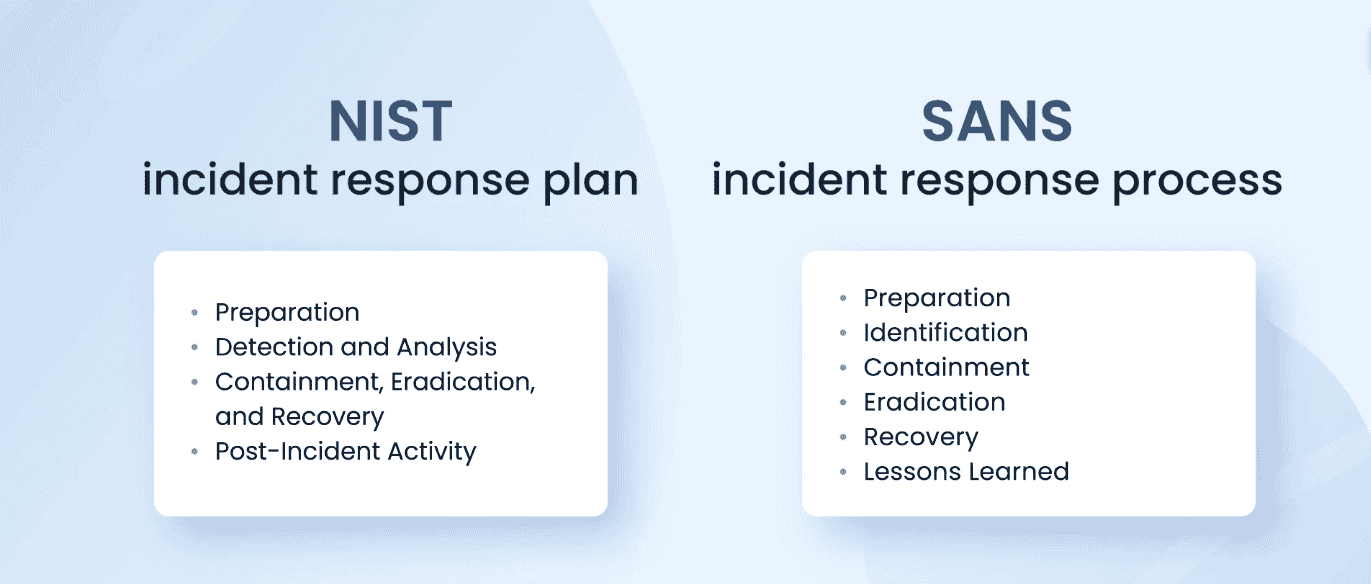
SANS is a private training, certification, and research organization, while NIST is a U.S. government agency that publishes cybersecurity standards and guidelines. Both are premier organizations, but each has a distinct focus: SANS teaches people how to do the work, and NIST defines what good looks like.
| Area | SANS | NIST |
| Type | Private organization | U.S. government agency |
| Main Output | Cybersecurity training, specialized courses, and certification | Security standards and guidelines |
| Audience | Individual professionals and teams | Governments, businesses, and other entities |
| Threat Intelligence | Active research and real-time feeds | Not a core function |
| Industry Standards | Influences them through community work | Publishes them formally |
Security teams often use both together. NIST frameworks guide security policies across information systems, while SANS courses teach staff how to implement network security controls on real systems.
SANS is a global frontrunner in hands-on training, and NIST anchors much of the world’s thinking on cybersecurity standards. Together, they help build secure networks that can withstand a shifting cyber threat landscape.
What Is the Difference Between NIST Policy and Standard?
A NIST policy is an official statement of the agency’s position or intent, while a NIST standard is a specific, detailed requirement that organizations follow to protect systems and data. Policy explains the “why,” and standards spell out the “what.”
The National Institute of Standards and Technology is a non-regulatory agency within the US Department of Commerce. It doesn’t enforce laws itself, yet its publications shape cybersecurity across government and private industry.
| Feature | NIST Policy | NIST Standards |
| Purpose | States the agency’s position | Defines specific requirements |
| Detail Level | High-level and directional | Detailed and measurable |
| Example | Commitments to open, consensus-based development | Federal Information Processing Standards (FIPS) |
Here’s a nuance many people miss. A lot of what NIST publishes is actually guidelines and best practices, not mandatory standards. The NIST Cybersecurity Framework, for example, is voluntary for most private organizations. Compliance consultants often clear up this confusion early in an engagement because it changes how a team prioritizes its work.
Cybersecurity Standards
Cybersecurity standards are documented guidelines and best practices that help organizations assess vulnerabilities, protect systems and networks, and manage cyber threats consistently. Common examples include ISO/IEC 27001, PCI DSS, and the NIST framework discussed above.
Three Phases Teams Move Through
- Developing: Choose one framework that fits your industry and size
- Implementing: Turn its controls into real configurations and processes
- Managing: Measure, review, and improve your cybersecurity programs over time
Consultants frequently see teams try to adopt three frameworks at once and stall completely. The practical advice? Start with one, master it, then map others onto it. Good security grows in layers, not all at once.
Network Security
Network security is the set of policies, procedures, tools, and technologies that protect a computer network and its data from unauthorized access, malicious attacks, and downtime. It applies to organizations of all sizes, from two-person startups to global banks.
People often forget the availability piece. Keeping system availability high is just as important as keeping intruders out.
| Control | Hardware or Software | Main Job |
| Firewalls | Both | Filter traffic between zones |
| Encryption | Software | Protect sensitive information in transit |
| Authentication | Software | Confirm users and devices are who they claim |
| Intrusion detection sensors | Both | Monitor traffic and detect suspicious activity |
Network defenders who have trained in SANS intrusion detection courses often say packet analysis changed how they see their networks. Once you can read raw traffic, alerts stop being mysterious. Strong network security also supports compliance with laws and regulations that require you to protect customer data.
Security Policies
Security policies are written rules that define how an organization protects its organizational assets, devices, and data, covering everything from password policies and acceptable use to incident response and backup. They turn a cybersecurity strategy into everyday expectations for everyone.
| Policy | What It Covers | Usually Owned By |
| Acceptable Use | Employee behavior on laptops and smartphones | Human Resources and the IT department |
| Password and Authentication | Password policies and multi-factor rules | IT department |
| Access Control | VPNs, firewalls, and network architecture | Network team |
| Encryption and Endpoint Security | Data security on every device | Security team |
| Backup | Recovery from malicious attacks and outages | IT department |
| Incident Response | How to handle security incidents | Security team and Legal |
Making Policies Stick
Seasoned security managers share one consistent lesson: a policy nobody reads protects nothing. The best security policies are short, specific, and paired with employee security training.
Here’s a helpful tip. Start from SANS’s free templates, then cut anything that doesn’t match your resources. Blocking unauthorized access works best when security measures feel realistic to the people following them. Revisit policies yearly as cyber threats change, and update network security rules whenever your environment does.
Final Thoughts
SANS stands out as a premier cybersecurity training institution because it pairs a comprehensive suite of courses and certifications with research that tracks emerging threats as they happen. For individuals choosing where to invest, comparing and contrasting SANS with NIST makes the path much clearer.
Use NIST to set your cybersecurity learning objectives and define the controls your environment needs. Then turn to SANS to build the cybersecurity knowledge and hands-on cybersecurity prowess to deliver on them.
That pairing helps you make an informed decision, keep up with the newest threats, and stay confident in a cyber threat environment that never stands still. The digital landscape will keep shifting, and the right training keeps you a step ahead!
Frequently Asked Questions
These quick answers cover the questions people ask most often before signing up for their first SANS course.
What Types of Courses Does SANS Offer?
SANS offers over 60+ specialized courses covering key areas of cybersecurity, including security essentials, cloud security, security operations, digital forensics, incident response, and insider threat detection. Most courses connect to certifications that prove your skills.
These programs serve professionals at every level, from newcomers building core knowledge to experts keeping pace with the evolving cyber threat landscape.
How Can I Access SANS Training Courses?
You can access SANS training courses online or in person through several formats:
- In-person classes at training events around the world
- Live-streamed classes taught in real time
- Self-paced courses you can take on your own schedule
- A virtual event that mirrors the conference experience
- A private training event for your whole team
How Do I Know Which SANS Course to Take?
Use the Course Finder tool on the SANS website to search courses by skill levels, area of interest, location, and areas of expertise. It narrows dozens of options down in minutes.
Helpful tip: pick your target job role first, then work backward. Seasoned students say that approach saves money and keeps learning focused.
Can I Take SANS Courses Online?
Yes! SANS offers self-paced online courses and live online instruction, so you can enjoy learning from anywhere. The content matches what’s taught in in-person classes, giving you the same depth with far more convenience.